Views: 213 Author: U-Need Publish Time: 2026-09-26 Origin: Site
Content Menu
● Why China Is Strong in Prototype Machining
● How We Evaluated These Suppliers
>> Capacity and Production Continuity
>> Communication and Export Experience
● Top 10 Prototype Machining Services Companies in China
>> 1. U-Need Precision Machinery Co., Ltd.
>> 2. WayKen
>> 3. 3ERP
>> 5. HLH Rapid
>> 8. Anebon Metal Products Limited
● Common Prototype Machining Risks
>> Unrealistic Tolerance Claims
>> Prototype Quality Does Not Guarantee Production Stability
>> The Hidden Fixture Cost Issue
● Buyer's Guide: How to Source Prototype Machining Services Successfully
>> Prepare a Complete RFQ Package
>> Compare DFM Feedback, Not Only Price
>> Review the Supplier's Factory Capability
>> Define Incoterms and Shipping Responsibilities
● FAQ
>> 1. How can I verify whether a supplier's ISO certificate is still valid?
>> 2. Does ISO 9001 mean a prototype machining supplier is suitable for medical or aerospace parts?
>> 3. What is the best quantity for an initial prototype order?
>> 4. Which process should I choose: CNC machining, 3D printing, vacuum casting, or injection molding?
>> 5. How can I prevent material substitution during prototype machining?
China remains one of the most practical sourcing destinations for prototype machining, low-volume production, tooling development, and custom component manufacturing. The reason is not limited to cost. China's advantage comes from the close connection between CNC machining, mold manufacturing, sheet metal fabrication, finishing, electronics supply chains, material sourcing, assembly, and international shipping.
For global procurement managers, engineering teams, brand owners, and distributors, the central question is not simply which supplier can provide the lowest quotation. The more important question is which manufacturing partner can repeatedly produce conforming parts, communicate technical risks early, maintain material consistency, and support the transition from prototype validation to stable production.
Prototype machining is now an important part of product development in industries such as industrial automation, robotics, automotive components, medical devices, consumer electronics, laboratory instruments, energy equipment, and smart hardware. A well-made prototype can help a buyer test fit, function, strength, appearance, assembly logic, and manufacturing feasibility before committing to expensive tooling or higher-volume production.
This article introduces 10 prototype machining service companies in China. The selection focuses on suppliers with visible CNC machining capability, rapid manufacturing experience, multi-process support, export-market orientation, quality-control awareness, and a reasonable fit for international OEM and ODM buyers.
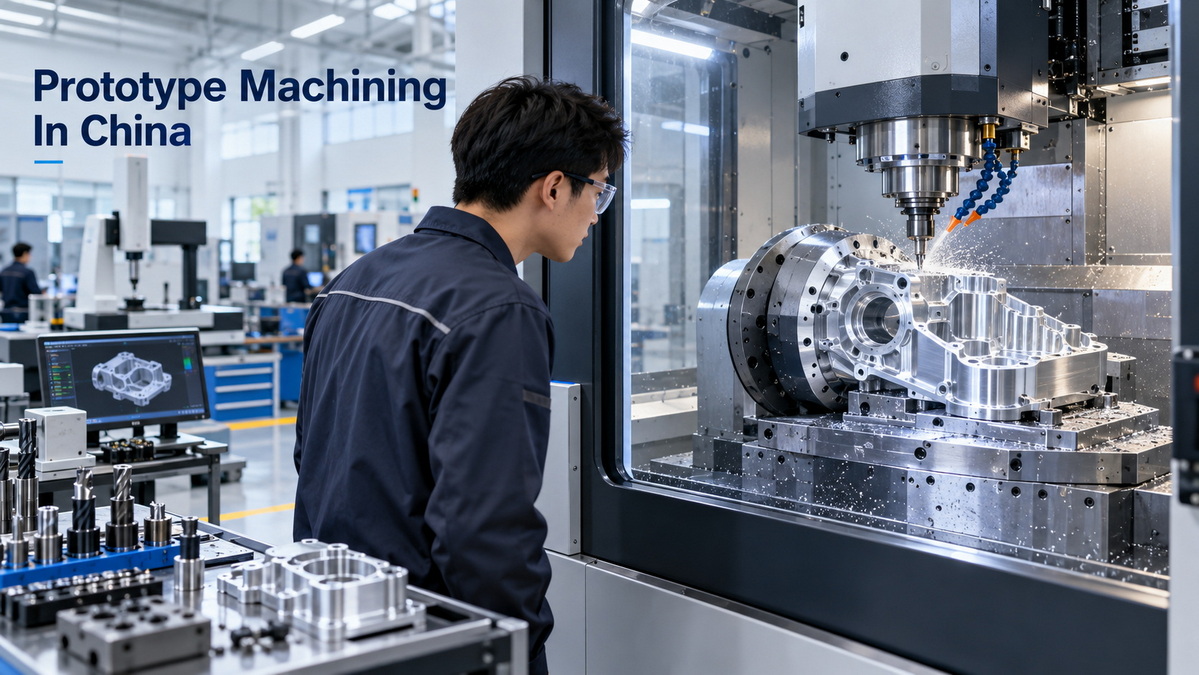
China has developed a highly connected manufacturing ecosystem for precision parts and rapid product development. In regions such as Shenzhen, Dongguan, Zhongshan, Foshan, Suzhou, Ningbo, and Shanghai, buyers can often find machining factories, mold makers, sheet metal suppliers, finishing specialists, material distributors, assembly providers, and logistics services within a relatively short distance.
This concentration matters when a project includes multiple manufacturing processes.
For example, an industrial product prototype may require:
- CNC-machined aluminum housing components
- Stainless steel shafts or brackets
- Bent sheet metal mounting plates
- Molded plastic enclosures
- Rubber or silicone components
- Surface finishing and laser marking
- Screws, springs, and purchased hardware
- Functional assembly and protective export packaging
If each process is managed by a different supplier, the buyer may need to coordinate drawings, revision updates, delivery schedules, inspection standards, and shipping arrangements across several companies. A capable prototype manufacturing partner can reduce that coordination burden by managing multiple processes under one project workflow.
China also benefits from a mature export infrastructure. International buyers can source prototypes through express courier services for urgent development work, air freight for larger batches, and sea freight for production-stage orders. This creates flexibility for product-development schedules and cost planning.
However, the same broad supplier base also makes factory selection more difficult. Many companies can offer CNC machining quotations. Fewer can provide consistent material control, documented inspection, engineering feedback, revision management, and stable long-term delivery performance.
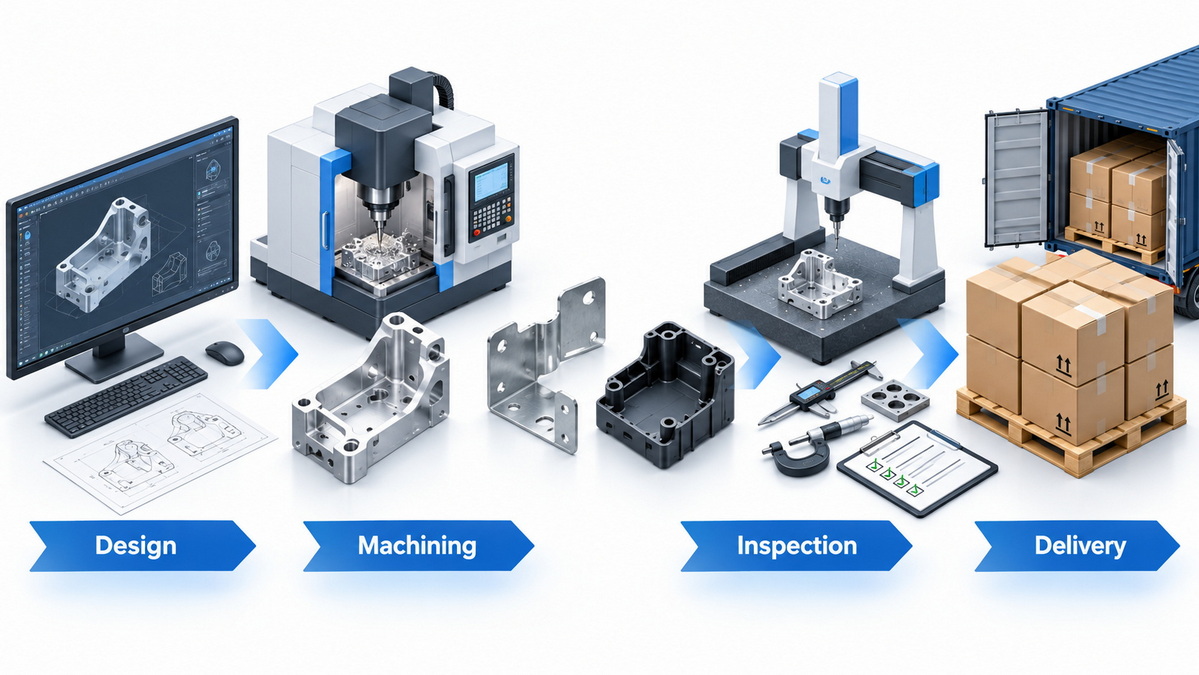
The companies in this guide were selected using a practical buyer-focused framework. The goal is not to identify a single universal choice, because prototype machining needs vary significantly by industry, quantity, material, complexity, and compliance requirements.
Instead, the comparison considers the factors that experienced sourcing teams typically review before approving a supplier.
A prototype machining supplier should have more than basic milling capacity. Depending on the project, buyers may need access to:
- 3-axis, 4-axis, and 5-axis CNC milling
- CNC turning and turn-mill operations
- Wire EDM and sinker EDM
- Grinding and precision finishing
- CNC machining for metal and engineering plastics
- Sheet metal laser cutting and bending
- Injection molding and rapid tooling
- Vacuum casting and silicone tooling
- 3D printing for concept models or complex structures
- Surface treatment and cosmetic finishing
- Assembly, marking, and export packaging
A supplier with broad process coverage can be especially useful when a project evolves from an early concept to a low-volume market-validation batch.
A reliable supplier should review the design before manufacturing. This process is often called design-for-manufacturing feedback. It helps identify potential issues before the factory starts cutting material.
Common issues include:
- Tolerances that are tighter than the product function requires
- Deep cavities that need special tooling
- Thin walls that may deform during machining
- Sharp internal corners that require EDM
- Hole depths that exceed standard drilling ratios
- Threads located too close to edges
- Surface-finish requirements that conflict with dimensions
- Unclear material grades or heat-treatment requirements
- Missing datums or incomplete GD&T callouts
Strong engineering communication can prevent expensive rework, delayed testing, and repeated prototype iterations.
Quality control should be visible throughout the production process, not only at the final inspection stage. Buyers should ask how the supplier controls incoming materials, first-piece approval, in-process measurements, final inspection, packaging checks, and nonconforming products.
For critical projects, useful documents may include:
- First article inspection reports
- CMM inspection reports
- Material test reports
- Certificates of conformance
- Surface-finish records
- Hardness reports
- Thread gauge records
- Gauge calibration documentation
- Packing inspection records
- Part traceability labels
The exact documentation package should be agreed before the purchase order is issued.
A supplier may successfully make a few prototype samples but lack the systems needed for low-volume or repeat production. Buyers should assess whether the supplier can support product development beyond the first batch.
The right supplier should be able to explain how it will manage:
- Material-lot consistency
- CNC program revision control
- Machine setup and fixture repeatability
- Tool-life monitoring
- Inspection frequency
- Outsourced finishing control
- Packaging standards
- Production scheduling
- Engineering change notices
- Repeat-order consistency
International buyers need suppliers that can communicate clearly in writing, confirm revisions, provide realistic lead times, and disclose technical risks before production begins.
A good supplier should not simply accept every drawing without questions. A careful review is often a positive sign. It shows that the factory has considered how the part will actually be machined, measured, finished, and packed.

The companies below represent different strengths. Some focus on flexible CNC prototype machining, while others provide broader services including injection molding, sheet metal fabrication, 3D printing, tooling, finishing, and low-volume production.
The right supplier depends on your product, material requirements, production quantity, documentation needs, and long-term supply strategy.
| Company | Location | Founded | Core Strength | MOQ Positioning | Suitable For |
|---|---|---|---|---|---|
| U-Need Precision Machinery Co., Ltd. | Dongguan, Guangdong | 2016 | CNC machining, molds, sheet metal, OEM customization | From 1 piece | SMEs, OEM brands, multi-process projects |
| WayKen | Shenzhen, Guangdong | 2002 | CNC prototypes and low-volume production | Prototype-friendly | Metal and plastic prototype projects |
| 3ERP | Zhongshan, Guangdong | 2010 | Rapid prototyping and low-volume manufacturing | Prototype to low volume | Multi-process product development |
| RapidDirect | Shenzhen, Guangdong | 2009 | Digital manufacturing and scalable sourcing | Prototype to production | Online quoting and repeat part sourcing |
| HLH Rapid | Dongguan, Guangdong | Not publicly confirmed | CNC, molding, and rapid manufacturing | Prototype to low volume | International development projects |
| Star Rapid | Zhongshan, Guangdong | 2005 | Prototype engineering and bridge production | Prototype to production | Complex hardware development |
| Jingrui Proto | China | Not publicly confirmed | CNC, 3D printing, molding, sheet metal | Prototype to low volume | Regulated and industrial projects |
| Anebon Metal Products | Dongguan, Guangdong | Not publicly confirmed | Precision CNC metal machining | From 1 piece | Machined metal components |
| Great Light Metal | China | Not publicly confirmed | 5-axis machining and industrial parts | Quote-dependent | Medical and industrial applications |
| TOP Prototype | China | Not publicly confirmed | Rapid prototyping and mixed processes | Prototype to production | Plastic and metal product development |
Location: Dongguan, Guangdong, China
Founded: 2016
Main Services: CNC machining, CNC milling, CNC turning, 5-axis machining, precision grinding, EDM, wire EDM, mold manufacturing, injection molds, stamping dies, cold-forging dies, sheet metal fabrication, laser cutting, bending, stamping, and 3D printing.
Main Markets: Global OEM buyers, brands, distributors, industrial manufacturers, and product-development teams.
Suitable For: Small and medium-sized companies, engineering teams, custom brands, and buyers requiring flexible OEM support.
U-Need Precision Machinery Co., Ltd. is a practical manufacturing partner for buyers who need more than a single CNC-machined sample. The company offers an integrated service structure covering custom precision parts machining, mold manufacturing, sheet metal fabrication, rapid prototyping, and production-oriented support.
This combination is particularly useful when a product includes multiple parts made through different processes.
For example, an industrial equipment manufacturer may require:
- A CNC-machined aluminum control panel
- A stainless steel laser-cut bracket
- A bent sheet metal enclosure
- A stamped metal spring part
- A plastic injection-molded cover
- A custom die for higher-volume production
- Laser marking and protective packaging
Rather than coordinating multiple unrelated suppliers, buyers can assess whether U-Need can support the project from prototype validation to production preparation.
One of U-Need's main strengths is flexibility. The company supports orders from one piece to mass production, making it relevant for companies that need early-stage prototypes before committing to larger quantities.
This is especially valuable for:
- Startup hardware brands
- Industrial product developers
- Machinery manufacturers
- Robotics companies
- Automation-equipment suppliers
- Custom electronics enclosure developers
- Spare-parts distributors
- Overseas OEM buyers
For small and mid-sized brands, supplier flexibility can be more important than the largest possible factory capacity. A buyer may need fast communication, drawing feedback, sample adjustments, small-batch trial production, and a willingness to support design changes before the product is fully mature.
U-Need's service range allows buyers to explore different manufacturing methods during product development. A CNC-machined part may be used for functional testing, while a sheet metal part may be used for enclosure validation, and a mold may later support higher-volume plastic production.
The company is also suitable for projects where procurement teams want direct communication with a manufacturing-focused supplier. For custom OEM projects, buyers should provide detailed drawings, material requirements, tolerances, finishing instructions, expected volumes, and packaging requirements as early as possible.
Before placing an order, buyers should request:
- A formal quotation with separate tooling and non-recurring engineering costs
- Material grade confirmation
- DFM feedback
- Sample lead time
- Inspection-report availability
- Surface treatment specifications
- Packaging details
- Production lead-time estimates
- Export shipping options
U-Need is a relevant option for buyers seeking a cost-conscious, flexible, and engineering-oriented partner for custom prototype machining, mold tooling, sheet metal fabrication, and long-term OEM manufacturing support.
Location: Shenzhen, Guangdong, China
Founded: 2002
Main Services: CNC milling, CNC turning, EDM, wire EDM, rapid prototyping, precision machining, surface finishing, and low-volume manufacturing.
Main Markets: Consumer products, industrial equipment, automotive, electronics, medical devices, and product-development companies.
Suitable For: Buyers requiring precision metal or plastic prototypes with low-volume production potential.
WayKen is an established rapid manufacturing company based in Shenzhen. It is known for CNC machining, rapid prototyping, low-volume manufacturing, and custom metal and plastic component production.
The company is particularly suitable for buyers who need detailed CNC prototype parts and require support beyond standard milling and turning. Its process range includes EDM and wire EDM, which can be useful for components with narrow slots, sharp internal corners, hardened materials, and complex features that cannot be efficiently machined with conventional milling tools.
WayKen may be a good fit for:
- Functional aluminum prototypes
- Stainless steel components
- Custom plastic housings
- Precision mechanical parts
- Electronic enclosures
- Automotive prototype components
- Optical and testing fixtures
- Low-volume industrial parts
For buyers working with precise mechanical assemblies, WayKen may be suitable when the supplier needs to manage complex tolerances, finishing processes, and dimensional consistency.
However, buyers should still clarify how the supplier defines its stated machining tolerance. Tolerance capability depends on part geometry, material, machining direction, clamping method, machine setup, thermal conditions, and finishing requirements.
A well-prepared RFQ should identify critical features and include drawings with clear GD&T requirements.
Location: Zhongshan, Guangdong, China
Founded: 2010
Main Services: CNC machining, 3D printing, vacuum casting, injection molding, sheet metal fabrication, die casting, aluminum extrusion, finishing, and low-volume manufacturing.
Main Markets: Automotive, medical, aerospace, consumer electronics, industrial equipment, and product-development companies.
Suitable For: Buyers who need multiple prototype manufacturing processes under one project-management workflow.
3ERP is a rapid prototyping and low-volume manufacturing supplier located in Zhongshan, Guangdong. It provides a broad service range that includes CNC machining, additive manufacturing, injection molding, vacuum casting, sheet metal fabrication, die casting, and finishing.
This broad process coverage can be valuable for product teams still deciding which manufacturing route is most appropriate.
For example, a buyer developing a new smart-device enclosure may use:
- SLA printing for early visual design validation
- CNC machining for functional aluminum testing
- Vacuum casting for small-batch cosmetic samples
- Rapid tooling for injection-molded engineering samples
- Sheet metal fabrication for mounting systems
- Die casting for future higher-volume metal components
3ERP may suit buyers who need a supplier capable of supporting several project stages without changing manufacturers every time the product design evolves.
The company is particularly relevant for prototype projects requiring both cosmetic and functional evaluation. Functional metal prototypes, transparent plastic parts, overmolded parts, sheet metal enclosures, and small-batch production components may all require different manufacturing processes.
Buyers should ask whether the supplier can provide:
- First article inspection reports
- CMM measurement reports
- Material certificates
- Surface-finish standards
- Assembly support
- Revision-control documentation
- Low-volume production plans
- Repeat-order controls
For projects involving critical appearance requirements, buyers should approve a physical color sample or "golden sample" before larger production begins.
Location: Shenzhen, Guangdong, China
Founded: 2009
Main Services: CNC machining, sheet metal fabrication, injection molding, 3D printing, vacuum casting, die casting, and on-demand manufacturing.
Main Markets: Global product developers, engineering companies, industrial buyers, automotive suppliers, medical-device developers, and hardware brands.
Suitable For: Buyers who prefer digital quoting, centralized part management, and scalable manufacturing support.
RapidDirect is a China-based digital manufacturing company with a strong emphasis on online quotation workflows, engineering feedback, CNC machining, sheet metal fabrication, molding, and scalable production support.
Its digital approach may appeal to procurement teams managing multiple parts, several product revisions, or repeat orders. Buyers can upload part files, request quotes, compare manufacturing options, and receive DFM-oriented feedback.
RapidDirect may be suitable for:
- Buyers with multiple CNC part numbers
- Companies requiring quick quotation cycles
- Engineering teams using frequent design iterations
- Buyers needing sheet metal and CNC parts from one platform
- Companies moving from prototype quantities to larger production volumes
- Procurement teams managing global supplier comparisons
The company is relevant for projects that require a clear transition from initial prototype machining to repeat production. However, buyers should confirm which processes are completed in-house and which are handled through partner factories.
For critical projects, it is important to request documentation that identifies:
- The production site
- The quality system applied to the order
- The material source
- The inspection method
- The responsible manufacturing entity
- The process used for special treatments
- The packaging standard
Digital quoting is useful, but a buyer should still expect human engineering review for complex parts, unusual materials, difficult tolerances, sealing surfaces, cosmetic features, and assemblies.
Location: Dongguan, Guangdong, China
Main Services: CNC machining, injection molding, rapid prototyping, 3D printing, low-volume production, and engineering support.
Main Markets: International product developers, UK and European buyers, industrial product companies, consumer brands, and engineering teams.
Suitable For: Buyers who want China-based manufacturing support combined with international commercial communication.
HLH Rapid is a rapid manufacturing company with China-based production resources and international commercial support. It provides CNC machining, prototype manufacturing, injection molding, 3D printing, and low-volume production services.
The company may be useful for overseas buyers who want a supplier familiar with international project-management expectations, including prototype development, design revisions, manufacturing feedback, and delivery coordination.
HLH Rapid may suit projects involving:
- Plastic prototype parts
- CNC-machined metal components
- Injection-molded trial parts
- Consumer product housings
- Industrial assemblies
- Functional product testing
- Small-batch manufacturing
- Design verification samples
For buyers requiring injection molding, it is important to discuss tooling strategy early. Rapid prototype tooling may reduce initial cost and shorten lead time, but it may not have the same lifespan, surface quality, material compatibility, or production stability as hardened mass-production tooling.
The buyer should clarify:
- Tool steel type
- Expected mold life
- Number of cavities
- Resin grade
- Texture requirements
- Color requirements
- Gate location
- Shrinkage assumptions
- Mold-maintenance responsibilities
- Ownership of tooling after payment
Location: Zhongshan, Guangdong, China
Founded: 2005
Main Services: Rapid prototyping, CNC machining, low-volume manufacturing, tooling, finishing, and bridge production.
Main Markets: Product-development companies, industrial equipment manufacturers, electronics brands, automotive suppliers, and international engineering teams.
Suitable For: Buyers managing complex product-development programs that may move from prototypes into bridge production.
Star Rapid is an established rapid manufacturing company located in Zhongshan. It is known for supporting prototype development, CNC machining, tooling, low-volume production, and manufacturing coordination for hardware products.
The company may be relevant for buyers who need more than one-off parts. It can be considered for projects requiring early prototypes, engineering revisions, functional test parts, small-batch production, and preparation for future mass production.
Typical projects may include:
- Industrial control systems
- Robotics components
- Consumer electronics hardware
- Automotive accessories
- Smart-home products
- Medical equipment housings
- Testing fixtures
- Product-development assemblies
A key advantage of a more established rapid manufacturing supplier is its potential ability to manage multiple manufacturing stages. However, buyers should not assume that all processes are performed internally.
Before placing an order, buyers should clarify:
- Which operations are in-house
- Which operations are outsourced
- How outsourced finishing is controlled
- Whether material traceability is maintained
- Whether inspection records are available
- How nonconforming parts are handled
- Whether replacement parts can be made from the same controlled program
For complex programs, it is useful to assign a formal revision number to every drawing, CAD file, inspection report, and purchase order.
Location: China
Main Services: CNC machining, 3D printing, vacuum casting, sheet metal fabrication, injection molding, surface finishing, and low-volume production.
Main Markets: Automotive, medical, industrial equipment, electronics, aerospace-related projects, and global product developers.
Suitable For: Buyers requiring broad process coverage for prototype validation and industrial applications.
Jingrui Proto provides rapid prototyping and low-volume manufacturing support across multiple processes. Its service range includes CNC machining, 3D printing, vacuum casting, sheet metal fabrication, injection molding, surface treatment, and custom production support.
The company can be suitable for buyers who need several manufacturing technologies for the same product-development project.
For example, a medical-equipment developer may need:
- CNC-machined aluminum structural components
- Clear or translucent plastic prototype parts
- Sheet metal mounting systems
- Injection-molded plastic covers
- Silicone or vacuum-cast functional samples
- Customized packaging for international delivery
Jingrui Proto may be relevant for projects that need coordinated prototyping across metal and plastic materials.
For regulated industries, however, buyers should validate the actual quality documentation available for the specific order. A supplier may have broad manufacturing capabilities, but not every part requires the same level of traceability, documentation, testing, or approval.
For medical, automotive, aerospace, or safety-critical components, buyers should define the required documentation at the quotation stage.
Location: Dongguan, Guangdong, China
Main Services: CNC machining, CNC milling, CNC turning, metal prototype machining, precision components, and production-part support.
Main Markets: Industrial equipment, consumer products, automotive, machinery, electronics, and engineering companies.
Suitable For: Buyers sourcing precision machined metal components in small or medium quantities.
Anebon Metal Products is a machining-focused supplier in Dongguan. It is especially relevant for buyers requiring custom CNC-machined metal parts, prototype components, turned parts, and precision mechanical products.
The company may be suitable for:
- Aluminum prototype components
- Stainless steel machined parts
- Brass fittings
- Steel shafts
- Custom brackets
- Mechanical housings
- Precision turned components
- Automation-machine parts
- Industrial fixtures
A machining-focused supplier can be a practical choice when the project does not require a large number of manufacturing processes. Buyers who only need CNC milling, turning, drilling, tapping, and finishing may prefer a supplier with concentrated machining expertise.
For metal parts, buyers should specify the material grade clearly. "Aluminum" or "stainless steel" is not enough for a controlled engineering order.
Examples of commonly specified materials include:
| Material Category | Typical Grades |
|---|---|
| Aluminum | 6061-T6, 6082, 7075-T6, 5052 |
| Stainless Steel | 303, 304, 316, 17-4PH |
| Carbon Steel | 1018, 1045, 4140 |
| Tool Steel | D2, H13, P20, S136 |
| Titanium | Grade 2, Grade 5 |
| Brass | C360, C260 |
| Copper | C110 |
| Engineering Plastics | POM, PEEK, PA66, ABS, PC, PMMA |
Material requirements should also include heat treatment, hardness, temper, coating, and inspection requirements where relevant.
Location: China
Main Services: 5-axis CNC machining, CNC milling, CNC turning, sheet metal fabrication, 3D printing, injection molding, vacuum casting, die casting, and finishing.
Main Markets: Medical devices, industrial equipment, automation, aerospace-related applications, and precision engineering projects.
Suitable For: Buyers requiring advanced machining support for complex parts and demanding industrial applications.
Great Light Metal is positioned as a provider of precision machining and advanced manufacturing services. Its stated capabilities include 5-axis CNC machining, multi-process manufacturing, surface finishing, and support for industrial and medical-oriented applications.
Five-axis machining can provide important advantages for certain part geometries.
It may reduce the number of setups needed for:
- Complex curved surfaces
- Multi-angle features
- Impellers
- Turbine-like components
- Deep cavity parts
- Aerospace brackets
- Medical-device components
- Complex aluminum housings
- Robotics joints
- Optical or sensor fixtures
However, buyers should avoid assuming that every part requires 5-axis machining. In many cases, a well-designed 3-axis or 4-axis setup can be more cost-effective. The correct process depends on part geometry, tolerance requirements, material, quantity, and finishing requirements.
Great Light Metal may be relevant for buyers who need machining support for industrial and technically demanding applications. For medical or aerospace-related work, buyers should review the supplier's actual documentation process, traceability controls, inspection capability, and quality-system scope.
Location: China
Main Services: CNC machining, 3D printing, vacuum casting, injection molding, rapid prototyping, surface finishing, and low-volume production.
Main Markets: Consumer products, automotive, industrial design, electronics, medical products, and engineering-development teams.
Suitable For: Buyers who need flexible prototype methods for metal and plastic product development.
TOP Prototype provides a range of rapid manufacturing services, including CNC machining, additive manufacturing, vacuum casting, injection molding, and low-volume production.
The company can be useful for buyers who are still selecting the right production route for a new product.
Different prototype methods serve different purposes.
| Prototype Need | Recommended Process |
|---|---|
| Functional metal prototype | CNC machining |
| Fast concept model | FDM, SLA, or SLS 3D printing |
| Small batch of cosmetic plastic parts | Vacuum casting |
| Production-like plastic samples | Rapid-tooling injection molding |
| Complex sheet metal enclosure | Laser cutting and bending |
| Production-preparation metal part | CNC machining, die casting, or stamping evaluation |
A common mistake is choosing the lowest-cost prototype process without considering what needs to be tested.
For example, an SLA-printed plastic enclosure may look visually convincing, but it may not accurately represent the strength, heat resistance, snap-fit behavior, or texture of a final injection-molded ABS, PC, or PC/ABS housing.
A prototype should be selected based on the question it must answer:
- Does the part fit?
- Does the product function?
- Can the assembly survive mechanical testing?
- Does the surface appearance meet brand requirements?
- Can the design be manufactured at scale?
- Does the material perform under heat, moisture, vibration, or chemical exposure?
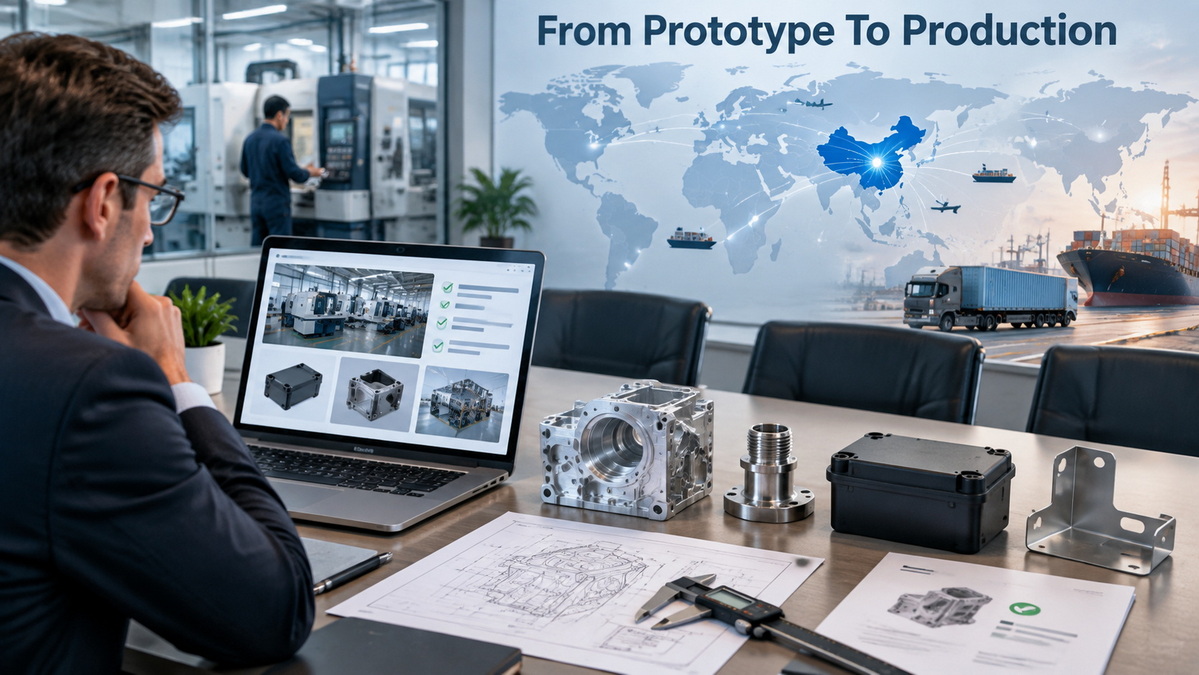
Prototype machining can reduce product-development risk, but poor supplier selection can create new problems. Buyers should understand the most common risks before placing an order.
Material substitution is one of the most serious sourcing risks.
A part specified as 7075-T6 aluminum may be made from a lower-cost aluminum alloy if the material requirement is not clearly controlled. The final part may look similar, but mechanical strength, corrosion resistance, anodizing response, and fatigue performance can differ significantly.
To reduce this risk:
- State the exact material grade and temper on the drawing
- Require written approval for any substitution
- Request material certificates for critical parts
- Conduct independent material testing when necessary
- Retain approved samples for comparison
Some suppliers advertise extremely tight tolerances without explaining the conditions required to achieve them.
A tolerance may be possible on a small feature under controlled conditions, but not across an entire thin-walled housing after anodizing, blasting, painting, or multiple machining setups.
To reduce this risk:
- Identify critical dimensions
- Define datums clearly
- Request a DFM review
- Ask for a dimensional inspection plan
- Confirm whether tolerances apply before or after finishing
- Use a first article before larger production
Finishing processes can affect both appearance and dimensions.
Common issues include:
- Uneven anodizing color
- Scratches during handling
- Inconsistent powder-coating thickness
- Poor masking on threads or sealing surfaces
- Inconsistent bead-blasting texture
- Plating thickness affecting fit
- Polishing changing edge geometry
- Paint color variation between batches
To reduce risk, buyers should specify:
- Finish type
- Color code
- Gloss level
- Texture standard
- Coating thickness
- Masking areas
- Cosmetic inspection zones
- Approved sample requirements
A supplier may produce ten excellent prototypes through manual attention. That does not automatically mean it can produce 10,000 consistent production parts.
Production stability requires:
- Repeatable fixtures
- Controlled machine programs
- Consistent material supply
- Operator training
- Defined inspection frequency
- Packaging standards
- Traceability
- Corrective-action procedures
- Change control
Buyers should ask for a production-control plan before moving to higher volumes.
One of the most overlooked risks in prototype machining is the hidden cost of holding fixtures, soft jaws, inspection gauges, and special setup requirements.
A supplier may quote a low unit price based on basic clamping. But if the part has thin walls, strict flatness requirements, complex geometry, multiple orientations, or high repeatability demands, the supplier may later need to create custom soft jaws, dedicated fixtures, inspection fixtures, or special gauges.
Without proper fixtures, parts may warp, shift, scratch, or vary between setups.
Before issuing a purchase order, ask:
> Does the quotation include programming, custom soft jaws, holding fixtures, inspection fixtures, special gauges, first article setup, and non-recurring engineering costs?
A professional supplier should separate these costs clearly rather than introducing them after production begins.
A strong RFQ package should include:
- 2D technical drawings
- 3D CAD files
- Part revision number
- Material grade
- Heat treatment requirements
- Surface-finish specifications
- Tolerance requirements
- GD&T requirements
- Prototype quantity
- Planned annual quantity
- Inspection requirements
- Packaging requirements
- Delivery location
- Preferred shipping terms
- Target delivery date
A 3D model alone is often not enough. Critical requirements such as datums, threads, tolerances, cosmetic zones, and finish details are usually better controlled through a 2D drawing.
The best quotation is not always the lowest quotation.
A supplier that asks technical questions may be more reliable than a supplier that accepts every drawing without comment.
Compare suppliers based on:
- Material assumptions
- Manufacturing method
- DFM feedback
- Tolerance understanding
- Finishing details
- Inspection availability
- Lead time
- Tooling costs
- Packaging quality
- Communication speed
- Documentation capability
A lower quote may exclude important costs such as finishing, inspection, fixtures, custom packaging, or export documentation.
For new suppliers or critical parts, begin with a first article.
The first article should be reviewed for:
- Dimensional accuracy
- Material confirmation
- Surface quality
- Thread performance
- Assembly fit
- Functional testing
- Color consistency
- Packaging quality
- Labeling accuracy
- Delivery performance
A first article is not only a part approval. It is also a supplier evaluation tool.
When possible, request:
- Factory photos or videos
- Machine lists
- Inspection equipment lists
- Quality-control workflow
- Sample inspection reports
- Current certification documents
- Material storage procedures
- Packaging process photos
- Production flow charts
- Examples of similar projects
For larger programs, consider a third-party factory audit or on-site visit.
Prototype shipments are often sent by express courier, while larger orders may move by air freight or sea freight.
Buyers should agree on:
- Incoterms
- Shipping method
- Customs responsibility
- HS code classification
- Insurance
- Export documentation
- Packaging requirements
- Delivery address
- Import duty and VAT responsibility
- Country-of-origin labeling
For precision parts, export packaging should protect against scratches, corrosion, moisture, vibration, and deformation.
China offers a strong prototype machining environment because buyers can access CNC machining, precision tooling, sheet metal fabrication, injection molding, finishing, packaging, and export logistics through connected manufacturing clusters.
The right supplier should not be selected only because of a low price, a fast quote, or a large machine list. A reliable prototype machining partner should be able to confirm material grades, tolerances, inspection methods, revision control, lead times, surface finishing, packaging requirements, and production scalability before manufacturing begins.
For buyers seeking flexible support across custom CNC machining, mold manufacturing, sheet metal fabrication, laser cutting, bending, stamping, and OEM production, U-Need Precision Machinery Co., Ltd. is a practical company to include in a supplier comparison. Its broad process coverage and support for orders from one piece to mass production make it relevant for brands, distributors, manufacturers, and product-development teams that need efficient communication and customized manufacturing support.
A disciplined sourcing process begins with a complete RFQ package, technical review, clear quality requirements, first-article validation, and carefully controlled production expansion. This approach helps buyers reduce risk, improve product quality, and build more reliable long-term manufacturing partnerships.
Request the current certificate and review the legal company name, factory address, certificate number, issuing body, scope, issue date, and expiry date. Confirm that the certificate belongs to the exact company entity and production site that will manufacture your parts. If possible, verify the certificate through the issuing certification body.
No. ISO 9001 is a general quality-management standard. Medical projects may require ISO 13485, material traceability, documented process controls, cleaning requirements, and additional records. Aerospace projects may require AS9100, first article inspection, special-process approvals, and customer-specific documentation. The certification must match the project's actual requirements.
The right quantity depends on the testing plan. One to five parts may be enough for basic dimensional and assembly checks. Functional testing, destructive testing, reliability validation, customer samples, pilot production, and field testing may require more units. Buyers should define the prototype quantity based on the engineering purpose, not only the minimum order quantity.
Choose the process based on what you need to validate. CNC machining is suitable for functional parts requiring production-like materials and tight tolerances. 3D printing is useful for fast iteration and complex geometries. Vacuum casting is suitable for small batches of cosmetic plastic parts. Rapid-tooling injection molding is useful when the prototype needs to reflect production resin behavior more closely.
Specify the exact material grade and temper on the drawing and purchase order. State that substitutions require written approval. Request a material certificate for important parts. For critical applications, conduct independent material verification and retain an approved sample as a reference for future orders.
1. [U-Need Precision Machinery Co., Ltd.]
2. [General Administration of Customs of the People's Republic of China]
3. [WayKen Rapid Manufacturing]
4. [3ERP Rapid Prototyping and Low-Volume Manufacturing]
5. [RapidDirect Custom Manufacturing]
7. [Star Rapid]
8. [Jingrui Proto]
10. [Great Light Metal]
11. [TOP Prototype]


