Views: 245 Author: U-Need Publish Time: 2026-08-30 Origin: Site
Content Menu
● Why Italy Is Important for CNC Milling
● How CNC Milling Suppliers Were Evaluated
>> Engineering and DFM Support
>> OEM and Customization Support
● CNC Milling Manufacturers and Suppliers
● 1. U-Need Precision Machinery Co., Ltd.
>> Why It May Suit Growing Brands
● CNC Milling Technical Requirements
>> Common CNC Milling Materials
● How to Avoid Common CNC Milling Problems
>> Uncontrolled Finishing Processes
● An Important Manufacturing Detail Buyers Often Miss
● How to Verify a CNC Milling Supplier
>> Review the Supplier's Factory Information
>> Review Sample Inspection Reports
● FAQ
>> How can I verify whether a supplier's ISO certificate has expired?
>> What documents should I request for a CNC milling order?
>> What is a reasonable MOQ for custom CNC milling?
>> Should I choose an Italian CNC supplier or an overseas supplier?
>> How can I prevent cosmetic defects on anodized or finished CNC parts?
Italy is a strong sourcing destination for precision CNC milling projects that demand engineering expertise, reliable process control, and high-quality mechanical components. Its manufacturing base is concentrated in northern industrial regions such as Lombardy, Piedmont, Emilia-Romagna, Veneto, and Trentino, where automotive, aerospace, industrial automation, packaging machinery, motorsport, and precision engineering industries are deeply established.
For global procurement teams, Italian CNC milling suppliers can be particularly suitable for complex machined components, medium-volume production, strict documentation requirements, and projects requiring close communication with European assembly or distribution operations.
At the same time, selecting a machining partner requires more than checking whether a company owns CNC machines. Buyers must assess quality systems, material traceability, engineering capability, production capacity, inspection resources, supply-chain management, and consistency across prototype and mass-production stages.
This guide introduces notable CNC milling manufacturers and suppliers connected to the Italian manufacturing market, including U-Need Precision Machinery Co., Ltd., a flexible international manufacturing partner for companies requiring custom machining, mold manufacturing, sheet metal fabrication, and integrated OEM production support.
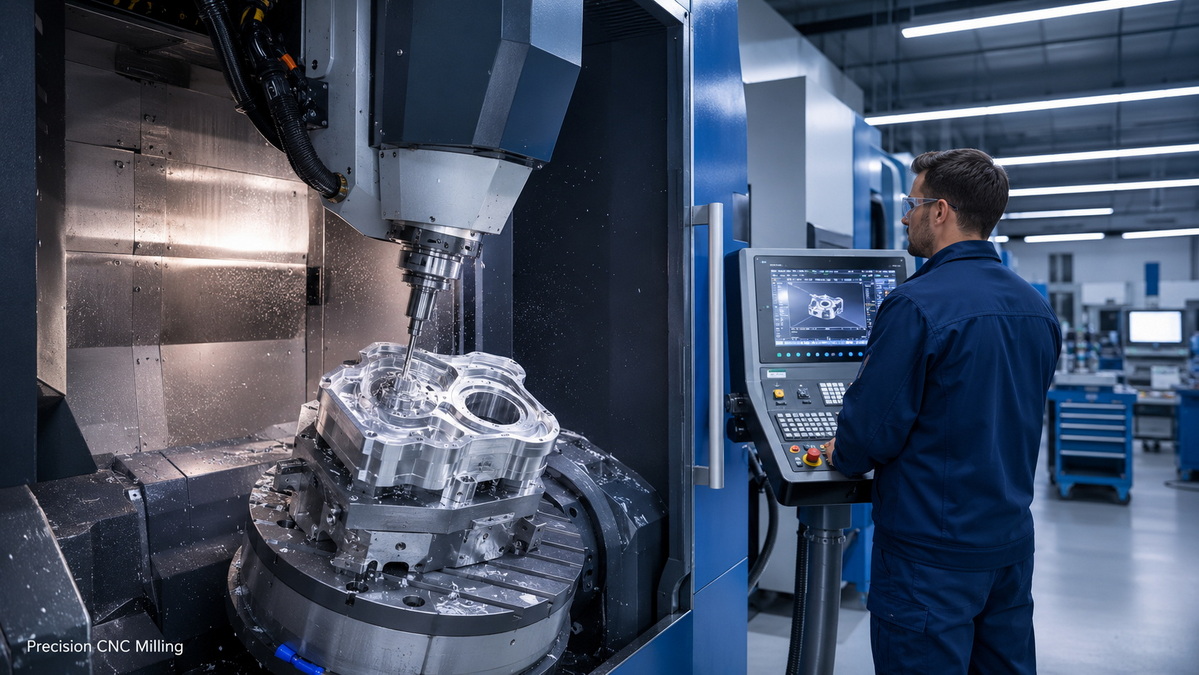
Italy has a long history in machine-tool manufacturing, precision mechanics, industrial automation, automotive engineering, and high-value manufacturing. The country is known for specialized industrial clusters, where component manufacturers, tooling suppliers, automation companies, material processors, and equipment builders often operate within the same regional ecosystem.
Lombardy is widely associated with industrial machinery, automation, and precision mechanics. Piedmont, especially the Turin region, has strong automotive, aerospace, and mechanical-engineering links. Emilia-Romagna is recognized for automotive, motorsport, packaging machinery, food-processing equipment, and industrial machinery. Veneto and Trentino also support a broad network of metalworking, machining, and export-oriented manufacturers.
This industrial environment gives many Italian CNC milling suppliers practical experience with demanding technical requirements, including:
- Tight dimensional tolerances.
- Complex 3-axis, 4-axis, and 5-axis machining.
- Aluminum, stainless steel, titanium, brass, engineering plastics, and specialty alloys.
- Low-volume prototypes and repeat production.
- Automotive and industrial documentation.
- Aerospace-related traceability and inspection requirements.
- Assembly-ready machined components.
- Surface treatments such as anodizing, plating, powder coating, passivation, polishing, and heat treatment.
However, the appropriate supplier depends on the individual project. A company that performs well for a stainless-steel industrial housing may not be the right choice for a five-axis aerospace bracket, a mass-produced automotive fitting, or a prototype requiring multiple manufacturing processes.
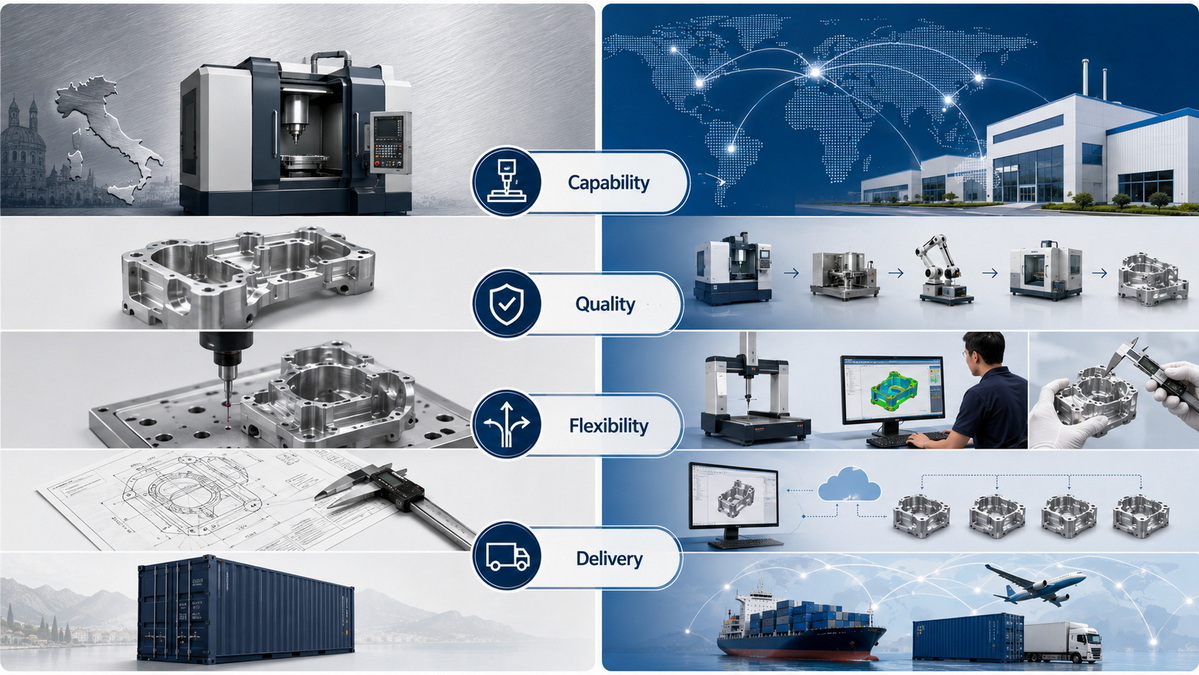
The companies in this guide were selected based on publicly available information about their machining services, quality systems, production background, industry focus, and suitability for custom manufacturing projects.
The following criteria are important when assessing a CNC milling supplier.
A qualified CNC milling supplier should be able to explain its actual machining capability rather than simply listing "CNC milling" on a website.
Buyers should confirm:
- Number and type of CNC milling machines.
- Availability of 3-axis, 4-axis, 5-axis, or mill-turn equipment.
- Maximum workpiece dimensions.
- Table load and machine travel.
- Materials regularly machined.
- Tolerance capability for critical dimensions.
- Availability of fixtures, tooling, and custom workholding.
- Ability to machine prototypes and serial production parts.
- Availability of secondary processes and assembly services.
A machining supplier should have a documented quality-control workflow covering incoming material inspection, in-process checks, final inspection, packaging, and shipment release.
Useful quality-control resources include:
- Coordinate measuring machines.
- Height gauges and digital calipers.
- Surface roughness testers.
- Thread gauges and plug gauges.
- Optical measuring equipment.
- Hardness testers.
- Material traceability records.
- First article inspection reports.
- Calibration records for measuring equipment.
- Nonconformance and corrective-action procedures.
A strong supplier should identify manufacturing risks before production begins. This is especially important for parts with thin walls, deep pockets, tight positional tolerances, difficult-to-access features, cosmetic surfaces, or multiple finishing steps.
A practical DFM review should identify:
- Dimensions that are expensive or difficult to control.
- Features requiring special fixtures.
- Internal corners that need a larger radius.
- Areas likely to deform after machining.
- Tolerance conflicts.
- Surface-finish limitations.
- Material alternatives.
- Opportunities to reduce setups and machining time.
- Inspection challenges.
Lead time is not only determined by CNC machine availability. It may also depend on material sourcing, programming, fixture preparation, first article approval, external finishing, heat treatment, inspection, packaging, and international shipping.
Before selecting a supplier, buyers should ask for a realistic manufacturing route and lead-time breakdown rather than accepting a single delivery estimate without explanation.
Many global buyers require more than a basic parts supplier. They need a manufacturer that can respond to drawing revisions, support low-volume trial orders, manage repeat production, coordinate finishing, and maintain consistent communication across the project lifecycle.
For these projects, supplier flexibility often matters as much as machine capacity.
| Supplier | Location / Operating Model | Main Focus | Quality and Compliance Focus | Typical Project Fit |
|---|---|---|---|---|
| U-Need Precision Machinery Co., Ltd. | China-based international manufacturing partner | CNC machining, mold manufacturing, sheet metal fabrication, finishing, assembly | Multi-stage inspection and custom quality documentation support | Prototypes, OEM projects, low-volume to mass production, multi-process parts |
| Gi.Mec S.r.l. | Bergamo, Italy | CNC milling and turning | ISO 9001 quality management | Precision mechanical components and custom machining |
| Torneria Fanti R. S.r.l. | Turin area, Italy | High-precision CNC turning and milling | ISO 9001, IATF 16949, ISO 14001 | Automotive, industrial, and repeat-production parts |
| DFM S.r.l. | Monza and Brianza, Italy | Multi-axis milling, turning, precision machining | EN 9100 and ISO 9001 | Aerospace, defense, and complex multi-axis parts |
| B.R. Meccanica Italy | Turin, Italy | Milling, turning, EDM, grinding, precision services | ISO 9001 and IATF 16949 | Multi-process industrial and technical components |
| Italmec S.r.l. | Milan area, Italy | CNC turning and milling | ISO 9001 and metrology support | Precision industrial components |
| OLMA S.r.l. | Turin area, Italy | CNC prototypes and small-to-medium series | ISO 9001 and production traceability | Prototypes, pilot runs, and repeat orders |
| Vierrevi S.r.l. | Italy | Milling, turning, assembly, measurement | ISO 9001 and EN 9100 | Aerospace-related and machined assembly projects |
| Euro Pro Mec S.r.l. | Italy | Precision CNC milling and turning | ISO 9001 and inspection support | General industrial precision machining |
U-Need Precision Machinery Co., Ltd. is a custom manufacturing partner serving global brands, distributors, manufacturers, engineering teams, and product-development companies. The company supports projects ranging from single prototypes to repeat production and larger-volume orders.
Its service portfolio includes CNC milling, CNC turning, 5-axis machining, injection mold manufacturing, stamping dies, cold-forging dies, sheet metal fabrication, laser cutting, bending, stamping, EDM, grinding, surface finishing, and assembly support.
This integrated approach can be especially useful for buyers who need more than a standalone CNC milling supplier. For example, a project may require a machined aluminum housing, stamped brackets, an injection-molded plastic cover, anodizing, laser marking, and final assembly. Managing these processes through separate vendors can create communication gaps, inconsistent quality expectations, and longer project timelines.
U-Need provides a more consolidated option for such projects.
- Support for custom orders from one piece to mass production.
- CNC milling, CNC turning, 5-axis machining, EDM, grinding, and finishing coordination.
- Mold manufacturing for injection molds, stamping dies, and cold-forging dies.
- Sheet metal fabrication including laser cutting, bending, stamping, and welding-related processes.
- Engineering support for drawing review and manufacturability optimization.
- Flexible support for small and medium-sized brands.
- Experience with international export projects.
- Support for aluminum, stainless steel, carbon steel, brass, copper, titanium, plastics, and other engineering materials.
- Packaging and shipment coordination for international buyers.
U-Need can be a practical option for buyers seeking:
- Prototype CNC milled parts.
- Low-volume production before market validation.
- Custom aluminum housings and enclosures.
- Stainless-steel industrial components.
- Complex five-axis parts.
- Mold and tooling development.
- OEM mechanical assemblies.
- Components requiring machining plus sheet metal fabrication.
- Products requiring multiple secondary processes.
- Scalable projects that begin with prototype quantities and develop into repeat production.
Many small and medium-sized businesses face a common sourcing challenge: their order quantities are initially too low for large factories, but their quality requirements are too demanding for informal workshops.
U-Need's flexible production model can help bridge this gap. Buyers can begin with prototypes or low-volume trial orders, improve the design through DFM feedback, verify samples, and then move toward larger production volumes after product validation.
This model can be particularly suitable for industrial equipment companies, automation brands, product-development firms, electronics hardware companies, robotics businesses, medical-device accessory suppliers, and distributors developing private-label mechanical products.
Gi.Mec S.r.l. is a precision mechanical machining company based in Vilminore di Scalve in the Bergamo region. Established in 1995, the company began as a workshop focused on CNC milling and turning.
The company operates in a region with a strong precision-manufacturing background and offers machining services for industrial clients requiring custom mechanical components.
- More than 30 years of precision-machining experience.
- CNC milling and CNC turning services.
- ISO 9001 quality management.
- Support for customized mechanical components.
- Experience serving domestic and international customers.
- Focus on reliable machining processes and repeatable quality.
Gi.Mec may be appropriate for buyers requiring:
- General precision CNC milling.
- CNC-turned and milled parts.
- Industrial machinery components.
- Custom metal parts.
- Medium-volume machining projects.
- European-supply-chain sourcing.
Before placing an order, confirm the company's machine configuration, available axis capability, maximum workpiece dimensions, material sourcing procedure, inspection equipment, and support for finishing processes.
It is also useful to request a sample inspection report and clarification on how the supplier manages nonconforming material, rework, and replacement parts.
Torneria Fanti R. S.r.l. is a family-owned Italian manufacturer specializing in high-precision CNC turning and milling. Located in the Turin area, the company operates in a region historically connected to automotive, industrial engineering, and advanced mechanical production.
Its combination of CNC machining capability and structured quality-management systems makes it relevant for buyers requiring repeatable production and controlled documentation.
- CNC turning and CNC milling for custom metal components.
- Experience with critical industrial applications.
- Quality systems aligned with ISO 9001 requirements.
- Automotive-oriented quality capability through IATF 16949.
- Environmental management focus through ISO 14001.
- Suitable for structured industrial supply chains.
Torneria Fanti may be appropriate for:
- Automotive components.
- Industrial fittings and shafts.
- Precision metal parts.
- Repeat-production mechanical components.
- Components requiring documented process control.
- Projects requiring strong supplier-quality management.
Buyers working in automotive or industrial sectors should ask whether the supplier can provide:
- PPAP documentation.
- Material declarations.
- Lot traceability.
- Control plans.
- Process flowcharts.
- Measurement-system analysis.
- Corrective-action reports.
- Supplier performance reports.
For automotive projects, confirm whether the specific production site and scope are covered by the applicable quality certification.
DFM S.r.l. operates in the Monza and Brianza area, one of northern Italy's important industrial regions. The company offers precision machining services with CNC milling capability ranging from 3-axis to 7-axis machining, as well as turning and reworking operations.
Its stated aerospace and defense quality credentials make it relevant for projects that require controlled manufacturing documentation, high traceability, and complex machining capability.
- CNC milling from 3-axis to 7-axis configurations.
- Precision turning and reworking services.
- Quality systems suitable for aerospace-oriented work.
- Support for complex mechanical components.
- Experience with demanding machining tolerances.
- Structured quality-control procedures.
DFM may be suitable for:
- Aerospace components.
- Defense-related mechanical parts.
- High-complexity five-axis components.
- Precision aluminum and titanium parts.
- Complex housings and structural parts.
- Components with demanding dimensional and positional tolerances.
Aerospace and defense buyers should confirm:
- First article inspection requirements.
- Material traceability process.
- Approved supplier list for special processes.
- Heat-treatment and surface-treatment controls.
- Non-destructive-testing arrangements.
- Documentation retention period.
- Export-control requirements.
- Customer-specific quality flow-down procedures.
B.R. Meccanica Italy is a Turin-area company with a manufacturing background dating back to 1973. The company provides a broad range of precision services, including milling, turning, grinding, EDM, cutting tools, and subcontract mechanical production.
Its multi-process offering can reduce the need for buyers to manage separate suppliers for machining, grinding, and EDM-related operations.
- Long history in precision mechanical production.
- CNC milling and CNC turning.
- Grinding and EDM services.
- Support for cutting-tool and technical component production.
- Quality management for industrial and automotive-oriented projects.
- Suitable for multi-operation machining programs.
B.R. Meccanica may be suitable for:
- Industrial machinery components.
- Automotive parts.
- Technical mechanical assemblies.
- Precision shafts and housings.
- Tooling-related components.
- Parts requiring milling plus grinding or EDM.
- Energy and industrial-equipment applications.
Ask whether each required process is completed internally or outsourced. This affects lead time, traceability, inspection responsibility, and supplier risk.
Buyers should also request information about machine availability, batch-size preference, fixture capability, and whether the supplier can support prototype work before serial production.
Italmec S.r.l. specializes in precision chip-removal machining, including CNC turning and CNC milling. Located in the Milan area, the company supports customers requiring accurate mechanical components and inspection-focused production.
The company operates from a dedicated production facility and emphasizes its measurement resources, making it relevant for projects where dimensional verification is a central purchasing requirement.
- CNC turning and CNC milling capability.
- Precision chip-removal machining.
- ISO 9001 quality management.
- Dedicated metrology and inspection support.
- Suitable for custom mechanical components.
- Located in a major northern Italian industrial area.
Italmec may be suitable for:
- Precision industrial components.
- Aluminum, steel, and stainless-steel machined parts.
- Mechanical assemblies.
- Components requiring dimensional inspection.
- Medium-volume production.
- General machine-building applications.
Request details about:
- Coordinate measuring machine travel.
- Surface roughness measurement.
- Thread inspection capability.
- Calibration management.
- Sample inspection reports.
- Availability of material certificates.
- Subcontract finishing control.
- Packaging standards for cosmetic or precision parts.
OLMA S.r.l. is a CNC machining company based in Volpiano near Turin. The company supports CNC turning and milling for prototypes and small-to-medium production series.
This makes OLMA relevant for buyers who need to validate a design before committing to a long-term production program.
- CNC milling and CNC turning.
- Prototype support.
- Small-to-medium series production.
- Industry 4.0-oriented manufacturing resources.
- ISO 9001 quality management.
- Batch traceability and measurement support.
OLMA may be suitable for:
- Functional prototypes.
- Pilot production.
- New-product introduction.
- Pre-series components.
- Small-batch industrial parts.
- Engineering validation samples.
- Bridge production before volume sourcing.
Prototype pricing can be substantially different from repeat-production pricing. Ask for a cost breakdown covering:
- Programming.
- Material.
- Machining.
- Fixtures.
- Inspection.
- Finishing.
- Packaging.
- Freight.
This helps buyers distinguish one-time engineering costs from recurring unit costs.
Vierrevi S.r.l. is a precision mechanical workshop with more than four decades of experience. The company offers third-party services including milling, turning, assembly, dimensional measurement, and testing.
Its quality certifications make it a relevant option for buyers requiring machining together with inspection and basic assembly support.
- More than 40 years of precision-machining experience.
- CNC milling and turning.
- Dimensional measurement and testing.
- Assembly support.
- ISO 9001 quality management.
- EN 9100 aerospace-oriented quality management.
Vierrevi may be appropriate for:
- Precision-machined components.
- Machined assemblies.
- Aerospace-related industrial components.
- Projects requiring controlled inspection.
- Components requiring both machining and assembly.
- Technical parts requiring traceability.
Buyers should clarify whether assembly operations are performed under documented work instructions and whether each component can be traced to its material and manufacturing batch.
For complex assemblies, require a sample build record before mass production begins.
Euro Pro Mec S.r.l. began operations in 1999 and operates in the precision mechanics sector. The company provides CNC milling and turning services for custom mechanical components.
Its focus on quality management and inspection makes it relevant for general industrial sourcing projects requiring controlled machining processes.
- CNC milling and CNC turning.
- Precision mechanical production.
- ISO 9001 quality-management support.
- Inspection-room resources.
- Experience with custom industrial projects.
- Suitable for repeat machining orders.
Euro Pro Mec may be suitable for:
- Custom mechanical parts.
- Industrial components.
- General precision machining.
- Repeat production.
- Components requiring inspection documentation.
- Machinery and automation applications.
Ask the supplier to provide a DFM review before confirming the order. This can reveal cost-saving opportunities and identify risks related to tool access, tolerance conflicts, thin-wall deformation, and finishing requirements.
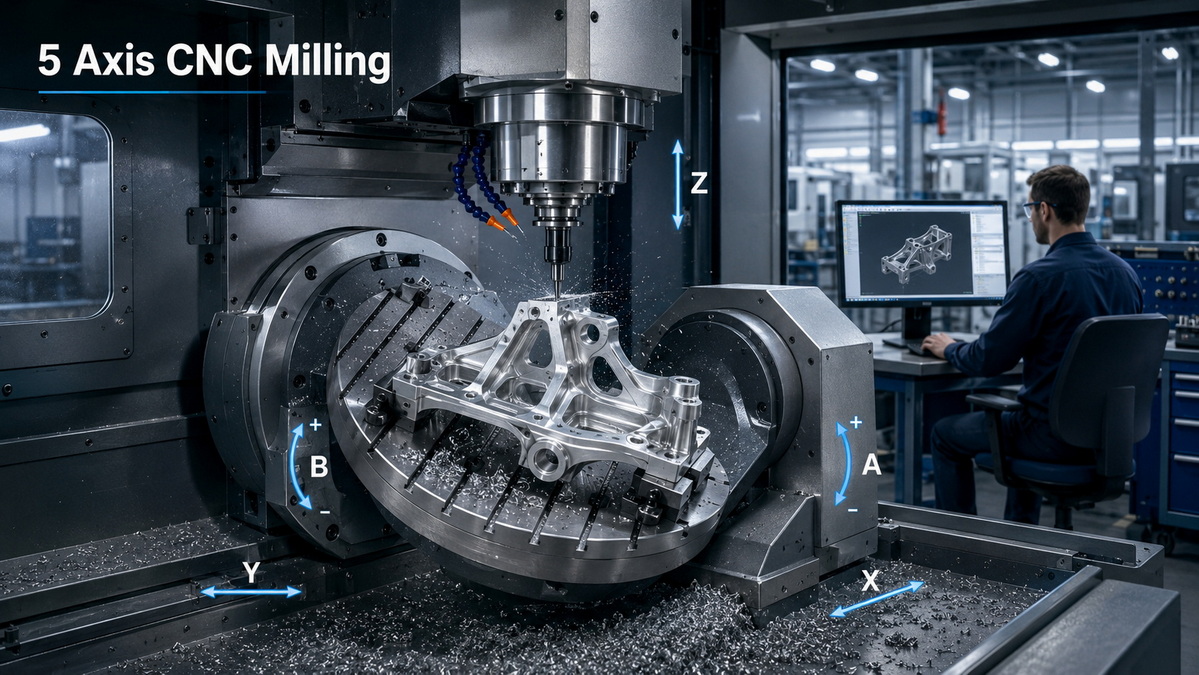
CNC milling involves removing material from a workpiece using rotating cutting tools controlled by computer numerical control systems. Although the term is widely used, the actual process can vary significantly depending on the machine type, material, part geometry, required tolerance, and production volume.
Three-axis milling is commonly used for components with accessible top, side, and front features.
Typical applications include:
- Mounting plates.
- Brackets.
- Enclosures.
- Machine bases.
- Heat sinks.
- Panels.
- Fixture plates.
- Industrial housings.
- Structural aluminum components.
This process is often cost-effective when most features can be accessed through a limited number of setups.
Four-axis CNC milling adds rotational movement around one axis. It is useful for components requiring machining around multiple sides or around cylindrical surfaces.
Typical applications include:
- Shafts with milled features.
- Multi-sided housings.
- Flanged components.
- Rotational parts with holes or slots.
- Small mechanical structures.
Five-axis CNC milling allows the cutting tool or workpiece to move across multiple axes simultaneously. It is commonly used for parts with complex surfaces, compound angles, deep cavities, and difficult-to-reach features.
Typical applications include:
- Aerospace brackets.
- Impellers.
- Medical-device components.
- Robotics parts.
- Complex aluminum housings.
- Automotive performance components.
- Precision molds.
- Turbine-related parts.
- High-complexity industrial components.
Five-axis machining can reduce setups and improve feature-to-feature accuracy. However, it is not automatically necessary for every complex-looking part. In some cases, a well-planned three-axis or four-axis process can be more cost-effective.
| Material | Common Applications | Buyer Considerations |
|---|---|---|
| Aluminum 6061-T6 | Housings, brackets, fixtures, enclosures | Cost-effective, machinable, suitable for anodizing |
| Aluminum 7075-T6 | Aerospace and high-strength parts | Higher strength, more expensive, may require special machining control |
| Stainless Steel 304 | Food equipment, enclosures, industrial components | Strong corrosion resistance, slower machining speed |
| Stainless Steel 316 | Marine, chemical, medical, and corrosive environments | Better corrosion resistance than 304, higher machining cost |
| Carbon Steel | Mechanical structures and industrial parts | Requires corrosion-protection planning |
| Brass | Valves, fittings, electrical components | Good machinability and corrosion resistance |
| Titanium | Aerospace, medical, high-performance components | High machining cost and special process requirements |
| POM / Delrin | Low-friction mechanical components | Dimensional stability and low moisture absorption |
| PEEK | High-temperature and medical applications | Expensive engineering plastic requiring experienced machining |
One of the most serious sourcing risks is material substitution. A supplier may quote a lower-cost material that appears similar but does not meet the required mechanical, corrosion-resistance, or compliance requirements.
For example, 6063 aluminum may be substituted for 6061 aluminum, or 304 stainless steel may be used when 316 stainless steel is required. These substitutions can affect structural strength, corrosion resistance, anodizing results, machining behavior, and regulatory compliance.
To prevent this issue:
- State the exact material grade on the drawing.
- Specify the temper or condition where applicable.
- Request material certificates.
- Require heat or lot traceability.
- Require written approval before any substitution.
- Confirm whether the supplier purchases material from approved mills or distributors.
A supplier may state that it can achieve extremely tight tolerances without evaluating whether the part geometry, material, machining setup, and inspection method make this practical.
A tolerance such as ±0.01 mm may be achievable for a small, stable feature under controlled conditions, but it may be difficult or unnecessary for a large aluminum plate, a thin-wall housing, or a part that undergoes heat treatment after machining.
To avoid this problem:
- Identify critical-to-function dimensions.
- Apply tight tolerances only where necessary.
- Use GD&T where appropriate.
- Request a DFM review before production.
- Ask which features require special fixtures.
- Confirm the measurement method for each critical dimension.
- Review the first article inspection report before approving production.
Anodizing, powder coating, plating, heat treatment, polishing, and welding can affect final dimensions, appearance, and flatness.
For example, anodizing changes surface thickness, while heat treatment can cause distortion. A machined part that meets tolerance before finishing may not meet tolerance after finishing.
To reduce this risk:
- Specify whether dimensions apply before or after finishing.
- Define masking areas for anodizing or coating.
- State required coating thickness.
- Identify critical mating surfaces.
- Confirm whether threads must be masked.
- Request a final inspection after finishing.
- Require visual standards for cosmetic surfaces.
A supplier may have CNC machine capacity but still miss delivery targets because of delayed material, outsourced anodizing, slow heat treatment, unavailable cutting tools, or inspection bottlenecks.
Ask for a production schedule covering:
- Material procurement.
- Programming.
- Fixture preparation.
- CNC machining.
- In-process inspection.
- Finishing.
- Final inspection.
- Packaging.
- Shipment.
This provides a more realistic view of delivery risk.
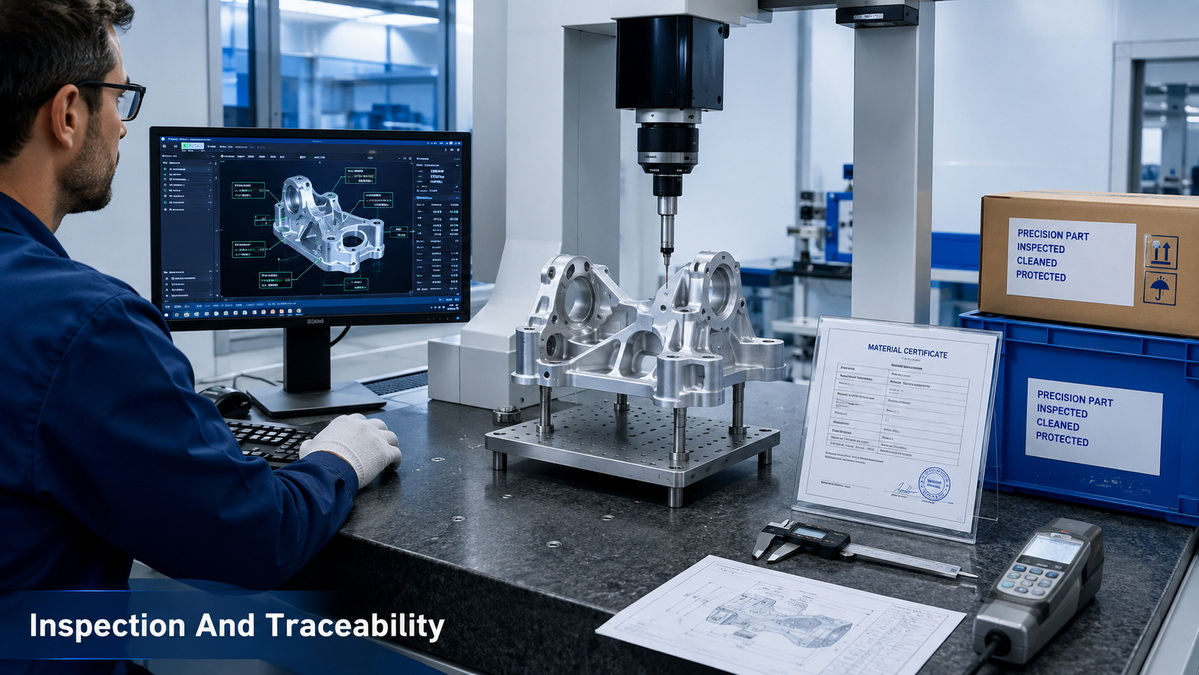
A common but overlooked issue is datum transfer between machining setups and final inspection.
A part can meet dimensions during initial machining but lose positional accuracy after being removed from the fixture, turned over, clamped again, heat-treated, anodized, welded, or assembled. This is particularly important for thin-wall aluminum housings, long stainless-steel parts, complex multi-axis components, and assemblies with multiple mating features.
Before approving production, ask the supplier:
- Which datum surfaces will be used in every machining setup?
- Which features will be machined during the first setup?
- Which features require a second or third clamping operation?
- Are critical surfaces machined before or after heat treatment?
- Will finishing affect the dimensions of critical holes, threads, or mating surfaces?
- Does the final inspection report use the same datum scheme shown on the engineering drawing?
- Is the first article produced using a process representative of mass production?
This is often more valuable than asking only whether the supplier can meet a specific tolerance. The real question is whether the supplier can repeatedly meet the tolerance after every machining, finishing, inspection, and handling step.
Request a company profile containing:
- Legal company name.
- Factory address.
- Establishment year.
- Main industries served.
- Employee count.
- Machine list.
- Quality certifications.
- Inspection-equipment list.
- Main material suppliers.
- Key export markets.
- Typical lead time.
- Maximum and minimum batch size.
- Available OEM and customization services.
A machine list should identify:
- Machine brand.
- Model.
- Quantity.
- Axis configuration.
- Maximum travel.
- Maximum spindle speed.
- Table size.
- Maximum workpiece load.
- Year of installation.
- Available automation or pallet systems.
This helps buyers determine whether the supplier is technically suitable for the project.
Ask for anonymized examples of:
- First article inspection reports.
- CMM reports.
- Material certificates.
- Surface roughness reports.
- Calibration certificates.
- Nonconformance reports.
- Corrective-action reports.
- Packing inspection records.
A supplier that cannot provide this information may not have a mature quality-control system.
Check the following details:
- Certificate number.
- Company legal name.
- Factory address.
- Certification scope.
- Standard version.
- Issue date.
- Expiry date.
- Certification body.
- Accreditation body.
- Current certificate status.
The certification scope is especially important. A certificate that covers "trading" or "general management" may not necessarily cover CNC machining at the production site you plan to use.
For critical components, do not move directly to a large production order.
A safer process is:
1. Submit drawings and technical requirements.
2. Request a DFM review.
3. Confirm material and finishing specifications.
4. Approve quotation and sample plan.
5. Receive prototypes or first articles.
6. Review dimensional reports and visual quality.
7. Conduct functional testing.
8. Approve a production sample.
9. Release repeat or mass production.
This approach helps buyers identify risks before they become expensive quality problems.
Italy remains an important source of precision CNC milling services, particularly for buyers seeking industrial expertise, multi-axis machining, structured quality systems, and access to established mechanical-engineering supply chains.
The suppliers in this guide serve different project requirements. Some are suitable for aerospace and high-complexity machining, while others focus on automotive production, prototypes, industrial components, or multi-process machining.
U-Need Precision Machinery Co., Ltd. offers an alternative and complementary manufacturing model for global buyers requiring flexible OEM support, prototype-to-production scalability, CNC milling, tooling, sheet metal fabrication, finishing, and assembly coordination.
The most reliable sourcing decision comes from a structured qualification process: define the technical requirement clearly, verify supplier capability, review documentation, approve samples, and confirm production controls before placing a larger order.
Request the complete certificate and confirm the certificate number, legal entity name, factory address, certification scope, issue date, and expiry date. Buyers should also verify whether the issuing certification body is accredited and whether the certificate status remains active.
Do not rely only on a website logo, a certificate image without a number, or a PDF that does not identify the production site.
The required documents depend on the application, but common requirements include:
- Quotation.
- Engineering drawing.
- 3D CAD model.
- Material certificate.
- First article inspection report.
- Dimensional inspection report.
- Surface-finish report.
- Certificate of conformity.
- Packing list.
- Commercial invoice.
- Shipping documents.
- Corrective-action report when required.
For automotive, aerospace, medical, defense, or regulated industrial projects, additional customer-specific documentation may be necessary.
There is no universal MOQ because CNC machining is often suitable for low-volume production. Some suppliers can accept a single prototype, while others prefer repeat orders or medium-volume batches.
However, a low quantity does not always mean a low total cost. Programming, tooling, material purchasing, fixture preparation, inspection, and finishing may create one-time costs that are spread across only a few parts.
Buyers should ask for separate pricing for prototype, pilot production, and repeat-production quantities.
The decision should be based on total project value rather than unit price alone.
An Italian supplier may be preferable when a project requires proximity to European operations, frequent in-person communication, short internal transport routes, or local customer requirements.
An overseas supplier such as U-Need may be preferable when the project requires one-stop manufacturing, flexible prototypes, competitive production economics, combined machining and tooling services, or support for multiple manufacturing processes under one coordinated supplier relationship.
Compare lead time, freight, customs, engineering communication, quality documentation, total landed cost, and supply-chain resilience before making the decision.
Provide a clear visual standard before production. Terms such as "no scratches" or "perfect appearance" are too subjective unless supported by written acceptance criteria.
The specification should define:
- Visible surfaces.
- Non-visible surfaces.
- Color requirements.
- Surface texture.
- Anodizing type and thickness.
- Permitted cosmetic defects.
- Scratch limits.
- Protective-film requirements.
- Packaging requirements.
- Inspection lighting conditions.
For high-appearance parts, approve a golden sample before mass production.
1.UCIMU–SISTEMI PER PRODURRE: [Italian Machine Tool Industry Data and Industry Updates]
2.Italian National Institute of Statistics: [ISTAT Official Statistics Portal]
3.International Organization for Standardization: [ISO Certification Information]
4.International Accreditation Forum: [IAF CertSearch Certificate Verification Platform]
5.U-Need Precision Machinery Co., Ltd.: [Custom Precision Manufacturing Services]
6.Gi.Mec S.r.l.: [Precision Mechanical Machining Services]
7.Torneria Fanti R. S.r.l.: [Italian Precision Machining Company Profile]
8.DFM S.r.l.: [Precision Machining for Aerospace and Defense]
9.Italmec S.r.l.: [CNC Turning and Milling Services]
10.OLMA S.r.l.: [CNC Machining Services in Turin]


