Views: 240 Author: U-Need Publish Time: 2026-10-16 Origin: Site
Content Menu
● Understanding Different Types of Machining Operations
● What Are Machining Operations?
● Conventional Machining Operations
>> Turning: Producing Cylindrical Features
>> Milling: Creating Pockets, Slots, and Complex Surfaces
>> Drilling, Boring, Reaming, and Tapping
>> Grinding: Finishing Precision Surfaces
>> Broaching: Producing Repeated Profiles
>> Sawing, Shaping, and Planing
● Non-Conventional Machining Operations
>> Electrical Discharge Machining
>> Electrochemical and Chemical Machining
>> Laser Cutting and Laser Beam Machining
>> Ultrasonic and Abrasive Waterjet Machining
● How to Select the Right Machining Operation
● Why Tolerances and Surface Finish Need Separate Attention
● Practical Example: Planning a Precision Shaft
● Design Decisions That Reduce Machining Cost
>> Provide Practical Tool Access
>> Separate Functional and Cosmetic Requirements
>> Compare Complete Manufacturing Routes
● What to Include in a Precision Machining RFQ
● Summary: Build a Better Manufacturing Plan with U-Need
>> What Are the Main Types of Machining Operations?
>> What Is the Difference Between Turning and Milling?
>> Is CNC Machining a Separate Manufacturing Process?
>> Can EDM Machine Any Material?
>> Which Machining Process Produces the Best Surface Finish?
>> How Can Buyers Reduce Precision Machining Costs?
Different types of machining operations serve different manufacturing purposes. Turning produces cylindrical features. Milling creates pockets, slots, and complex surfaces. Drilling makes holes, while grinding and electrical discharge machining address specialized finishing and geometry requirements.
For buyers, choosing a process is not simply about finding the machine with the highest accuracy. It means identifying a manufacturing route that delivers the required function, consistent quality, and reasonable total cost.
A precision component may need several operations before it is ready for assembly. Understanding how these processes work together helps engineers, purchasing teams, and product developers make better manufacturing decisions.
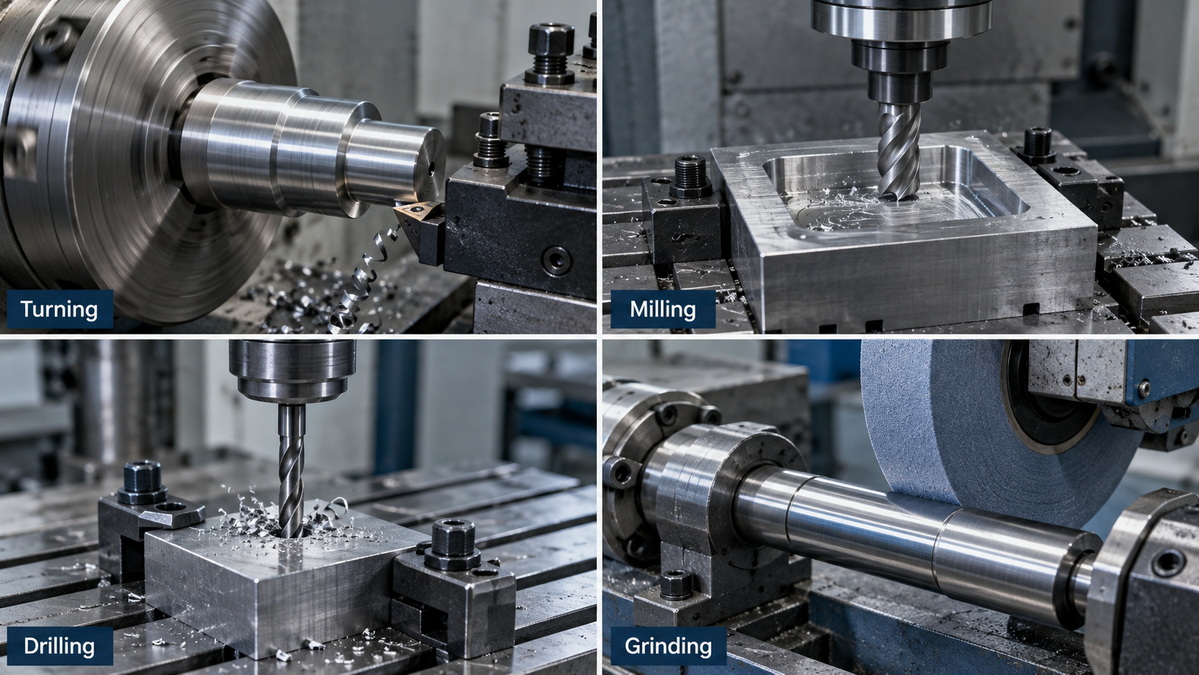
Machining operations remove material from a workpiece to produce specified dimensions, shapes, and surfaces. Starting materials can include metal bars, plates, castings, forgings, and partially finished components.
Conventional machining removes material through cutting or abrasion. Non-conventional methods use mechanisms such as electrical discharge, electrochemical dissolution, or concentrated thermal energy.
CNC machining describes computer-controlled machine operation rather than a separate material-removal process. Turning, milling, drilling, and grinding can all use CNC equipment.
Machining also differs from forming processes. Bending, stamping, and forging primarily reshape material rather than removing it, although a finished part may combine forming and machining.
Turning rotates the workpiece against a cutting tool. It is particularly suitable for shafts, bushings, sleeves, pins, and components dominated by round features.
Common turning operations include:
- Facing an end surface.
- Reducing an outside diameter.
- Producing tapered profiles.
- Cutting grooves.
- Machining internal and external threads.
A turned component may still require milling for flats, keyways, or off-center features. Process planning should therefore consider the entire part rather than its cylindrical shape alone.
Milling uses a rotating, multi-edge cutting tool to remove material. Controlled movement between the tool and workpiece produces flat faces, pockets, channels, contours, and other features.
The workpiece does not necessarily remain stationary. Machine tables may translate or rotate depending on the equipment.
Three-axis milling suits many accessible features. Five-axis machining can improve access to angled surfaces and reduce repositioning, but it is not automatically the most economical choice.
Tool reach, internal corner radii, and workholding remain important constraints.
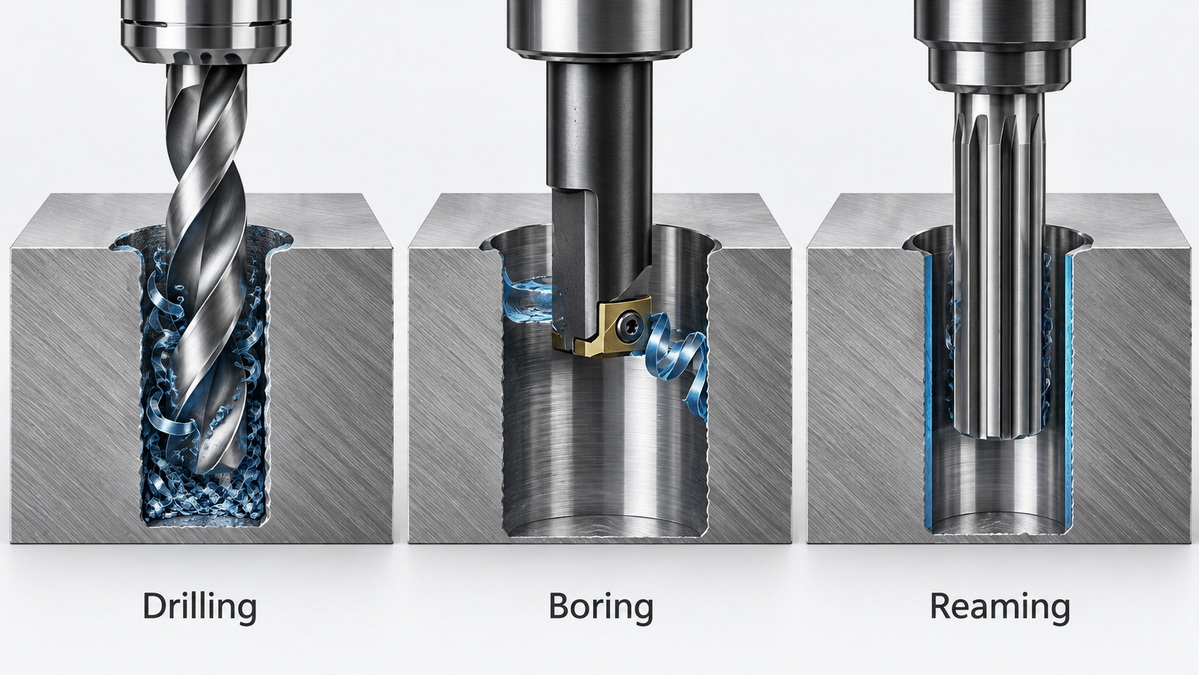
These operations perform different hole-making tasks.
| Operation | Primary purpose | Typical application |
|---|---|---|
| Drilling | Creates an initial round hole | Fastener holes and fluid passages |
| Boring | Enlarges and refines an existing hole | Bearing seats and accurately located bores |
| Reaming | Removes a small allowance to finish a hole | Dowel-pin holes and precision fits |
| Tapping | Produces an internal thread | Threaded assembly connections |
A drilled hole may be sufficient for bolt clearance. A locating hole may require additional finishing.
Hole size, position, finish, and fit should be specified separately. Improving one characteristic does not automatically ensure the others.
Grinding removes material with an abrasive wheel. It is useful for hardened components and surfaces requiring controlled dimensions or fine finishes.
Typical applications include bearing journals, tooling surfaces, and precision flat faces.
Grinding performance depends on wheel selection, dressing, cooling, and stock allowance. Poor thermal control can damage the surface.
It is therefore a planned finishing operation, not a universal correction for problems introduced earlier.
Broaching uses a tool with progressively sized cutting teeth. Each tooth removes part of the material as the tool passes through or across the workpiece.
Typical applications include keyways, splines, and non-round holes.
Dedicated tooling can make broaching attractive for repeat production. For small batches or frequently changing designs, tooling investment may favor another approach.
Sawing commonly prepares stock for subsequent machining by cutting bars, tubes, and other materials to length.
Shaping and planing use single-point cutting tools with reciprocating motion. In shaping, the tool typically reciprocates. In planing, the workpiece does.
These processes can produce flat surfaces and grooves. Milling is often used for comparable work, but shaping and planing remain relevant in selected applications.
Electrical discharge machining, or EDM, removes material through controlled electrical sparks. The workpiece must be electrically conductive.
Two common forms are:
- Wire EDM, which cuts profiles using a moving wire electrode.
- Sinker EDM, which uses a shaped electrode to create cavities.
EDM is useful for hardened tooling and features that are difficult to reach with conventional cutters.
Trade-offs include cutting speed, electrode consumption, flushing requirements, and surface condition. A thermally altered recast layer may require additional treatment when the application demands it.
Electrochemical machining, or ECM, removes conductive material through controlled electrochemical dissolution. The workpiece acts as the anode in an electrolytic system.
Chemical machining uses an etchant and protective masking to remove selected material.
These processes suit particular geometries and material requirements. Dimensional control, chemical compatibility, handling procedures, and waste treatment must be considered.
Neither process should be treated as a general replacement for milling or turning.
Laser processing uses concentrated energy to melt, vaporize, or otherwise remove material. Laser cutting is particularly relevant to sheet-metal profiles.
Because it is non-contact, it avoids conventional cutting-tool forces. However, it remains a thermal process.
Cut-edge quality, distortion, and the heat-affected zone depend on material and operating conditions. A laser-cut blank may subsequently require bending, welding, or machining.
Ultrasonic machining combines high-frequency tool vibration with abrasive action. It can be useful for hard, brittle materials that are difficult to process using conventional cutting tools.
Abrasive waterjet cutting uses water carrying abrasive particles to remove material.
Waterjet cutting avoids a thermal heat-affected zone. Nevertheless, cut taper, edge condition, and achievable detail still require evaluation.
Start with function, not a preferred machine.
The right process must produce the necessary features consistently without adding unnecessary operations.
| Part requirement | Candidate process | Main consideration |
|---|---|---|
| Predominantly cylindrical geometry | Turning | Workholding and concentricity |
| Pockets and prismatic features | Milling | Tool access and corner radii |
| Precision locating hole | Boring or reaming | Size, position, and inspection |
| Hardened precision surface | Grinding | Thermal control and finish |
| Difficult conductive tooling feature | EDM | Access and surface integrity |
| Repeated spline or keyway | Broaching | Tooling investment and volume |
| Sheet-metal profile | Laser or waterjet cutting | Edge quality and downstream forming |
Material, geometry, tolerance, finish, and quantity should be evaluated together.
A route that suits ten prototypes may not be the best choice for thousands of identical components.
There is no universal tolerance for CNC machining or non-conventional machining.
Results depend on feature size, material, machine condition, tooling, workholding, temperature, and measurement methods.
Dimensional tolerance describes allowable variation in size or geometry. Surface roughness describes surface texture. A smooth surface can still be dimensionally incorrect.
For purchasing decisions:
1. Identify dimensions that control assembly or performance.
2. Define the necessary datums and geometric relationships.
3. Specify surface finish where function requires it.
4. Agree on inspection methods for critical features.
Avoid assigning tight tolerances to every dimension by default. Unnecessary requirements can increase manufacturing and inspection costs without improving product performance.
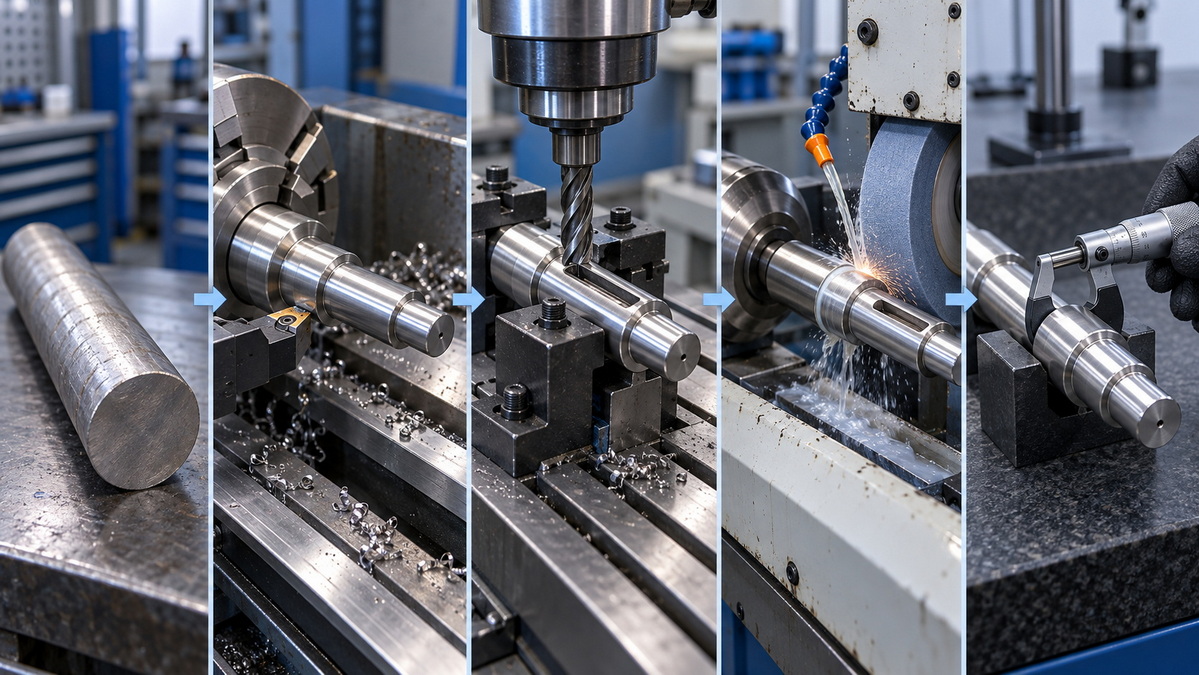
Consider an illustrative steel shaft with bearing seats, a keyway, and an axial threaded hole. This example demonstrates process planning rather than a documented customer project.
A possible manufacturing sequence is:
1. Saw the stock to length.
2. Turn the main diameters and shoulders.
3. Drill and tap the axial hole.
4. Mill the keyway.
5. Perform heat treatment if specified.
6. Grind selected bearing seats where necessary.
7. Deburr and inspect the finished component.
The sequence matters. Heat treatment can change dimensions, so critical finishing may need to occur afterward.
The drawing should also define how the bearing seats relate to each other. Correct diameters alone may not ensure satisfactory rotation or assembly.
This illustrates why precision manufacturing usually depends on a coordinated route rather than one operation.
Deep pockets and narrow features may require long, small-diameter tools. Reduced rigidity can limit machining conditions and increase processing time.
Where function permits, use accessible feature orientations and larger internal radii.
Conventional milling leaves a radius in internal corners. If a sharp corner is essential, another operation may be necessary.
A sealing face, bearing seat, and cosmetic surface do not necessarily need the same finish.
Apply demanding requirements where they support performance. Avoid specifying premium finishing across the entire component without a functional reason.
A sheet-metal enclosure may be better produced by cutting and bending than by removing most of a solid billet.
Conversely, a formed or molded component may still require machining on selected interfaces.
Compare total effort, including tooling, finishing, inspection, and repeatability—not only the price of an individual operation.
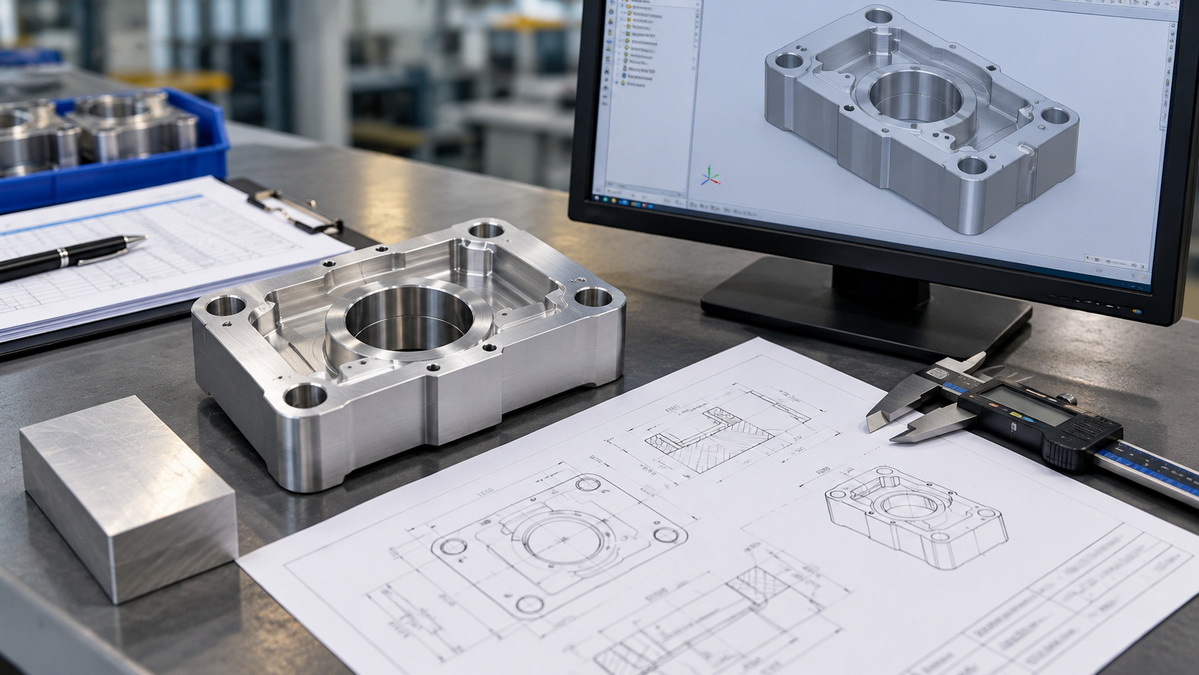
A complete request for quotation helps suppliers evaluate requirements and propose an appropriate manufacturing route.
Provide:
- A 3D model and dimensioned drawing.
- Material grade and condition.
- Prototype quantity and expected production volume.
- Critical tolerances and datum requirements.
- Surface finish and coating specifications.
- Heat-treatment requirements.
- Inspection and documentation expectations.
- Delivery schedule and packaging requirements.
Flag unresolved requirements rather than allowing suppliers to guess.
For example, explain whether a hole locates a component, supports a bearing, or provides bolt clearance. That distinction can change the recommended process and inspection plan.
Understanding machining operations helps buyers connect part requirements with practical manufacturing methods.
Turning, milling, hole-making, grinding, and non-conventional processes each offer specific advantages. Reliable results depend on selecting and sequencing them around material, geometry, functional tolerances, and production volume.
U-Need is your precision manufacturing partner in China, supporting global brands, distributors, and manufacturers with custom precision parts machining, mold manufacturing, and sheet metal fabrication.
Its service scope includes injection molds, stamping dies, cold-forging dies, laser cutting, bending, and stamping.
Send U-Need your drawings, material specifications, target quantity, and critical quality requirements. Request a manufacturability review and quotation to evaluate the right process combination for your project.
Common operations include turning, milling, drilling, boring, reaming, tapping, grinding, and broaching. Non-conventional methods include EDM, ECM, laser processing, and ultrasonic machining. Many finished parts require several operations.
Turning primarily rotates the workpiece, while milling rotates the cutting tool. Turning commonly produces cylindrical features. Milling produces pockets, slots, flat faces, and complex contours.
No. CNC means computer numerical control. It controls machine movements and operation. Turning, milling, drilling, and several other processes can use CNC equipment.
No. Conventional EDM requires an electrically conductive workpiece. Hardness is less restrictive than in many cutting operations, but geometry, flushing, and surface requirements still influence suitability.
There is no single answer. Grinding and other finishing operations can produce fine surfaces, but the appropriate method depends on material, geometry, and the specified finish.
Use accessible geometry, allow practical internal radii, and reserve tight tolerances for functional features. Provide clear drawings and quantities so suppliers can evaluate the complete manufacturing route.
1. TOPS — "Types of Machining Operation | Conventional and Non-Conventional." Original article used as the starting point for restructuring and identifying topics requiring clarification. Its broad process-capability comparisons were not adopted as universal manufacturing guarantees. [topsbest-precision]
2. Sandvik Coromant — "What Is Successful Milling." Technical guidance supporting milling applications and the relationship between feature geometry, process conditions, and machining outcomes. [sandvik.coromant]
3. Encyclopaedia Britannica — "Machine Tool: Basic Machine Tools." Reference for conventional machine-tool categories, including turning, milling, grinding, shaping, and planing. [britannica]
4. Encyclopaedia Britannica — "Broaching Machine." Explanation of progressively sized cutting teeth and internal and external broaching applications. [britannica]
5. Protolabs — "CNC Hole Design: Through, Blind, Tapped, and More." Practical guidance on hole types, precision fits, and reaming applications. [protolabs]
6. Protolabs — "Understanding CNC Machining Tolerances." Background on dimensional requirements and why published machining tolerances depend on supplier service conditions. [protolabs]
7. Protolabs Network — "How to Design Parts for CNC Machining." Guidance supporting internal corner radii, tool accessibility, deep-feature considerations, and manufacturable geometry. [hubs]
8. Encyclopaedia Britannica — "Electrical-Discharge Machining." Reference for the electrical-discharge removal mechanism and conductive-material requirement. [britannica]
9. "Electro-Discharge Machining Advanced Materials under Low …" — Research overview published in 2026. Supporting material on EDM removal mechanisms, electrode considerations, and recast-layer formation. [sciepublish]
10. Encyclopaedia Britannica — "Electrochemical Machining" and "Machining." References for electrochemical dissolution and ultrasonic abrasive machining principles. [britannica]
11. TWI — "Laser Cutting: Process Variants." Technical discussion of laser-cutting processes, cut quality, and manufacturing considerations. [twi-global]
12. TWI — "What Is the Heat Affected Zone?" Explanation of thermally affected material and the distinction between thermal and non-thermal cutting processes. [twi-global]


