Views: 222 Author: U-Need Publish Time: 2026-04-20 Origin: Site
As an engineer who has spent years debugging machining problems on the shop floor, I know that the difference between a reliable and an average supplier often shows up on the surface of the part – literally. Rough finishes, chatter marks, tool lines, and burrs are never "just cosmetic"; they signal process issues that will eventually turn into failures, rework, and delays. That is exactly why U-Need has built its business around precision, process discipline, and transparent communication for global customers. [uneedpm]
Based in China, U-Need provides end-to-end precision manufacturing solutions, such as custom precision parts machining. Instead of treating each order as a one-off job, U-Need works as an ongoing technical partner to support global brands, distributors, and manufacturers from prototype through mass production.
For many overseas buyers, "China supplier" can mean attractive pricing but also unpredictable quality and communication gaps. U-Need's approach is different and is built around four pillars: experience, engineering discipline, process control, and transparency. [uneedpm]
In one frequently shared internal training video, a junior programmer asks why a machined surface looks rough and full of tool marks despite "correct" cutting speed. A senior engineer explains that linear speed is only the start; stepover, toolpath strategy, machine rigidity, and tool selection matter just as much.
Here is a snapshot of the kind of expert guidance that shapes U-Need's daily work:
- Stepover and surface roughness:
The senior engineer reminds the team that Ra is closely related to the square of the stepover divided by the tool radius, so for finishing cuts they lock stepover in the 0.05–0.10 mm range instead of using a large percentage of tool diameter. [get-it-made.co]
- Roughing vs finishing logic:
For roughing, U-Need may use up to 75% of tool diameter as stepover to maximize efficiency, accepting a coarser tool pattern; for finishing, they switch to fixed small stepovers to achieve a fine surface.
- Toolpath strategy:
The team standardizes on one-way climb milling with arc lead-in/lead-out and edge extensions of 2–3 mm for aluminum to prevent re-cutting chips and reduce tool marks.
- Vibration control in steels:
When machining steel, they recommend coated carbide four-flute end mills, small stepovers (0.08–0.10 mm), shallow depth of cut (≤0.15 mm), and helical ramp entry with corner feed reductions to avoid chatter and "wavy" surfaces.
This is not textbook knowledge for marketing brochures; it is hard-earned know-how from real CNC programming and process debugging. That expertise is precisely what overseas customers tap into when they work with U-Need. [uneedpm]
U-Need's value lies in integrating several manufacturing capabilities under one roof, avoiding hand-offs that introduce delay and quality risk. [uneedpm]
U-Need offers custom CNC turning and milling for metals and plastics, serving sectors such as automotive, industrial automation, consumer electronics, and tooling. [junyucncmachining]
Key advantages:
- Tight tolerances: CNC turning and milling with tolerances down to ±0.005 mm on critical features for suitable materials and reasonably sized parts. [uneedpm]
- Complex geometries: Ability to handle multi-axis operations and complex cavities that would be difficult for conventional shops. [precisionmachining-china]
- Finish-focused process: Process parameters are selected around Ra and functional requirements, not just dimensional tolerance. [firgelliauto]
- Material flexibility: Common steels, stainless steels, aluminum alloys, and engineering plastics, with assistance in material selection if needed. [junyucncmachining]
U-Need uses these machining capabilities both for end-use parts and as an internal backbone to support mold bases, cores, and precision inserts. [junyucncmachining]
For many global customers, tooling is where projects succeed or fail. U-Need designs and manufactures:
- Plastic injection molds – from rapid prototype tools to multi-cavity production molds.
- Stamping dies – progressive dies, transfer dies, and single-station tools for sheet metal parts.
- Cold-forging dies – for high-strength, near-net-shape metal components.
Drawing on industry best practices, U-Need focuses on:
- Precision machining of mold bases and cavities to avoid flash, mismatch, and premature wear. [junyucncmachining]
- Surface finishing of critical molding surfaces to achieve targeted Ra, improving mold release and reducing polishing time. [get-it-made.co]
- Material selection for dies and mold components (e.g., P20, H13, S136, SKD61) to balance cost, hardness, and toughness. [junyucncmachining]
This toolbox allows U-Need to support customers from part design review through tooling and mass production, helping reduce overall project risk. [uneedpm]
U-Need complements machining and molds with sheet metal fabrication, including:
- Laser cutting of steel, stainless steel, and aluminum sheets.
- CNC bending for precise angles and repeatability.
- Stamping with in-house or customer-supplied tooling.
This combination is particularly valuable for customers needing machined components plus sheet metal brackets, enclosures, or mounting hardware in the same project. [precisionmachining-china]
Surface roughness is often treated as a line item on a drawing, but in practice it is a system-level outcome of programming, tooling, and machine condition. [production.matthewmarks]
In the training example mentioned earlier, the senior engineer explains that if you only set spindle speed correctly but ignore stepover (tool path spacing), you will still get a rough, striped surface. While rigorous Ra calculation involves integrating deviations over a sample length, an approximate relationship shows that Ra is proportional to the square of the scallop height, which in turn is influenced by stepover and cutter radius. [firgelliauto]
U-Need's finishing guidelines:
- Roughing:
- Stepover up to 75% of tool diameter for maximum material removal.
- Expect visible tool marks; focus on stability and chip evacuation.
- Finishing:
- Fixed stepover between 0.05–0.10 mm for end mills in typical sizes.
- Carefully chosen feed and speed to stay below target Ra. [get-it-made.co]
- Use stable, climb-milling toolpaths to avoid chatter.
For buyers and engineers, this mindset means that surface finish requirements are translated into concrete process settings, not just a note on the drawing.
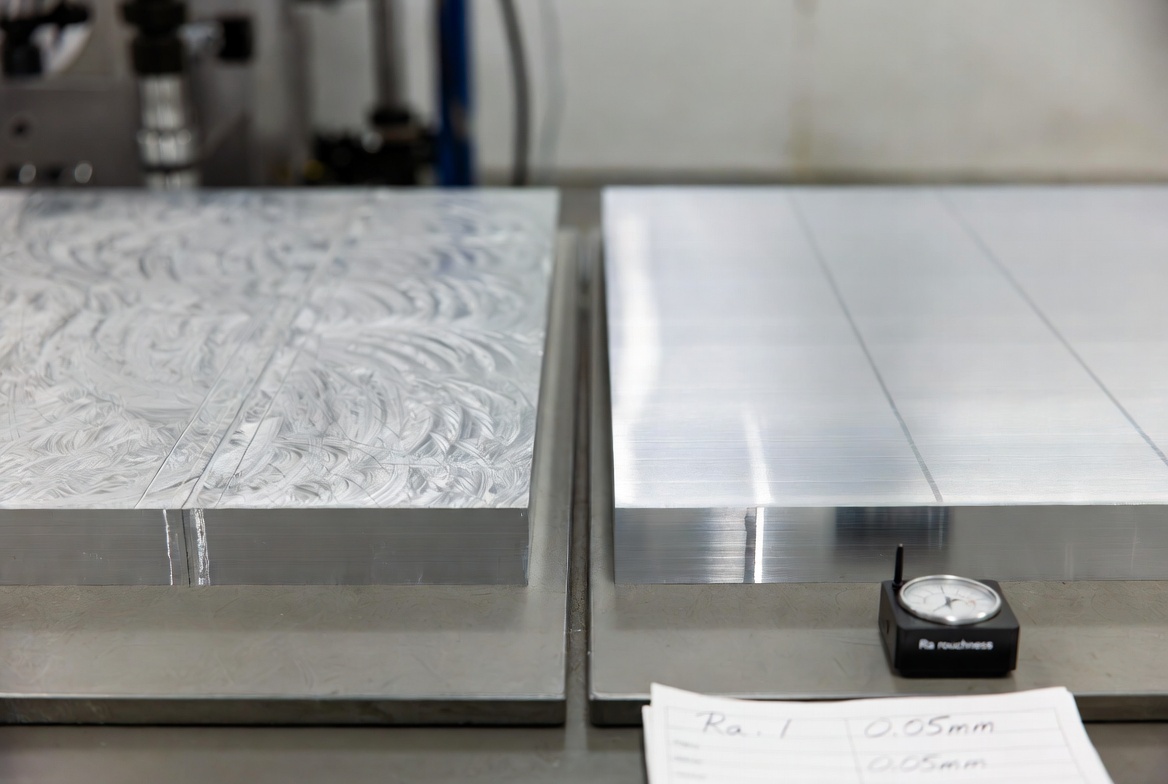
One common complaint in aluminum machining is – built-up edge and smeared surfaces. U-Need addresses this with:
- Tool selection:
- 2-flute or 3-flute high-helix end mills specifically designed for aluminum. [ksptg]
- Sharp cutting edges and large flute volume for rapid chip evacuation. [blog.fullertontool]
- Toolpath strategy:
- One-way climb milling rather than bidirectional paths, to keep cutting forces consistent.
- Arc-shaped tangential lead-in and 2–3 mm edge extension to avoid dwell marks at boundaries.
- Programming standards:
- Standardized UG/CAM templates for aluminum with pre-defined entry, exit, and overlap parameters.
Industry guidance supports this approach: 2-flute cutters excel when chip volume is high and evacuation is critical, while 3-flute tools are a strong choice for general aluminum work requiring stability and good finish. [hobby-machinist]
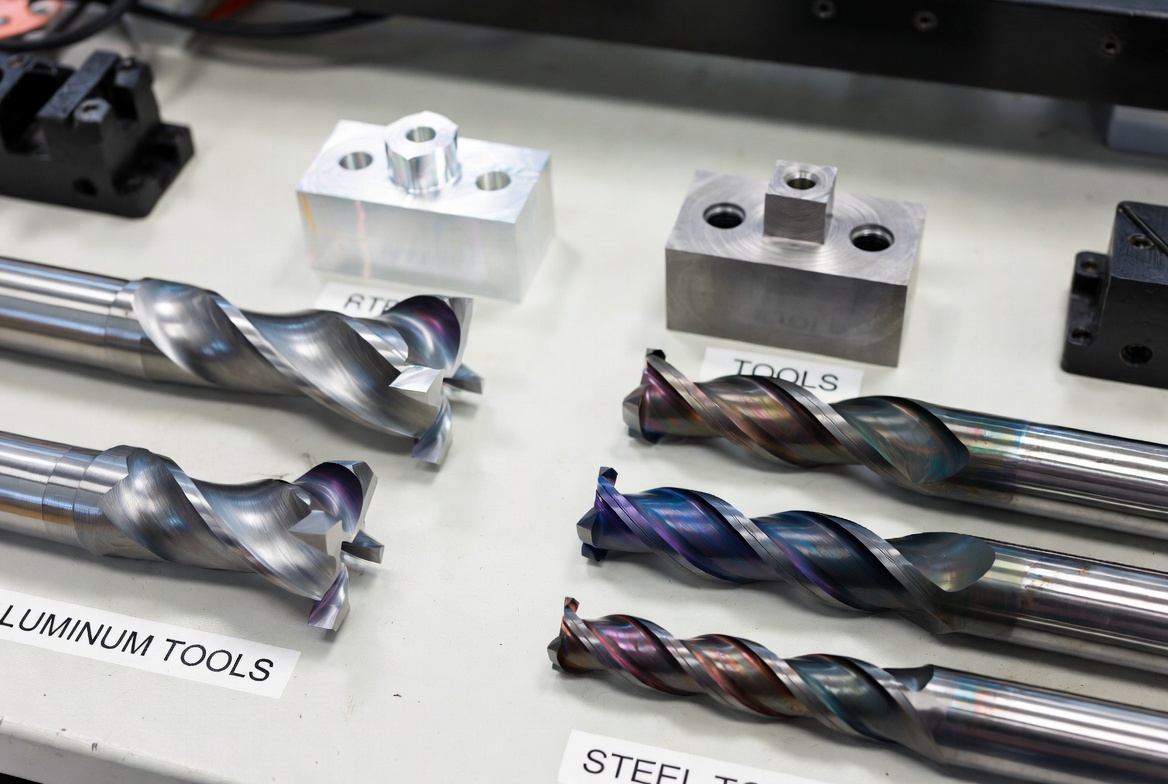
For steels, the engineer in the training clip mentions frequent – chatter waves and blend lines between tool passes. To prevent that, U-Need combines:
- Coated carbide 4-flute end mills designed for steel. [junyucncmachining]
- Small stepover (0.08–0.10 mm) and shallow depth of cut ≤0.15 mm in finishing passes.
- Helical ramp entries and reduced feed at corners (20–30% of nominal) to prevent abrupt load spikes.
These practices align with general industry recommendations that emphasize smooth load transitions, stable engagement, and adequate support to avoid chatter. [get-it-made.co]
Although individual customer reviews are often private, recurring feedback highlights a few themes that match what international buyers look for in a precision manufacturing partner in China. [reddit]
Customers who previously worked with low-cost job shops report:
- Large variation between samples and mass production
- Unexpected changes to process or material grades
- Cosmetic defects that lead to rework after overseas arrival
In contrast, U-Need emphasizes:
- First-article approval – sharing dimensional reports and surface-finish photos or videos before mass production. [youtube]
- Stable process windows – documented parameter sets for aluminum, steels, and tool steels rather than ad hoc adjustments.
- Root cause analysis – when issues occur, engineers trace them back to tooling, programming, or fixturing rather than simply "trying again."
Global buyers often need more than a "yes/no" supplier. U-Need supports customers by:
- Reviewing 2D drawings and 3D models for manufacturability—highlighting thin walls, deep pockets, or unrealistic tolerances.
- Suggesting adjusted tolerances or surface finish targets where tighter specs add cost without real functional benefit.
- Providing video snippets from the shop floor to show how parts are being machined or inspected. [reddit]
This level of transparency builds the trust that is often missing in long-distance manufacturing relationships. [partmfg]
To get the most from U-Need as your precision manufacturing partner in China, follow these practical steps.
When you first reach out:
1. Provide 2D drawings with tolerances and surface finish requirements (Ra where needed). [production.matthewmarks]
2. Attach 3D models (STEP/IGES) for complex parts.
3. Clarify priorities: Is this batch primarily for functional testing, assembly fit, or cosmetic evaluation?
The clearer your intent, the better U-Need can prioritize machining strategy, tool selection, and inspection methods.
Work with U-Need's engineers to:
- Confirm material grades and acceptable alternatives.
- Agree on critical surfaces where Ra and dimensional tolerances truly matter.
- Decide whether post-machining treatments (anodizing, plating, polishing) will be done in China or locally. [get-it-made.co]
This early alignment reduces the risk of rework and helps optimize cost. [reddit]
Before mass production:
- Start with a small prototype run.
- Request inspection reports, photos, and surface finish evidence for key features. [youtube]
- If needed, ask U-Need to adjust stepover, toolpath, or tooling on visible surfaces (for example, reducing stepover from 0.10 mm to 0.06 mm on a cosmetic face).
Once the prototype is approved, U-Need can lock down the process parameters and replicate them for larger batches. [uneedpm]
To illustrate how U-Need operates, consider a typical scenario for a global OEM:
1. The customer sends a machined aluminum housing with a requirement of Ra ≤ 1.6 µm on sealing faces and Ra ≤ 3.2 µm elsewhere. [firgelliauto]
2. U-Need's programmers select a 3-flute high-helix end mill for finishing, with one-way climb milling, 0.06 mm stepover, and carefully tuned feeds. [ksptg]
3. Prototype parts show minor visible tool marks. The customer requests a smoother cosmetic face.
4. U-Need reduces stepover to 0.04 mm, adjusts feed, and shares close-up photos and Ra measurements. [firgelliauto]
5. After approval, the process is documented and frozen, and production scales with consistent quality from batch to batch. [uneedpm]
This iterative, engineering-driven approach is what turns a supplier into a long-term manufacturing partner. [partmfg]
When you evaluate precision manufacturing partners in China, you are not just buying machine time; you are buying engineering depth, process control, and communication. [reddit]
U-Need offers:
- Practical shop-floor expertise, reflected in detailed control of stepover, toolpaths, and tooling for different materials.
- Integrated services across custom CNC machining, mold manufacturing, and sheet metal fabrication, reducing coordination effort. [precisionmachining-china]
- Structured engagement, from DFM review to prototype validation and process locking, building confidence in long-term production. [uneedpm]
- Transparent communication with data, photos, and videos, which is especially important for overseas customers. [youtube]
If you need a precision manufacturing partner in China who understands both engineering reality and international expectations, U-Need is positioned to bridge that gap. [reddit]

If you are planning a new product launch, need to localize tooling, or want to consolidate suppliers, now is a good time to engage U-Need as your precision manufacturing partner in China. [partmfg]
- Prepare your drawings, 3D models, and key requirements.
- Reach out for a consultative quotation that includes not just price, but also process suggestions.
- Use the first prototype batch to align on quality, surface finish, and tolerances before scaling up. [reddit]
Take the next step: contact U-Need's engineering team, share your files, and explore how their CNC machining, mold manufacturing, and sheet metal fabrication capabilities can support your next project from concept to mass production. [junyucncmachining]
U-Need serves automotive components, industrial automation, consumer electronics, tooling, and general machinery by providing custom CNC machining, molds, and sheet metal parts. [precisionmachining-china]
For many CNC turned and milled parts, U-Need can achieve tolerances down to ±0.005 mm on critical dimensions, depending on material, geometry, and inspection requirements. [uneedpm]
U-Need manages Ra by adjusting stepover, depth of cut, tool geometry, and toolpath strategy for each material, using smaller stepovers (0.05–0.10 mm) in finishing and validating results with roughness measurements. [production.matthewmarks]
Yes. U-Need routinely supports rapid prototyping, pilot runs, and full-scale production, often using the same fixtures and programs with tuned parameters for each phase. [partmfg]
U-Need communicates in English, shares inspection reports, photos, and videos, and follows a structured process from RFQ and DFM review through first-article approval and ongoing production feedback. [reddit]
1. U-Need CNC Machining Services – Company website (CNC turning and precision machining in China).
https://www.uneedpm.com/cnc-machining/ [uneedpm]
2. Internal engineering training content (Chinese-language CNC programming and surface-finish optimization discussion).
User-supplied video transcript.
3. JUNYU Precision Mould Co., Ltd – Mold machining capabilities and advantages (representative of Chinese precision mold manufacturers).
https://www.junyucncmachining.com [junyucncmachining]
4. Surface Roughness Explained – Ra roughness chart and definitions.
https://get-it-made.co.uk/resources/surface-roughness-explained [get-it-made.co]
5. Surface Roughness Converter (Ra, Rz, RMS relationships).
https://www.firgelliauto.com/blogs/engineering-calculators/surface-roughness-converter-ra-rz-rms [firgelliauto]
6. Ra/Rz Surface Roughness Conversion Calculator and explanations.
https://production.matthewmarks.com/surface-roughness-conversion-calculator/ [production.matthewmarks]
7. 2-Flute vs 3-Flute End Mills for Aluminum – characteristics and chip evacuation discussion.
https://blog.fullertontool.com/2-flute-vs.-3-flute-end-mills-for-machining-in-aluminum-which-one-to-choose [blog.fullertontool]
8. Do 3-Flute End Mills Really Dominate Aluminum? – high-helix and chip evacuation guidance.
https://www.ksptg.com/learning/3-flute-end-mills-aluminum/ [ksptg]
9. Market and buyer perspectives on Chinese CNC machining companies and remote collaboration.
https://www.reddit.com/r/AskEngineers/comments/1p5pi1s/what_are_the_best_cnc_machining_companies_in/ [reddit]
https://www.reddit.com/r/CNC/comments/15b6lz9/does_anyone_have_experience_using_online_chinese/ [reddit]
10. General overviews of top CNC machining companies and supplier selection in China.
https://www.partmfg.com/cnc-machining-companies/ [partmfg]
https://www.youtube.com/watch?v=XiSmzFrI5H8 [youtube]


