Views: 222 Author: U-Need Publish Time: 2026-05-23 Origin: Site
U-Needis a China-based precision manufacturing partner providing end-to-end CNC machining, mold manufacturing, and sheet metal fabrication for global brands, distributors, and OEM manufacturers. This article shares my on-the-ground experience working with U-Need and combines it with industry-level insights to help you evaluate them as a long-term strategic supplier, not just a low-cost vendor. [uneedpm]
When you work with offshore machining suppliers, you quickly learn that price is the easy part; consistency, communication, and engineering support are what really make or break your projects. From my experience collaborating with U-Need on multiple custom projects, they behave less like a job shop and more like a precision engineering partner that wants to understand the end application and lifecycle of each part. Instead of simply quoting drawings, their team engages early on manufacturability, tolerance stack-up, and risk points, which is critical when you are dealing with tight tolerances and multi-stage tooling. [uneedpm]
U-Need operates from Dongguan in Southern China, right in the Greater Bay Area manufacturing cluster, which gives them access to a highly integrated supply chain for metals, heat treatment, surface finishing, and logistics. That location advantage shows up in shorter lead times, easier consolidation of multiple processes, and better control over outsourced steps such as plating, anodizing, or specialized coatings. [china-machining]

If you are designing high-performance or safety-critical components, you know that not every "CNC supplier" can actually hold the tolerances they advertise over a full production run. U-Need focuses specifically on ultra-precision CNC machining with tolerances as tight as ±0.001 mm, which they state is significantly above typical industry standards for general machining. This capability is particularly relevant for sectors like automotive, industrial automation, robotics, medical fixtures (non-implant), and high-end consumer electronics, where repeatability and stability over time matter as much as one-off accuracy. [ppmfg]
From a process standpoint, U-Need covers CNC milling, CNC turning, and complex multi-axis machining across a range of metals and engineering plastics. They emphasize non-standard, fully custom CNC parts instead of catalog components, which is ideal if you are working with unique designs, legacy equipment, or private-label products that require proprietary geometries. [globalsources]
For companies building their own product lines, tooling quality directly controls part consistency, cycle time, and unit cost. U-Need offers design and manufacturing of injection molds, metal stamping dies, and cold-forging dies, supported by in-house machining, EDM, and grinding resources. This tooling capability makes it possible to keep both prototype and mass-production phases under one roof, rather than splitting mold making and part production between separate vendors. [cnc-jindee]
In practice, this means you can go from a prototype CNC batch to an optimized injection-molded or stamped solution as volumes grow, using the same engineering team that already understands your part's functional requirements. It also simplifies engineering changes, as mold modifications, inserts, and repairs can be managed quickly without lengthy cross-factory coordination. [cnc-jindee]
U-Need complements its machining and tooling services with sheet metal capabilities, including laser cutting, bending, and stamping. For many global customers, this combination is valuable because assemblies often mix machined components (shafts, housings, precision inserts) with sheet metal enclosures, brackets, and chassis. [uneedpm]
By keeping both under the same management system, U-Need can coordinate tolerances between mating machined and sheet metal interfaces, reducing the trial-and-error that typically happens when you source from separate suppliers. This is especially useful for equipment frames, control boxes, and structural parts where flatness and hole positional accuracy are critical. [uneedpm]
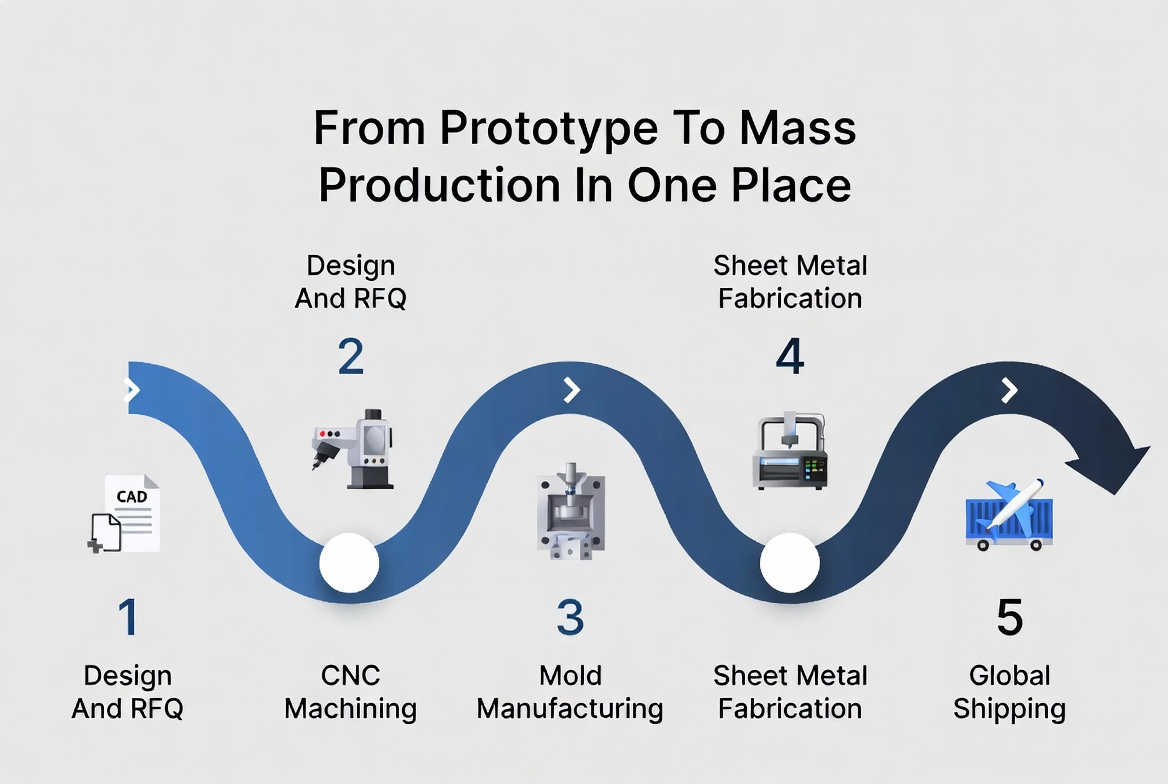
For new product introduction, you often need small batches first, then move into ramp-up. U-Need clearly positions itself as a one-stop solution that accepts MOQs as low as 1 piece for CNC-machined parts and prototypes. This is particularly helpful for: [uneedpm]
- Engineering validation builds and functional prototypes
- Pilot production for early customers
- Spare parts and aftermarket components with low demand
Their internal process is designed so you can start with a single part—validate fit, function, and performance—and then scale to larger batch orders without switching suppliers. [uneedpm]
In fast-moving markets, lead time is often just as important as price. U-Need highlights typical lead times of about 3–5 days for many precision machining orders, supported by flexible scheduling and around-the-clock customer support. Based on industry norms, this is competitive for custom CNC work, particularly when combined with tight tolerances and value-added operations like surface finishing and assembly. [hongsinn]
From a buyer's perspective, this responsiveness reduces the risk of line stoppages and helps you align production with real demand, rather than locking in large, speculative orders. [china-machining]

When you source critical components from overseas, the biggest concern is often: "What happens if something goes wrong?" U-Need addresses this with a 1-year warranty policy on its high-precision machining services and parts, covering manufacturing defects. This approach is more aligned with long-term partnership than transactional spot buying. [uneedpm]
To support consistent quality, U-Need combines high-precision equipment with structured inspection, including dimensional checks against drawings and real-time process control. Their stated minimum tolerance of ±0.001 mm is backed by quality systems similar to those used by other established precision machining firms that rely heavily on calibrated metrology equipment and documented procedures. [ppmfg]
From a risk management standpoint, this level of documentation and warranty support is a strong signal that they understand global customers' expectations for traceability and corrective action. [china-machining]
Having worked with a range of Chinese CNC and tooling suppliers, I see U-Need positioned in the segment where precision, responsiveness, and engineering support matter more than rock-bottom pricing. They are a suitable fit for: [china-machining]
- Mid-to-high complexity custom parts rather than simple, commodity components
- Projects where tolerance, surface finish, and stability over long runs are non-negotiable
- Customers who want one supplier to cover machining, molds, and sheet metal where possible
Their capabilities are comparable to established global precision houses that focus on close-tolerance work, combining CNC machining, tooling, and secondary processes under one umbrella. The main difference is that U-Need operates out of China's mature manufacturing ecosystem, which can deliver a favorable balance of cost, speed, and technical capability. [ppmfg]
From discussions with manufacturing clients and observing market trends, the most common use cases for a partner like U-Need include: [china-machining]
- Custom precision metal parts for industrial equipment and automation systems
- High-accuracy mold components, inserts, and core-cavity sets
- Tooling and fixtures for assembly lines and testing stations
- Brackets, frames, and enclosures combining machined and sheet metal elements
Companies that benefit most are those with ongoing product pipelines rather than one-off projects, because they can leverage U-Need's accumulated process knowledge, tooling history, and lessons learned across multiple generations of parts. [ppmfg]
Even a strong supplier needs clear input and structured collaboration to deliver their best work. Based on broader industry best practices, here is a simple framework you can follow when engaging U-Need on new projects: [developers.google]
1. Define your critical requirements
Share 2D drawings and 3D models with clearly marked critical dimensions, tolerance zones, and surface roughness. Highlight where you can accept design flexibility and where you cannot, such as sealing surfaces or bearing fits. [developers.google]
2. Discuss manufacturability early
Ask their engineers to review the design for machining and moldability. In many cases, small adjustments to radii, wall thickness, or draft can reduce cost and risk without changing the function. [cnc-jindee]
3. Align on inspection and documentation
Agree on what will be measured, how often, and what reports you require (FAI, PPAP elements, CMM data, material certificates). This ensures there are no surprises when parts arrive. [ppmfg]
4. Start with a pilot batch
Begin with a small run to validate dimensions, fit, and performance in your actual assembly. Use those findings to refine both design and process before scaling up. [china-machining]
5. Build a long-term roadmap
For recurring parts, share your expected yearly volumes and roadmap. This allows U-Need to plan dedicated fixturing, tooling, and capacity, which improves consistency and unit cost over time. [china-machining]
If you are exploring new precision manufacturing partners in China, U-Need is a strong candidate when your priority is tight tolerance, stable quality, and integrated services covering CNC machining, molds, and sheet metal fabrication. The most effective next step is to share a specific project (drawings, volumes, and functional requirements) and request a detailed manufacturability review and quotation. [uneedprecisionmachine]
You can reach U-Need via phone, email, or WhatsApp using the contact details listed on their official site, and discuss whether they are a fit for your industry, material requirements, and long-term volume plans. From there, starting with a low-volume prototype run is an efficient way to validate both technical capability and communication before shifting larger production volumes. [uneedprecisionmachine]
U-Need states that it can achieve minimum machining tolerances of ±0.001 mm on suitable materials and geometries, which is significantly tighter than many general-purpose machine shops. For most applications, tolerance capability will depend on part size, material, and process route, so it is best to confirm feasibility during the DFM stage. [ppmfg]
Yes, U-Need accepts MOQs as low as one piece for prototype runs and can then support scale-up through CNC machining, molds, and sheet metal tooling as volumes grow. This allows you to validate designs quickly and then transition to more cost-efficient production methods without changing suppliers. [cnc-jindee]
U-Need is a good fit for industries that require close-tolerance custom parts, such as industrial equipment, automation, robotics, and specialized consumer products. Any application where precision, repeatability, and coordinated machining–tooling–sheet metal work are important can benefit from their integrated capabilities. [cnc-jindee]
U-Need combines high-precision CNC equipment with structured inspection using metrology tools and documented procedures for critical dimensions. They also offer a 1-year warranty on their machining services and parts, which signals confidence in their process control and quality systems. [ppmfg]
You can initiate a project by sending your 2D drawings and 3D models along with material, volume, and application details through the contact channels on their website. From there, U-Need's engineering team can provide a manufacturability review, cost estimate, and indicative lead time, typically followed by a prototype run to validate the solution. [uneedprecisionmachine]
1. U-Need Precision Machining – "High-Precision CNC Machining Services and Custom Parts Down to ±0.001mm Tolerance." – [https://www.uneedpm.com] [uneedpm]
2. U-Need Precision Machinery Co., Ltd. – Contact information and address. – [https://www.uneedprecisionmachine.com/contact.html] [uneedprecisionmachine]
3. Jindee CNC – Mold making capabilities (injection molds, sheet metal molds, and production molds). – [https://cnc-jindee.com/mold-making/] [cnc-jindee]
4. Gensun Precision Machining – Overview of precision machining services in China and typical applications. – [https://www.china-machining.com] [china-machining]
5. Portland Precision Manufacturing – Precision CNC machining, quality systems, and inspection practices. – [https://www.ppmfg.com] [ppmfg]
6. Google Search Central – "Creating Helpful, Reliable, People-First Content." – [https://developers.google.com/search/docs/fundamentals/creating-helpful-content] [developers.google]
7. weventure – "E-E-A-T for Google: How to Win SEO Rankings in 2026." – [https://weventure.de/en/blog/e-e-a-t] [weventure]
8. Global Sources – "Industrial Precision Machining Parts" (materials and finishing options). – [https://www.globalsources.com/Precision-machining/precision-parts-1228450017p.htm] [globalsources]
9. Hongsinn CNC – "CNC Custom Precision Machining Metal Steel Parts OEM CNC ISO 9001" (general CNC best practices and quality expectations). – [https://www.hongsinn.com/sale-42858796-cnc-custom-precision-machining-metal-steel-parts-oem-cnc-iso-9001-turning-milling-drillin] [hongsinn]


