Views: 264 Author: U-Need Publish Time: 2026-08-15 Origin: Site
Content Menu
● How Plasma Cutting Aluminum Works
>> 1. The Plasma Arc Is Generated
>> 2. The Torch Pierces the Material
>> 3. The CNC System Follows the Profile
>> 4. Secondary Operations Complete the Part
● What Quality Can You Expect?
● Gas Selection Matters When Cutting Aluminum
>> Key Parameters That Affect Results
● Plasma Cutting vs. Laser Cutting Aluminum
>> When Plasma Cutting Is a Better Fit
>> When Laser Cutting Is a Better Fit
>> When Waterjet Cutting Should Be Considered
● Design Considerations Before Production
>> Include These Details in Your Drawing Package
● Aluminum Plasma Cutting Safety Considerations
>> Water Tables and Hydrogen Risk
● Integrated Manufacturing for Aluminum Components
>> Can a plasma cutter cut aluminum?
>> Does plasma cutting aluminum leave dross?
>> Can plasma-cut aluminum be welded?
>> Is plasma cutting suitable for thin aluminum sheet?
>> Is plasma cutting more economical than laser cutting?
>> Can plasma cutting achieve tight tolerances?
>> Is it safe to plasma cut aluminum on a water table?
For custom aluminum components, the most important decision is not simply whether plasma can cut the material. It is whether plasma cutting is the most suitable process for the part's tolerance, appearance, thickness, production quantity, and functional requirements.
A plasma cutter can cut aluminum, along with other electrically conductive metals such as mild steel, stainless steel, copper, and brass.
Plasma cutting uses an electrically generated arc and a high-velocity gas stream to create extremely hot plasma. This plasma melts a narrow path through the aluminum, while the gas stream removes molten metal from the cut.
Modern CNC plasma systems can produce clean, repeatable aluminum profiles for many industrial applications. They are commonly used for structural components, equipment panels, brackets, machine frames, transport parts, mounting plates, and large-format aluminum profiles.
However, plasma cutting is not automatically the best choice for every aluminum component. A thin decorative panel, a highly detailed electronics enclosure, and a thick structural mounting plate may require completely different cutting approaches.
The right process should be selected based on the full manufacturing requirement rather than on material compatibility alone.
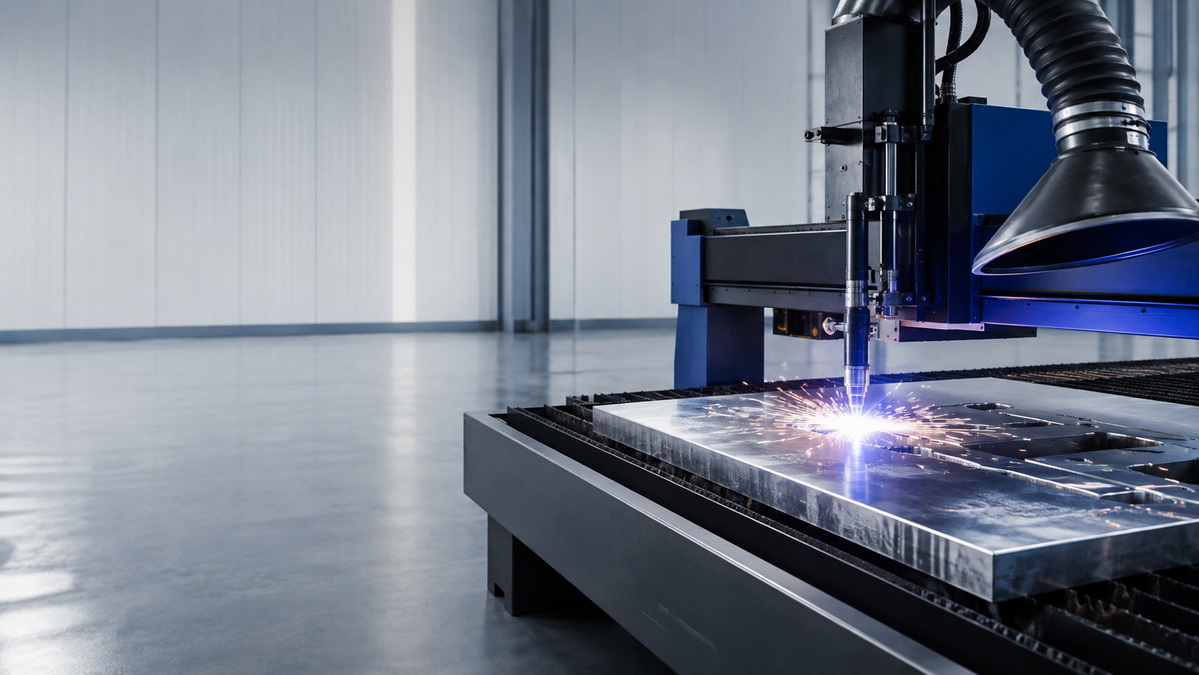
Plasma cutting is a thermal manufacturing process. The machine uses electricity to transform gas into plasma, which is capable of melting conductive metal at high speed.
A typical aluminum plasma cutting system includes:
- Plasma power source
- CNC cutting table
- Torch and torch-height controller
- Gas supply system
- Consumables such as electrodes and nozzles
- Fume extraction or water-table equipment
- CAD/CAM nesting and programming software
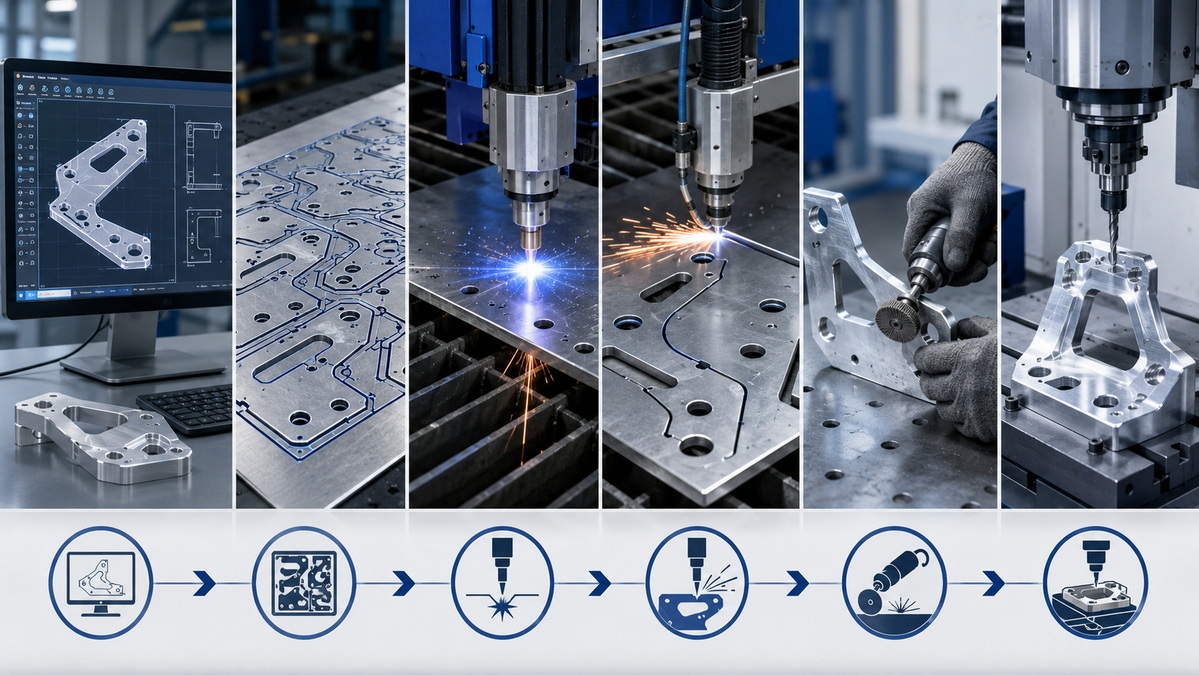
The overall process follows several stages.
An electrical arc forms between the torch electrode and the aluminum workpiece. Gas passing through the torch becomes ionized and turns into plasma.
The plasma arc reaches a temperature high enough to melt aluminum quickly. Because aluminum conducts electricity, it completes the electrical circuit required for the cutting process.
For internal holes, slots, and closed profiles, the torch begins with a pierce. The pierce creates an opening through the plate before the torch follows the programmed cutting path.
Piercing is often more demanding than edge-start cutting. It can increase wear on consumables and may leave a visible mark near the pierce location. Proper lead-in placement helps move this mark away from critical edges or visible surfaces.
Once the arc is stable, the CNC cutting table moves the torch along the programmed geometry. Cutting speed, stand-off distance, amperage, gas flow, and torch angle all affect the final edge quality.
When these settings are properly controlled, plasma cutting can produce accurate and efficient aluminum profiles suitable for many fabrication applications.
Many aluminum parts require more than one process. A plasma-cut blank may move to deburring, bending, welding, machining, powder coating, anodizing, or assembly.
For example, a large aluminum mounting plate may be plasma cut to create the outside profile and noncritical openings. Precision bores, bearing surfaces, and alignment features can then be finished with CNC machining.
This combined approach often reduces overall machining time while maintaining control over the dimensions that matter most.
Plasma cutting can produce reliable results, but edge condition varies according to the equipment, material, thickness, gas process, and operating parameters.
A plasma-cut edge may be highly suitable for a welded structure, industrial enclosure, transport component, or powder-coated part. It may be less suitable for a polished consumer product, a tight press-fit feature, or an exposed edge with demanding cosmetic requirements.
The key is to define what "quality" means for the individual part.
| Requirement | Plasma Cutting Suitability | Recommended Approach |
|---|---|---|
| Thick aluminum plate | Excellent for many applications | Use CNC plasma cutting |
| Large structural profile | Strong option | Add machining only where required |
| Tight-tolerance features | Limited without secondary work | Finish critical areas by CNC machining |
| Fine internal details | May be challenging | Consider laser cutting |
| Cosmetic exposed edges | May need cleanup | Add deburring, grinding, or use laser |
| Welded assemblies | Suitable with proper edge preparation | Specify welding requirements early |
| High-volume repeated parts | Effective with automated nesting | Validate first-article quality |
Several visible edge characteristics should be considered during part planning:
- Kerf width: Plasma cutting removes a wider path of material than some fine-detail cutting processes.
- Edge taper: The cut edge may not be perfectly perpendicular if height, speed, or consumables are not controlled.
- Dross: Molten material can adhere to the underside of the cut if the parameters are unsuitable.
- Oxidation: Certain gas choices can create oxide layers that may require cleaning before welding or finishing.
- Heat-affected zone: The area near the cut is exposed to thermal energy and may behave differently from the base material.
The best manufacturing approach is to identify critical edges and dimensions before quoting. Not every feature requires the same level of precision or finishing. Applying tight requirements only where they affect function can improve production efficiency and control cost.
Gas selection has a major influence on cut quality, operating cost, edge condition, and consumable life.
Compressed air may be used for some aluminum-cutting applications, especially where the requirement is general fabrication rather than premium edge quality. However, air can create an oxidized edge and may not be the best option for parts that will be welded or require a smooth finished surface.
Nitrogen-based cutting processes are commonly used for aluminum. The appropriate gas combination depends on the plasma system, material thickness, desired cut quality, and operating conditions.
In practice, manufacturers should use the cutting charts provided by the plasma equipment supplier. These charts are designed for the exact power source, torch, consumables, gas process, and material thickness being used.
The following variables should be controlled during aluminum plasma cutting:
- Amperage: Must match material thickness and consumable selection.
- Travel speed: Excessively slow cutting can increase dross and heat input. Excessively fast cutting may create incomplete cuts or lag lines.
- Torch height: Incorrect stand-off distance can lead to bevel, uneven edges, and reduced consumable life.
- Pierce height and delay: Poor piercing settings can damage consumables and create inconsistent internal features.
- Consumable condition: Worn electrodes and nozzles reduce cut consistency.
- Lead-in position: A well-designed lead-in protects critical edges from pierce marks.
- Direction of travel: Consistent movement supports smoother, more uniform cut surfaces.
A production-ready setup should be validated with sample cuts before full-scale manufacturing begins.
Plasma cutting and laser cutting are both useful aluminum-processing methods. Neither is automatically superior in every situation.
The right choice depends on material thickness, edge-quality expectation, feature complexity, tolerance requirements, production volume, and budget.
| Factor | CNC Plasma Cutting | Laser Cutting |
|---|---|---|
| Suitable materials | Conductive metals only | Metals and selected nonmetal materials |
| Best use case | Medium and thick aluminum plate | Thin sheet, fine details, narrow kerfs |
| Cutting speed | Highly productive on suitable plate thicknesses | Fast and precise for many thin-sheet applications |
| Edge condition | Good but may need secondary finishing | Typically cleaner for fine-detail work |
| Feature detail | Suitable for standard industrial profiles | Better for small holes and intricate geometry |
| Tolerance potential | Depends on machine and setup | Generally stronger for fine tolerances |
| Cost profile | Often attractive for thicker parts | Often preferred for detailed thin-sheet parts |
| Secondary machining | Common for precision features | Still required for ultra-precision requirements |
Plasma cutting is often a practical choice when the part includes:
- Medium- or thick-gauge aluminum plate.
- Large external contours.
- Structural or industrial applications.
- Moderate tolerances.
- Welded or powder-coated assemblies.
- Features that can be finished later by machining.
- Production quantities that benefit from automated nesting.
Laser cutting may be preferable when the part requires:
- Thin aluminum sheet.
- Fine slots, small holes, or intricate details.
- Narrow kerfs.
- Minimal visible edge cleanup.
- High cosmetic expectations.
- Tight feature spacing.
- Complex profiles that need consistent repeatability.
Waterjet cutting is another useful option when heat input must be minimized. It is particularly valuable for heat-sensitive materials, thick materials with demanding edge requirements, or parts where thermal distortion must be avoided.
The trade-off is that waterjet cutting can be slower and may have a different operating-cost profile than plasma or laser cutting.

A high-quality aluminum part begins with a clear drawing and a manufacturable design. Buyers can reduce revision cycles by providing complete information early in the project.
1. Material grade and temper.
2. Material thickness.
3. Surface condition, such as mill finish, anodized, coated, or tread plate.
4. Critical dimensions and tolerances.
5. Hole diameters and positional tolerances.
6. Features that will be threaded, reamed, or machined after cutting.
7. Edges that will be welded or sealed.
8. Cosmetic surfaces that must remain clean after fabrication.
9. Finishing requirements.
10. Required quantity and expected repeat-order volume.
11. Inspection requirements, including first-article inspection or material certification.
Not every detail should be designed around the cutting process alone. A successful aluminum component considers the complete manufacturing route.
For example:
- Large external profiles can be plasma cut efficiently.
- Tight holes can be drilled or machined afterward.
- Bent features should include suitable bend allowances and reliefs.
- Welded edges should be specified for proper preparation.
- Cosmetic areas may require different cutting or finishing methods.
- Precision datum surfaces may need machining after fabrication.
This approach allows the manufacturer to apply the most efficient process to each feature rather than forcing one process to handle every requirement.
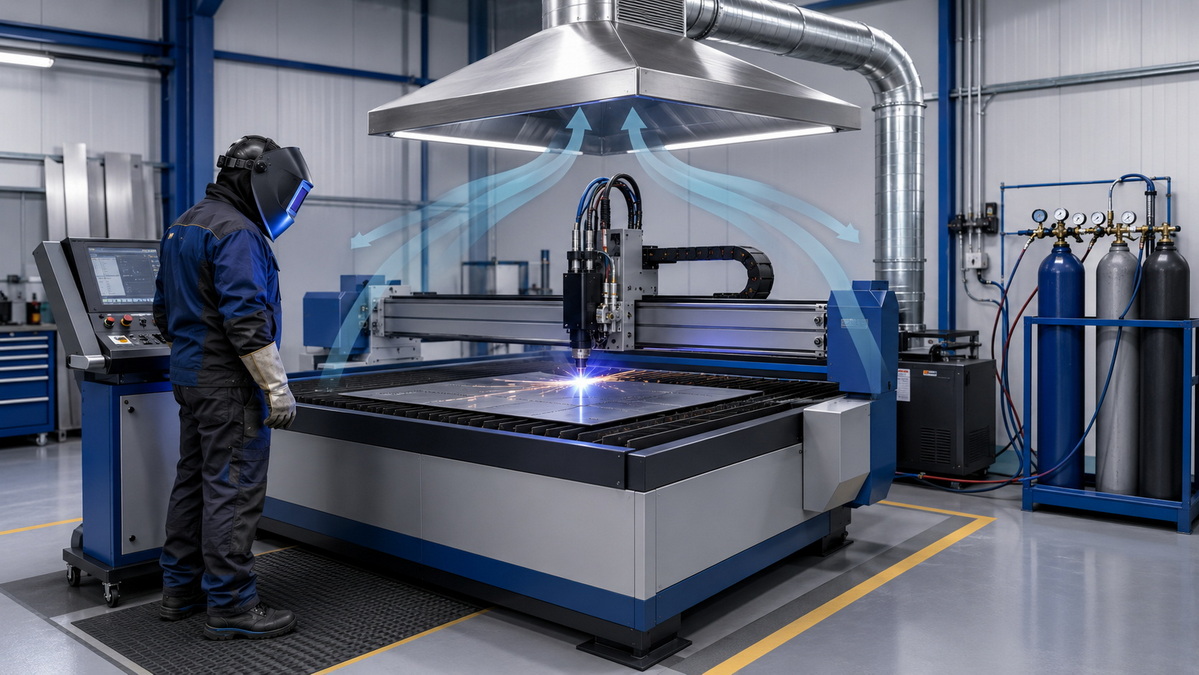
Aluminum plasma cutting involves high temperatures, electrical energy, intense light, molten material, fumes, noise, and gas-management requirements.
Operators should use suitable personal protective equipment, machine guards, fume-control systems, electrical safety procedures, and documented operating practices.
Special care is required when cutting aluminum on or under water.
Under certain conditions, the interaction between aluminum, water, and the cutting process can generate hydrogen. If hydrogen accumulates beneath a plate or within a poorly ventilated table structure, it can create a serious explosion hazard.
The risk depends on the alloy, cutting system, gas process, water-table design, ventilation, and whether hydrogen can safely dissipate.
Aluminum-lithium alloys require particularly strict controls and should not be cut in the presence of water.
- Follow the equipment manufacturer's operating manual.
- Use approved cutting charts for the material thickness and gas process.
- Confirm alloy information before beginning production.
- Do not assume a standard water table is suitable for aluminum.
- Verify that hydrogen cannot accumulate in enclosed table areas.
- Maintain appropriate dry or wet fume-control systems.
- Keep flammable materials away from the cutting zone.
- Inspect torches, leads, gas connections, and consumables regularly.
- Use appropriate eye, face, hand, body, hearing, and foot protection.
- Establish documented controls for high-risk materials and cutting conditions.
Safety planning should be specific to the machine, facility, material, and process. A qualified production team should evaluate each setup before cutting begins.
Aluminum components often require multiple processes before they become finished products. Selecting a manufacturing partner with integrated capabilities can reduce handoffs, simplify communication, and improve consistency from prototype through production.
U-Need supports custom manufacturing projects with capabilities that include:
- Custom precision parts machining.
- CNC milling and turning.
- Mold manufacturing.
- Injection molds.
- Stamping dies.
- Cold-forging dies.
- Laser cutting.
- Sheet metal bending.
- Metal stamping.
- Production-oriented finishing and assembly support.
For a custom aluminum project, the production route may combine plasma cutting for fast profile creation, CNC machining for critical dimensions, bending for formed geometry, and finishing for corrosion resistance or appearance.
This flexibility is especially useful for global brands, distributors, and manufacturers that need a practical balance between quality, delivery stability, and total manufacturing cost.
Plasma cutting is a capable and efficient process for aluminum fabrication. It performs especially well for medium- and thick-gauge plate, large profiles, structural parts, and components that do not require ultra-fine edge quality directly from the cutting table.
The strongest results come from matching the process to the part. Material grade, thickness, tolerances, weld requirements, surface finish, downstream machining, and safety controls should all be reviewed before production begins.
For projects that involve more than one manufacturing operation, an integrated process can often deliver better value than treating cutting, machining, forming, and finishing as separate decisions.
Share your drawing, material specification, quantity, tolerance requirements, and finishing expectations with U-Need to evaluate the most suitable manufacturing route for your aluminum parts.
Yes. Aluminum is electrically conductive, which makes it compatible with plasma cutting. The process can be used for aluminum sheet, plate, structural components, brackets, panels, and custom profiles.
It can. Dross is more likely when cutting speed, torch height, gas flow, amperage, or consumable condition is not properly controlled. A suitable process setup can significantly reduce dross and secondary cleanup work.
Yes, but the edge may require cleaning before welding. Oxides, dross, contamination, and rough surfaces can affect weld preparation. Manufacturers should know in advance which edges will be welded.
It can be used for thin aluminum, but laser cutting is often preferred when the part requires fine details, small holes, narrow kerfs, or a cleaner cosmetic edge.
It can be, particularly for thicker aluminum plate and larger industrial profiles. The final cost depends on material thickness, geometry, edge-quality requirements, production quantity, and required secondary operations.
Plasma cutting can provide reliable dimensional accuracy for many fabrication applications. However, precision bores, close-fit features, and critical datum surfaces are often best finished by CNC machining after cutting.
It requires careful engineering controls. Aluminum cutting in or over water can generate hydrogen under certain conditions. The table design, ventilation, gas process, material alloy, and operating procedure must be evaluated before use.
1. RapidDirect. [Can Plasma Cut Aluminum? Basic Guide] [rapiddirect]
2. Hypertherm. [Plasma Cutting Aluminum] [hypertherm]
3. The Fabricator. [Misconceptions About Plasma Cutting Aluminum] [thefabricator]
4. Xometry. [Laser Cutting vs. Plasma Cutting: Speed, Materials, Cost, and More] [xometry]
5. RapidDirect. [Laser Cutting vs. Plasma Cutting: A Detailed Guide] [rapiddirect]
6. U-Need. [High-Precision CNC Machining Services and Custom Parts] [uneedpm]


