Views: 239 Author: U-Need Publish Time: 2026-09-04 Origin: Site
Content Menu
● Casting vs. Machining: Main Differences
● When Is Casting the Better Choice?
>> Complex Geometry and Internal Cavities
>> Stable High-Volume Production
>> Near-Net-Shape Material Efficiency
● When Is CNC Machining the Better Choice?
>> Prototypes and Low-Volume Production
>> Tight Tolerances and Precision Features
● Why Cast-and-Machine Manufacturing Often Works Best
>> Example: Gearbox Housing Production
● Design Guidelines for Cast Parts
● Design Guidelines for Machined Parts
● How to Choose Between Casting and Machining
>> 1. Define the Part Function
>> 2. Identify Critical Features
>> 3. Compare Total Manufacturing Cost
>> 4. Assess Production Volume Carefully
>> 5. Review the Design Before Production
>> Is casting cheaper than CNC machining?
>> Can cast parts meet tight tolerances?
>> Is CNC machining better for aluminum parts?
>> Are machined parts stronger than cast parts?
>> Can CNC machining create internal channels?
>> Should prototypes be machined before casting tooling is made?
>> What files are needed for a casting or machining quotation?
Choosing between metal casting and CNC machining is one of the most important decisions in custom part development. The right manufacturing method affects cost, lead time, dimensional accuracy, material performance, tooling investment, and long-term production scalability.
For global brands, distributors, and manufacturers, the best choice is rarely based on unit price alone. A part that appears inexpensive at the quotation stage may become costly if it requires frequent design changes, extensive finishing, secondary operations, or expensive tooling modifications.
In many projects, the strongest solution is not casting or machining alone. It is a hybrid manufacturing approach: create a near-net-shape casting for the main body, then machine only the surfaces and features that require high precision.
This guide compares casting and machining in practical terms, helping engineers, procurement teams, and product developers choose the most suitable process for their production requirements.
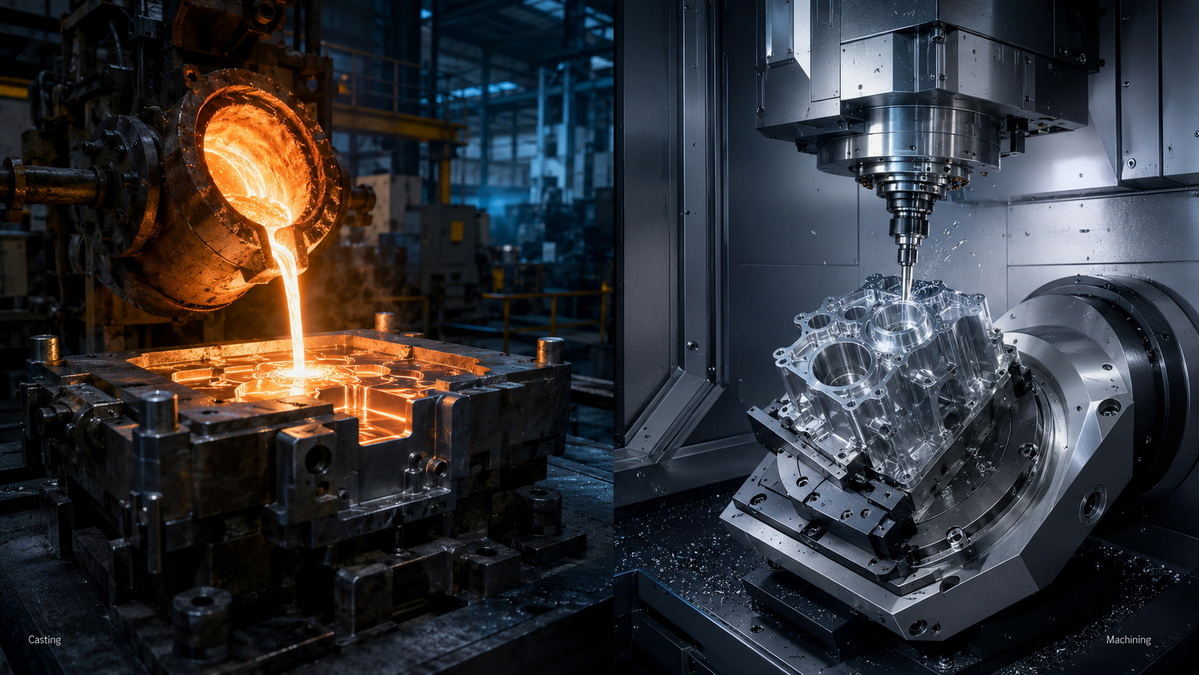
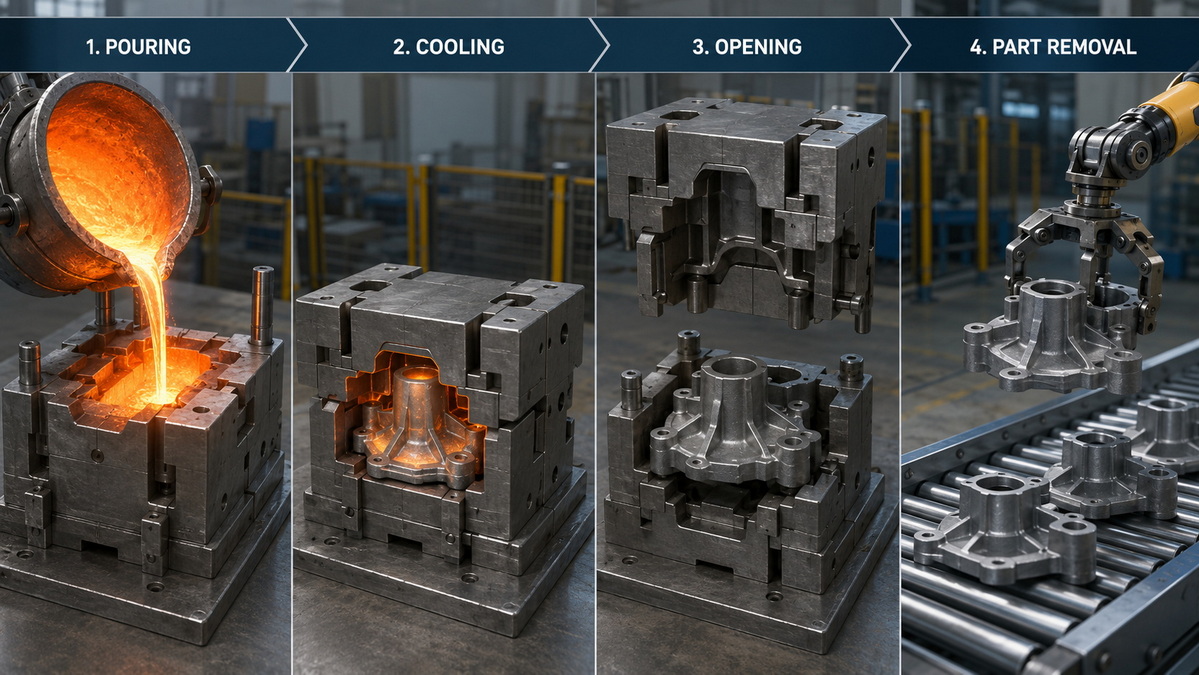
Metal casting is a manufacturing process that forms parts by pouring or injecting molten metal into a mold cavity. After the metal cools and solidifies, the part is removed from the mold and may receive additional finishing, machining, heat treatment, or surface treatment.
Casting is widely used for parts that require complex geometry, internal cavities, curved surfaces, ribs, bosses, or large dimensions that would be expensive to machine from solid stock.
Common metal casting processes include:
- Sand casting: Suitable for large parts, lower-volume production, and ferrous alloys such as iron and steel.
- Die casting: Often used for high-volume aluminum, zinc, and magnesium components.
- Investment casting: Suitable for intricate shapes, fine details, and parts requiring relatively good surface quality.
- Permanent mold casting: Uses reusable metal molds to improve repeatability and surface finish.
- Vacuum casting: Commonly used for prototype and low-volume polymer parts where appearance and functional testing are important.
Casting enables engineers to create near-net-shape components. This means the part can be produced close to its final shape before any secondary machining begins. The result may be lower material waste and less machining time, particularly for complex or heavy parts.
However, casting must be designed carefully. Wall thickness, draft angles, parting lines, shrinkage, feeding, cooling behavior, and machining allowance all influence the quality and manufacturability of the final component.
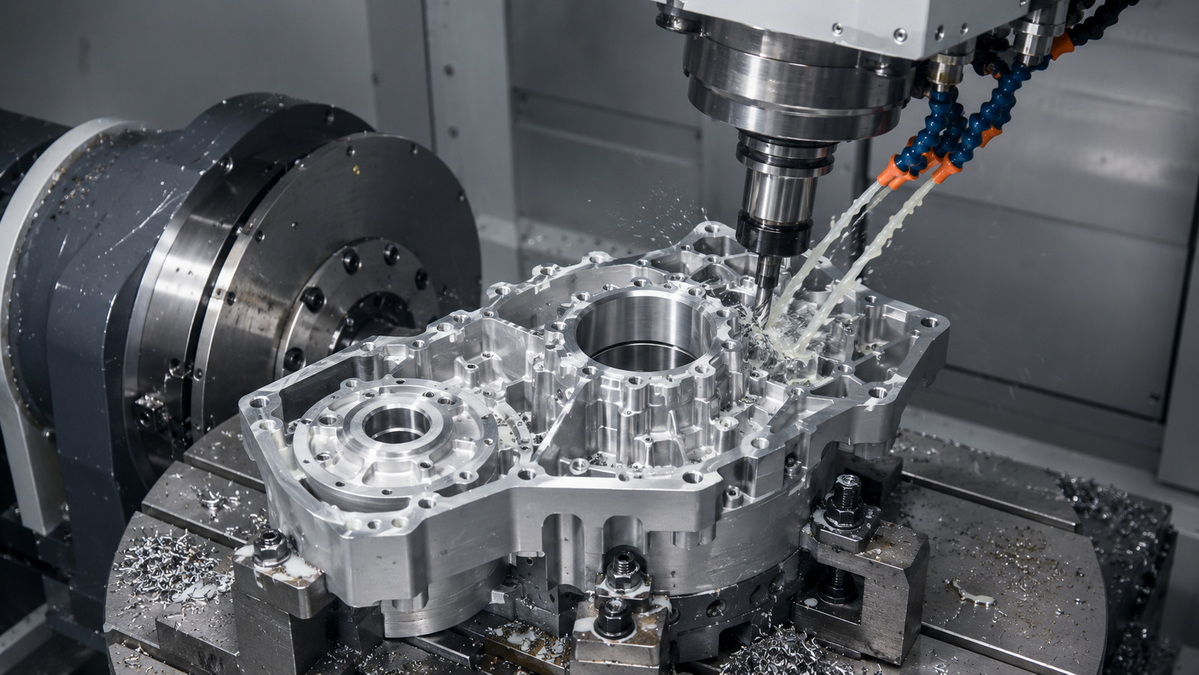
CNC machining is a subtractive manufacturing process. A machine removes material from a solid block, bar, plate, tube, or preformed blank to produce the final part.
The process uses programmed cutting tools to create features such as holes, slots, pockets, threads, bores, curved profiles, and precision surfaces.
Common CNC machining operations include:
- CNC milling: Used for flats, pockets, slots, profiles, and complex three-dimensional surfaces.
- CNC turning: Used for shafts, cylindrical components, threads, cones, and rotational parts.
- Drilling and tapping: Used for threaded holes, mounting holes, and internal features.
- Grinding: Used when very tight tolerances or fine surface finishes are required.
- EDM machining: Used for difficult-to-machine materials, narrow slots, sharp internal corners, and hardened tooling components.
CNC machining is highly suitable for prototypes, low-to-medium production volumes, replacement parts, and products that require frequent engineering changes.
For example, a precision aluminum enclosure may need accurately positioned threaded holes, flat sealing faces, and a tight-tolerance bore. CNC machining can produce these features directly from aluminum stock without requiring dedicated mold tooling.
Casting and machining can both produce high-quality metal parts, but they deliver value in different ways.
| Factor | Metal Casting | CNC Machining |
|---|---|---|
| Manufacturing principle | Forms molten metal inside a mold or die | Removes material from a solid workpiece |
| Initial investment | Usually requires mold, pattern, or die tooling | Usually requires programming, cutting tools, and fixtures |
| Best production volume | Medium to high-volume production | Prototypes, low-volume, and medium-volume production |
| Part complexity | Strong for complex shapes and internal cavities | Strong for accessible features and precision geometry |
| Dimensional accuracy | Moderate to high, depending on the casting method | High to very high |
| Surface finish | Often requires finishing or secondary machining | Usually provides a better machined finish |
| Design changes | Can be expensive after tooling is completed | Easier to revise through CAD and CNC programming |
| Material waste | Often lower because of near-net-shape production | Higher because material is removed as chips |
| Lead time | Longer when tooling must be designed and manufactured | Faster for prototype and low-volume orders |
| Scalability | Excellent once tooling is approved | Effective for small batches and controlled production runs |
Casting is often the better manufacturing process when production volume, part geometry, and long-term cost targets justify the investment in tooling.
Casting can create shapes that are difficult or costly to produce through CNC machining. These may include:
- Internal fluid channels.
- Hollow structures.
- Complex ribs and bosses.
- Curved external surfaces.
- Enclosed cavities.
- Thick-to-thin transitions.
- Integrated mounting features.
- Large, lightweight structures.
For example, a pump housing may require internal channels for fluid flow, external mounting points, reinforcing ribs, and a large cavity for internal components. Producing this part from a solid aluminum block could require long machining cycles and extensive material removal. Casting can form the basic geometry much more efficiently.
Casting becomes more attractive when annual demand is high and the design is stable. Once mold or die tooling is completed, the manufacturer can produce large quantities of repeatable parts with a lower cost per unit.
This is especially true for aluminum die casting, zinc die casting, and permanent mold casting.
Before investing in tooling, buyers should consider:
- Expected annual volume.
- Product life cycle.
- Design maturity.
- Part size and material.
- Required tolerances.
- Surface finish requirements.
- Secondary machining needs.
- Tooling maintenance expectations.
A casting die is a long-term production asset. It is most valuable when the part design has already been tested and approved.
Casting can reduce the amount of material removed during manufacturing. A near-net-shape component starts close to the final geometry, so less machining may be needed.
This advantage is particularly important for larger parts, expensive alloys, and components with significant internal volume.
However, casting also requires energy for melting, holding, pouring, and cooling metal. The total environmental impact should be assessed based on material recovery, production volume, energy use, scrap rate, transport distance, and expected product life.
CNC machining is often the stronger choice when the project needs flexibility, fast development, tight tolerances, or smaller production quantities.
CNC machining is ideal for prototypes because it does not require dedicated mold or die tooling. After the design is finalized, a machining program can be created and production can begin without waiting for a casting tool to be built.
This makes machining suitable for:
- Functional prototypes.
- Engineering validation parts.
- Pilot production.
- Bridge production.
- Spare parts.
- Custom equipment.
- Specialized industrial components.
- Low-volume product variants.
For example, a machinery manufacturer may need 30 custom brackets for a new automation system. CNC machining can produce these brackets quickly, allowing the engineering team to test fit, assembly, load performance, and installation before making a larger production commitment.
CNC machining offers excellent control over dimensions, surface finish, and feature location. It is particularly effective when parts require:
- Precision bores.
- Bearing seats.
- Threaded holes.
- Flat sealing surfaces.
- O-ring grooves.
- Accurate hole positioning.
- Controlled concentricity.
- Fine surface finishes.
- Tight geometric tolerances.
Many cast components still require CNC machining after casting because certain functional features cannot rely solely on the as-cast condition.
For example, a cast gearbox housing may include the main cavity, ribbing, and mounting structure. However, the bearing seats, flange face, threaded holes, and sealing surfaces are commonly machined after casting.
Design flexibility is one of the strongest advantages of CNC machining.
If a customer changes hole positions, wall thickness, mounting patterns, or external geometry, the CNC program can usually be updated without rebuilding a complete mold or die.
This is valuable when:
- Product development is still ongoing.
- Customer feedback may change the design.
- Testing may reveal performance improvements.
- Demand forecasts are uncertain.
- Several product variants are planned.
- The design requires lightweighting or optimization.
For many manufacturers, CNC machining is the lower-risk starting point. Once the design and market demand are proven, the part can be reviewed for casting, forging, stamping, or other production-scale processes.
For many industrial products, the most practical solution is a combination of casting and CNC machining.
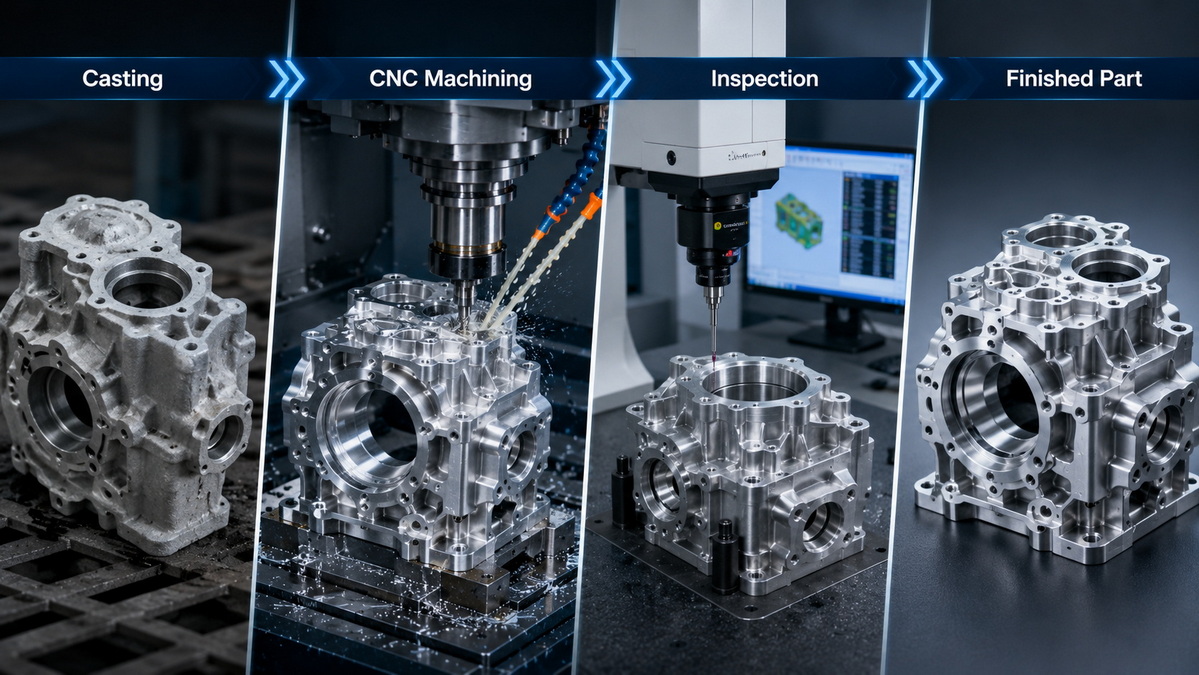
The process begins by producing a cast blank that forms the basic shape of the component. CNC machining is then used only for the surfaces and features that require strict dimensional control.
This method can reduce machining time while maintaining the precision required for critical functional areas.
Typical post-casting machining features include:
- Bearing bores.
- Threaded mounting holes.
- Shaft interfaces.
- Sealing faces.
- O-ring grooves.
- Datum surfaces.
- Precision pockets.
- Flange faces.
- High-accuracy hole patterns.
A gearbox housing often requires complex external ribs, oil passages, mounting points, and internal cavities. These features make casting an efficient way to produce the main structure.
At the same time, the part may require precise bearing locations, accurately machined mounting holes, flat sealing surfaces, and controlled shaft alignment.
A practical manufacturing route may include:
1. Designing the housing for casting with suitable wall thickness and draft angles.
2. Building the required mold, pattern, or die tooling.
3. Producing the cast housing blank.
4. Performing heat treatment or surface preparation if needed.
5. CNC-machining critical dimensions and functional surfaces.
6. Conducting dimensional inspection, leak testing, and final quality checks.
This approach combines the design freedom and high-volume efficiency of casting with the accuracy and consistency of CNC machining.
Good casting design helps reduce defects, improves production consistency, and lowers the risk of costly tooling revisions.
Consider the following guidelines when designing cast components:
- Use consistent wall thickness wherever practical.
- Add draft angles so the part can be removed from the mold or die.
- Avoid sharp internal corners and use radii instead.
- Reduce abrupt thick-to-thin wall transitions.
- Consider the location of parting lines early in the design process.
- Identify surfaces that require secondary machining.
- Include machining allowance for critical features.
- Review internal cavities and core requirements before tool design.
- Define inspection requirements before production begins.
- Consider how molten metal will flow, cool, and solidify inside the mold.
Porosity, shrinkage, warpage, incomplete filling, and surface defects can occur if the component design and casting process are not properly aligned. Early engineering review helps reduce these risks before tool manufacturing begins.
Good CNC design can shorten cycle times, reduce tooling costs, and improve repeatability.
Consider these machining guidelines:
- Avoid unnecessarily deep and narrow pockets.
- Use standard drill sizes when possible.
- Avoid internal corners with zero radius.
- Limit unnecessary tight tolerances.
- Keep thin walls practical for the selected material.
- Design threads that can be accessed by standard cutting tools.
- Use common materials when supply availability matters.
- Minimize the number of machine setups.
- Design features so cutting tools can reach them efficiently.
- Identify critical datums and inspection points clearly.
One of the most common cost issues is applying tight tolerances to every dimension. Instead, define tight control only for features that affect function, assembly, sealing, movement, or alignment.
The best manufacturing process depends on the part's functional requirements, geometry, quantity, material, and cost target.
Use the following process to make a more informed decision.
Start by identifying what the part must do.
Does it need to:
- Carry structural loads?
- Hold fluid or gas pressure?
- Dissipate heat?
- Protect electronic components?
- Support bearings or rotating shafts?
- Resist corrosion?
- Meet cosmetic appearance requirements?
- Connect with other precision components?
The manufacturing process should support the part's required performance rather than simply follow an initial production preference.
Separate part features into functional and non-functional categories.
Functional features often include:
- Bearing seats.
- Sealing surfaces.
- Precision bores.
- Threaded holes.
- Mating faces.
- Alignment holes.
- Critical wall thicknesses.
- Datum references.
Non-critical features may include external ribs, clearance areas, cosmetic surfaces, and non-mating contours.
This distinction helps determine whether a cast blank can meet most requirements before critical features are machined.
Do not compare only the quoted unit price. Compare the full cost of production, including:
- Tooling investment.
- Prototype cost.
- Raw material cost.
- Machine time.
- Secondary operations.
- Surface treatment.
- Inspection requirements.
- Scrap rate.
- Packaging and logistics.
- Tool maintenance.
- Cost of future design revisions.
A part with a lower unit price may not be the best long-term choice if it requires expensive tooling changes or complex post-processing.
Production volume is one of the most important selection factors.
- Low and uncertain volume: CNC machining is often more practical.
- Medium volume: Compare machining with cast-and-machine manufacturing.
- High and stable volume: Casting may deliver better long-term unit economics.
- Very high-volume repeat production: Die casting can offer strong consistency and efficiency after tooling approval.
The break-even point is different for every part. It depends on geometry, material, machine cycle time, casting complexity, secondary machining, tooling cost, and quality requirements.
Before committing to any production method, conduct a detailed manufacturability review.
A complete review should consider:
- Material selection.
- Tolerances.
- Wall thickness.
- Draft angles.
- Internal cavities.
- Tool accessibility.
- Surface finish.
- Assembly interfaces.
- Inspection requirements.
- Expected annual production volume.
This early review can prevent unnecessary tooling investment, reduce part cost, and improve production reliability.
There is no universal answer to the casting vs. machining decision.
CNC machining is generally the better choice for prototypes, low-to-medium volumes, engineering flexibility, tight tolerances, and highly precise functional features.
Metal casting is generally the better choice for complex near-net-shape geometry, internal cavities, stable high-volume production, and lower per-part cost after tooling is spread across large quantities.
Cast-and-machine manufacturing is often the best solution for industrial parts that require both scalable production economics and critical precision features.
U-Need supports global customers with custom precision parts machining, mold manufacturing, injection molds, stamping dies, cold-forging dies, laser cutting, bending, stamping, and sheet metal fabrication. Share your drawings, 3D files, material specifications, tolerances, and estimated annual quantities to determine the most suitable manufacturing route for your project.
Casting can be more cost-effective for high-volume production because mold or die tooling costs can be distributed across a large number of parts. CNC machining is often more economical for prototypes, small batches, and projects with uncertain demand because it requires less dedicated tooling.
Some casting processes can achieve good dimensional consistency, but critical features such as bearing bores, sealing surfaces, threads, and precision mounting interfaces often require secondary CNC machining.
CNC machining is excellent for aluminum prototypes, precision components, custom parts, and lower-volume orders. Aluminum die casting is often more suitable for high-volume production when the design is stable and the part has complex geometry.
The answer depends on the material, alloy, heat treatment, casting method, and loading conditions. Machined parts retain the properties of the original stock material, while cast-part performance depends on alloy composition, cooling behavior, internal structure, and quality control.
CNC machining can create open channels and accessible internal features. However, enclosed or highly complex internal passages can be difficult and expensive to machine from solid material. Casting can be more suitable when cores can form those internal features.
In many cases, yes. Machined prototypes allow engineers to validate assembly, fit, function, strength, and performance before investing in casting tooling. This can reduce the risk of expensive tool modifications later.
A complete quotation package should include a 3D CAD file, such as STEP, IGES, or X_T; a 2D drawing with tolerances; material requirements; surface finish requirements; estimated annual quantity; quality requirements; and delivery expectations.
1. RapidDirect. "[Casting vs Machining: Which One to Choose?]"
2. ASM International. "[Casting Design and Geometry]"
3. ASM International. "[Process Capability and Tolerances]"
4. ASM International. "[Aluminum Castings Engineering Guide]"
5. U.S. Department of Energy. "[Metalcasting]"
6. National Institute of Standards and Technology. "[Porosity in Metal Manufacturing and Process Monitoring]"
7. National Institute of Standards and Technology. "[The Tightening of Porous Castings]"


