Views: 241 Author: U-Need Publish Time: 2026-08-03 Origin: Site
Content Menu
>> Main features of climb milling
● What Is Conventional Milling?
>> Main features of conventional milling
● Climb Milling vs Conventional Milling
● Why Climb Milling Is Often Preferred
>> Advantages of climb milling
● When Conventional Milling Is the Better Choice
>> When to choose conventional milling
● How Machine Rigidity Affects the Choice
>> Simple rule
● Material and Application Considerations
>> Typical guidance by material
● Expert View from the Shop Floor
● Why This Matters in Precision Manufacturing
● FAQ
>> 1. What is the main difference between climb milling and conventional milling?
>> 2. Which method gives a better surface finish?
>> 3. Is climb milling always the better choice?
>> 4. Why do older machines often use conventional milling?
>> 5. Which method is better for thin parts?
>> 6. Can both methods be used in one job?
Climb milling vs conventional milling is one of the most important process choices in CNC machining. The direction you choose affects surface finish, cutting force, chip flow, tool wear, stability, and part quality.
For precision manufacturing, the right milling strategy depends on the machine, fixture, material, and target finish. In many modern CNC applications, climb milling is the preferred option, but conventional milling still has an important role in specific situations.
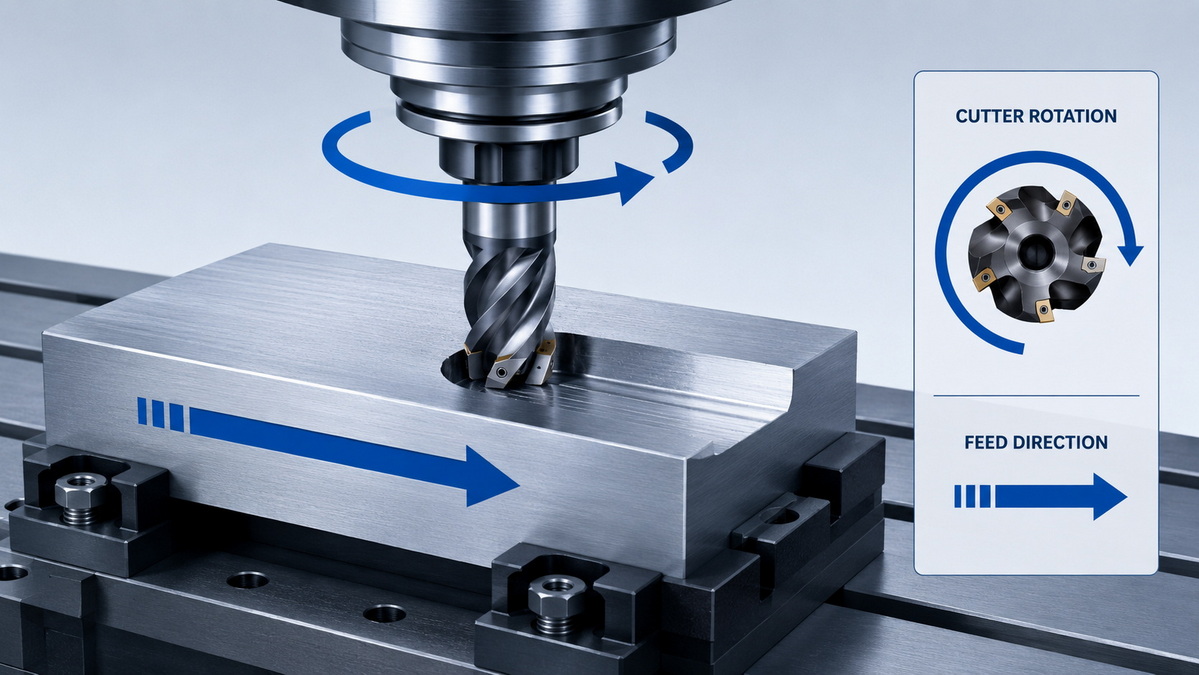
Climb milling, also called down milling, means the cutter rotates in the same direction as the feed. The chip starts thick and becomes thinner as the tooth leaves the cut.
This method is commonly used on rigid CNC machines because it can improve finish quality and reduce rubbing. It also helps chips move away from the cutting zone instead of being pushed into the finished surface.
- The cutter enters the material at maximum chip thickness.
- Chips are carried behind the cutter.
- Cutting forces are usually lower.
- Surface finish is often smoother.
- It requires stable workholding and low backlash.
Conventional milling, also called up milling, means the cutter rotates against the feed direction. The chip starts thin and becomes thicker as the tooth exits the cut.
This method is often more forgiving on manual machines or older equipment. It is useful when the machine has backlash, when the setup is less rigid, or when the operator wants a more cautious cutting approach.
- The cutter begins with a thin chip load.
- Chips are pushed in front of the cutter.
- It is more tolerant of backlash.
- It may generate more heat and rubbing.
- It can be useful for unstable or lower-rigidity setups.
| Factor | Climb Milling | Conventional Milling |
|---|---|---|
| Feed direction | Same as cutter rotation | Opposite to cutter rotation |
| Chip thickness | Thick to thin | Thin to thick |
| Surface finish | Usually better | Usually rougher |
| Cutting force | Lower | Higher |
| Tool wear | Often lower | Often higher |
| Chip evacuation | Better | More chip re-cutting |
| Machine requirement | Rigid, low backlash | More forgiving |
| Workholding impact | Downward force can stabilize the part | Upward force can lift the part |
This comparison shows why climb milling is often preferred in modern CNC machining. However, conventional milling remains useful when machine stability is limited.
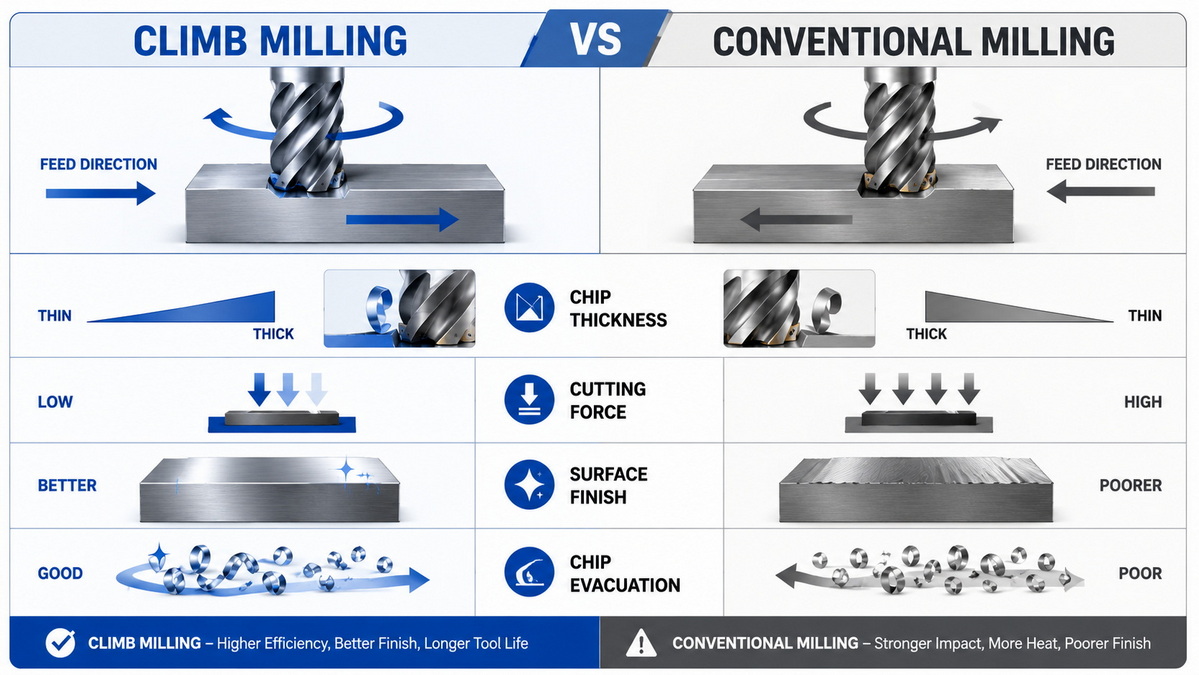
Climb milling is widely used because it improves efficiency and part quality. The cutter starts the cut with a thicker chip and leaves with a thinner one, which reduces rubbing and often lowers heat at the cutting edge.
It also helps chips leave the cutting area more cleanly. That reduces the chance of re-cutting chips, which can damage finish quality and shorten tool life.
- Better surface finish.
- Lower cutting force.
- Less rubbing at the start of the cut.
- Cleaner chip evacuation.
- Less chip re-cutting.
- Potentially longer tool life.
- Downward force can help stabilize thin parts in face milling.
For precision CNC parts, these advantages often translate into better consistency and higher productivity.
Conventional milling is still valuable in certain machining environments. It can be safer on machines with backlash because the cutter does not pull the table or part into the cut as aggressively.
It may also be useful when the setup is not rigid enough for climb milling, or when the workpiece or fixture cannot fully resist the pull-in action of the cutter.
- Older manual machines with backlash.
- Less rigid machine tools.
- Workpieces that cannot tolerate pull-in force.
- Some roughing operations on unstable setups.
- Situations where safety and control matter more than finish quality.
In these cases, conventional milling can provide more predictable cutting behavior.
The milling direction should always be matched to the machine condition. Machine rigidity, backlash, spindle condition, tool overhang, and fixture strength all affect cutting stability.
On a modern CNC machine with tight control and strong fixturing, climb milling usually performs better. On an older machine with looseness in the table or lead screw system, conventional milling is often the safer choice.
- Rigid CNC and strong fixture: climb milling is usually preferred.
- Backlash-prone or unstable setup: conventional milling may be safer.
This is why experienced machinists evaluate the entire setup before selecting toolpath direction.
Different materials respond differently to milling direction. Some materials benefit from the cleaner cutting action of climb milling, while others require more caution because of edge condition, hardness, or chip behavior.
- Aluminum: climb milling is commonly preferred for finish and chip evacuation.
- Mild steel: climb milling is often effective on rigid CNC machines.
- Stainless steel: climb milling can work well, but rigidity and tool selection are critical.
- Cast iron: either method may be used depending on setup and chip control.
- Work-hardened materials: strategy should be chosen carefully to avoid rubbing and edge damage.
For thin walls, deep pockets, and precision parts, milling direction should be selected together with feed rate, tool geometry, and clamping method.

If you are unsure which method to use, consider the following sequence:
1. Check machine backlash and rigidity.
2. Review fixture strength and part geometry.
3. Decide whether the job is roughing or finishing.
4. Consider the material and chip behavior.
5. Test with safe parameters before full production.
This simple approach helps reduce tool wear, scrap, and unstable cutting.
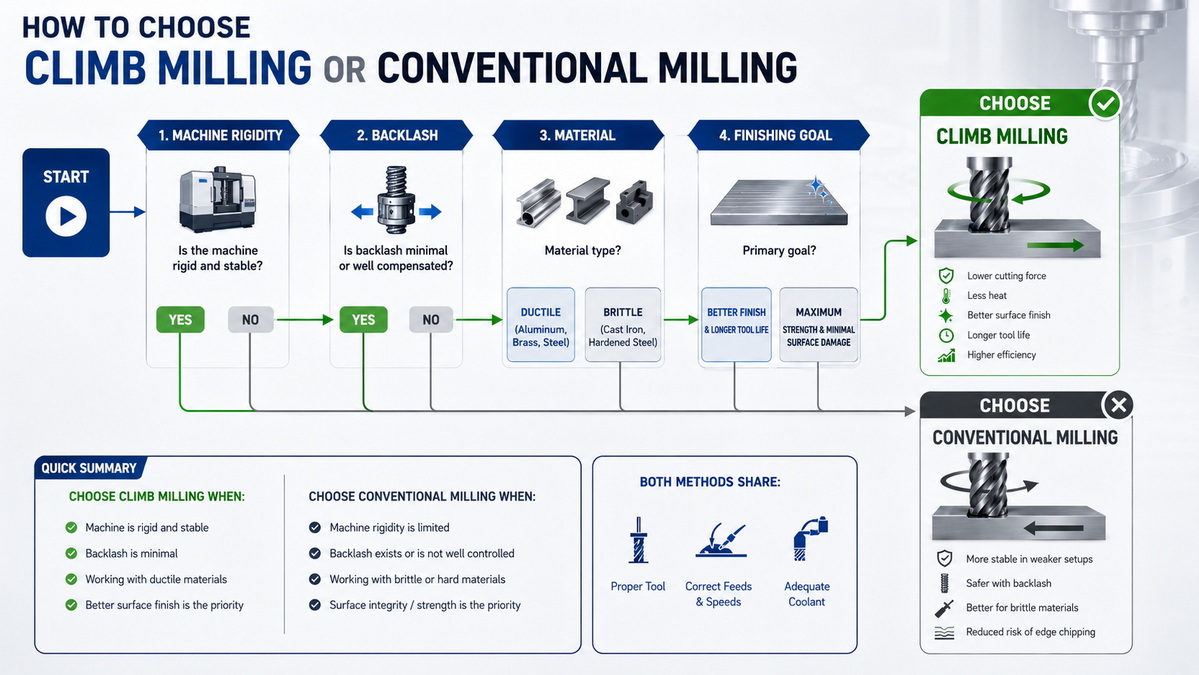
In real production, the choice is usually practical rather than theoretical. Machinists ask whether the machine is rigid enough, whether the part is securely clamped, and whether the toolpath will improve quality without adding risk.
If the setup is strong and the machine is stable, climb milling is usually the better choice. If the machine is loose or the part is difficult to hold, conventional milling may be the more reliable option.
For global buyers sourcing machined parts from China, milling direction affects quality, consistency, cost, and delivery performance. A wrong process choice can lead to poor finish, faster tool wear, unstable cuts, or dimensional issues.
At U-Need, precision machining means more than cutting metal. It means choosing the right process, controlling quality at every stage, and matching the machining strategy to the part's real requirements.
Whether the project involves custom precision parts machining, mold manufacturing, or sheet metal fabrication, milling direction is one of the process details that can influence the final result.
In most modern CNC environments, climb milling is the preferred choice because it usually gives better surface finish, lower cutting force, and more efficient chip removal. However, conventional milling still has value when the machine has backlash, the setup is less rigid, or the cutting condition requires more control.
The best strategy depends on the machine, the material, and the part structure. A good manufacturing partner will evaluate all of these before choosing the process.
If you are planning a precision machining project, U-Need can help you review the drawing, material, tolerance, and production method to determine the most suitable milling strategy.
Climb milling feeds in the same direction as cutter rotation, while conventional milling feeds against it. This changes chip thickness, cutting force, and surface finish.
Climb milling usually gives a better surface finish because it reduces rubbing and chip re-cutting.
No. It is usually better on rigid CNC machines, but it can be risky on machines with backlash or weak fixturing.
Older machines may have backlash. Conventional milling is more forgiving because it does not pull the table into the cut as aggressively.
Climb milling is often better if the setup is rigid, because the downward force can help stabilize the part.
Yes. Many machinists use both methods in the same part depending on whether they are roughing, finishing, or machining a sensitive feature.
1. [Climb Milling vs. Conventional Milling: Their Key Differences]
2. [Climb vs. Conventional Milling: Maximizing Efficiency in CNC Machining]
3. [Climb Milling vs Conventional Milling]


