Views: 241 Author: U-Need Publish Time: 2026-10-24 Origin: Site
Content Menu
● Why Source Tight Tolerance Machining in China?
>> What Recent Industry Data Shows
● Selection Criteria: How These Companies Were Evaluated
>> 1. Relevant Manufacturing Processes
>> 2. Engineering and Product Development Support
>> 3. Quality Control and Inspection
>> 4. Capacity and Delivery Transparency
>> 5. Certification and Compliance Relevance
● What "Tight Tolerance" Should Mean in Your RFQ
● Comparison Table: Capacity, MOQ, and Certification
● The Top 10 Tight Tolerance Machining Companies in China
>> 1. U-Need Precision Machinery Co., Ltd.
>> 2. WayKen Rapid Manufacturing
>> 6. DEK
>> 7. 3ERP
>> 10. Gensun Precision Machining
● Technical Buyer's Guide: Qualifying a Tight Tolerance Supplier
>> Specify Material Grade and Condition, Not Just Material Family
>> Separate Factory Certification From Product Compliance
>> Agree on Measurement Conditions
>> Qualify Production, Not Just the First Sample
● Common Procurement Pitfalls and How to Avoid Them
● An Overlooked Insider Check: Was the Part Measured Free or Restrained?
● Logistics and Commercial Controls for Precision Components
● Conclusion: Choose the Supplier That Can Prove the Process
● FAQ
>> 1. How can I verify whether a supplier's ISO certificate is current and covers the right factory?
>> 2. Can I place an order based on a supplier advertising ±0.001 mm?
>> 3. What should I do if the supplier's CMM report passes but my incoming inspection fails?
>> 4. How do I reduce the risk of receiving the wrong alloy or heat-treatment condition?
>> 5. How can I tell whether a supplier's capacity is real and available for my program?
China offers a broad supplier base for precision-machined components, but choosing a long-term manufacturing partner requires more than comparing quotations or advertised tolerances. Procurement teams need to evaluate factory certification, engineering support, material traceability, inspection capability, production capacity, and delivery performance together.
The companies below represent different sourcing options: flexible custom manufacturing partners, prototype specialists, digitally enabled production networks, and precision-machining suppliers. U-Need Precision Machinery Co., Ltd. appears first as the commissioning company and a relevant option for smaller brands requiring integrated customization—not as the winner of an independently audited ranking.
This guide prioritizes repeatability: the ability to manufacture conforming parts consistently across materials, production batches, finishing operations, and repeat orders.
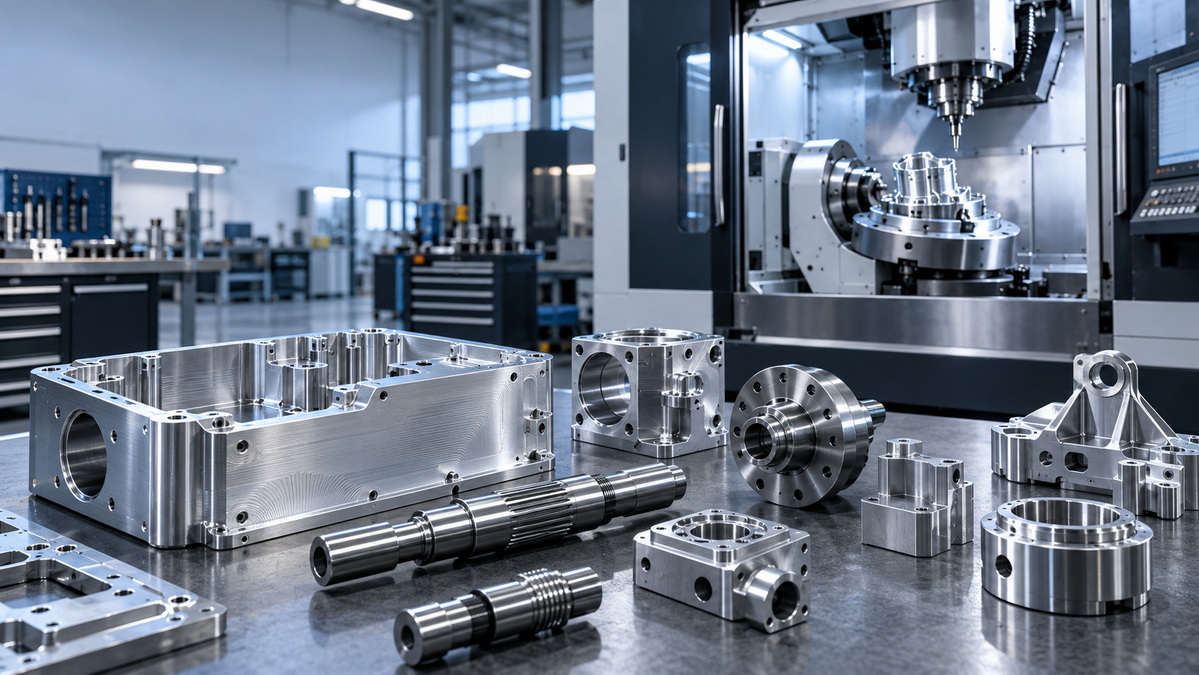
China's advantage extends beyond machining prices. Buyers can access machining, tooling, surface finishing, material supply, and assembly services within established manufacturing networks.
The suppliers examined here illustrate the concentration of custom manufacturing capabilities in Guangdong's Greater Bay Area:
- Shenzhen hosts suppliers such as WayKen, RapidDirect, and AT-Machining.
- Dongguan is home to U-Need, Runsom Precision, and Gensun's manufacturing operations.
- Zhongshan supports prototype and production providers including Star Rapid and 3ERP.
For buyers, this concentration can simplify coordination between machining and secondary processes. However, a supplier's location does not establish whether every operation is performed internally. Factory ownership, subcontracting arrangements, and inspection responsibility still require verification.
In its July 2025 China industry update, AMT—The Association For Manufacturing Technology—reported CMTBA statistics showing that China's machine-tool product imports and exports reached $10.6 billion during January–April 2025, up 5.4% year over year. Imports accounted for $3.35 billion.
Silverado Policy Accelerator's 2026 industry dashboard also reports that China accounted for approximately one-third of global metalworking machine-tool production in 2024 and surpassed Germany in machine-tool exports during the first half of 2025.
These figures describe the machine-tool industry, not the value of outsourced tight tolerance machining services. They demonstrate the scale of China's manufacturing infrastructure, but they should not be presented as evidence that an individual factory can satisfy a particular drawing.
This is a procurement-oriented shortlist based on publicly available company information, not a factory audit, purchased-parts test, or independently verified performance ranking.
Manufacturer claims—including tolerances, certifications, production scale, and customer coverage—should be confirmed before supplier approval. Where comparable figures were unavailable, they are identified rather than estimated.
The review considers access to processes relevant to demanding components:
- Three-, four-, and five-axis CNC milling.
- CNC turning and Swiss-type turning.
- Precision grinding.
- Wire EDM and sinker EDM.
- Tooling, molding, and secondary fabrication where relevant.
A broad service portfolio is useful, but buyers should evaluate the process route for their actual part rather than the supplier's complete service list.
Useful supplier support includes manufacturability reviews, material selection discussions, datum clarification, prototype iteration, and production-process development.
For OEM procurement, the central question is whether the supplier can reliably manufacture the buyer's controlled design. For ODM-style projects, buyers must additionally establish who owns the design, who validates performance, and who carries product-development responsibility.
The review favors suppliers that describe material verification, incoming inspection, in-process checks, first-article inspection, final inspection, or documented quality systems.
A quality-management certificate and a dimensional inspection report answer different questions. The certificate addresses the management system within its stated scope; the inspection report addresses the characteristics measured on particular parts.
Prototype acceptance, batch-production support, and published manufacturing scale are considered separately.
Annual company output does not establish available capacity for a specific part. Procurement teams should request the proposed machines, cycle time, inspection workload, finishing route, and available production slots.
Certification claims are included where published, but certificate validity and factory scope have not been independently authenticated for this article.
Buyers can use IAF CertSearch to examine certificate status, company identity, scope, certification body, and accreditation information.
"Tight tolerance" is not a universal factory classification. It must be defined through the drawing, material, geometry, process sequence, and acceptance method.
Published capability statements vary considerably. U-Need advertises machining accuracy down to ±0.001 mm, WayKen publishes CNC tolerances as tight as ±0.005 mm, and RapidDirect's homepage lists ±0.001 inch for its CNC machining service. These are supplier statements with different contexts—not directly interchangeable guarantees.
A useful RFQ separates the following requirements:
| Requirement | What the buyer should specify |
|---|---|
| Dimensional tolerance | Limits for each critical feature rather than a blanket assumption |
| Geometric control | Datum structure, position, profile, flatness, perpendicularity, or runout as applicable |
| Material | Exact grade, specification, temper or condition, and traceability requirements |
| Surface condition | Roughness, treatment, coating, and protected functional surfaces |
| Inspection condition | Temperature, restraint, measurement method, and acceptance criteria |
| Delivery condition | Requirements after all specified finishing and thermal processes |
The practical rule is simple: obtain written acceptance of the controlled drawing and inspection plan. Do not treat a homepage tolerance as contractual acceptance of every feature.
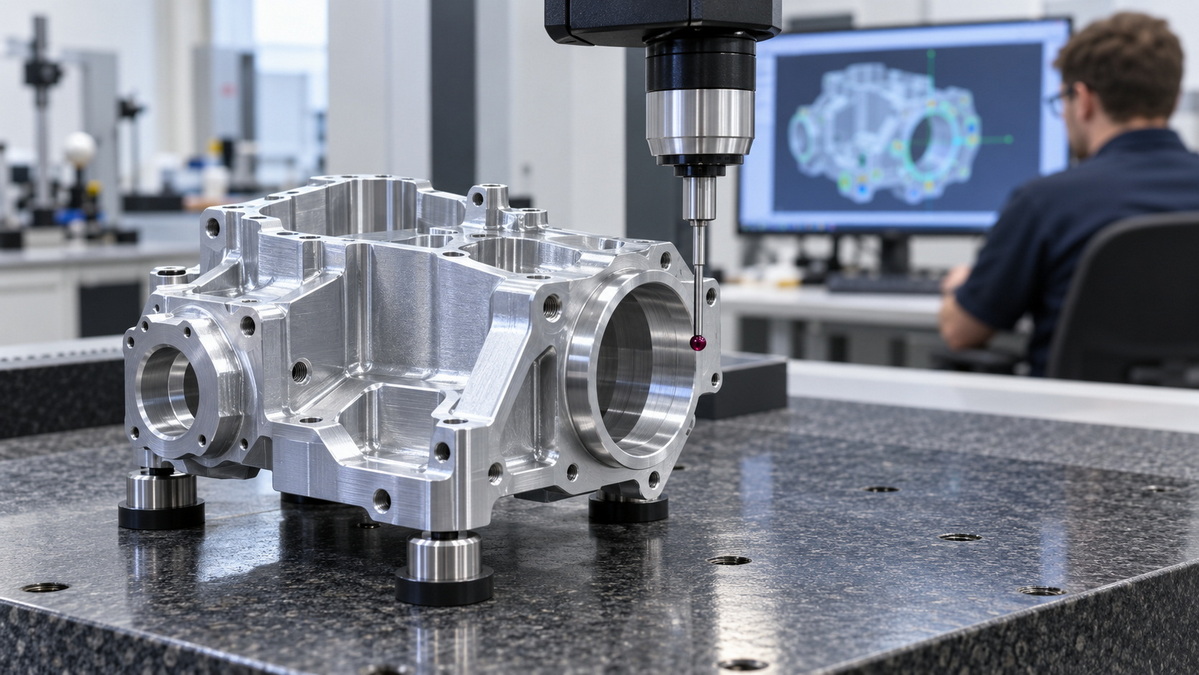
The capacity column describes published production scope, not independently verified machine availability. "Confirm" means the reviewed sources did not establish a dependable, comparable figure.
| Company | Published production scope or capacity indicator | MOQ information | Published certification information | Most relevant sourcing focus |
|---|---|---|---|---|
| U-Need | Prototypes through mass production; integrated machining, tooling, and fabrication | One custom piece accepted | Current certificate documents should be requested | Flexible OEM customization and consolidated sourcing. |
| WayKen | Rapid prototyping and low-volume manufacturing, with production support | Confirm by project | ISO 9001:2015; homepage also states IATF 16949:2016 | Precision prototypes and engineering validation. |
| RapidDirect | Owned Shenzhen factory plus a manufacturing network; low- to high-volume production | Confirm by process | ISO 9001, ISO 13485, ISO 14001, and IATF 16949 claimed | Digitally coordinated, multi-process sourcing. |
| Star Rapid | Rapid prototyping, tooling, and low-volume manufacturing | Confirm by project | ISO 9001 and ISO 14001 stated; request current certificates | Internationally supported product development. |
| HLH Prototypes | One prototype through advertised programs of up to 100,000 parts across processes | One prototype | Confirm certificates for the actual manufacturing site | Prototype-to-production development programs. |
| DEK | Prototype-to-production services; reports more than 1.2 million critical parts annually | Single prototypes supported in turning service | ISO 9001, ISO 13485, and AS9100D claimed | Precision machining and documented process control. |
| 3ERP | Rapid prototyping and low-volume manufacturing; machining, tooling, and molding | Confirm by process | ISO 9001:2015 stated | Bridge manufacturing and multi-process development. |
| Runsom Precision | Prototyping through low- and large-volume CNC production | Confirm by project | ISO 9001:2015 stated | Custom milled, turned, and Swiss-turned parts. |
| AT-Machining | Prototyping plus low- and large-volume manufacturing | Confirm by project | ISO 9001:2015 stated on homepage | Drawing-based precision CNC components. |
| Gensun Precision Machining | Prototype, low-volume, and high-volume manufacturing | Confirm by project | ISO 9001:2015 and ISO 14001:2015 stated | Repeat component supply and automation-related work. |
HLH's published quantity range spans its manufacturing services; it should not be interpreted as demonstrated CNC capacity for a particular component. Similarly, network-wide resources should not be presented as equipment owned by one factory.
Established: 2016
Location: Dongguan, Guangdong
Market coverage: Reports shipments to more than 100 countries; a geographic sales breakdown is not published on the reviewed homepage.
U-Need offers custom precision machining alongside injection molds, stamping dies, cold-forging dies, sheet metal fabrication, laser cutting, bending, and other manufacturing services. It accepts customization from one piece and describes support extending from design and prototyping to production and packaging.
Its relevance for smaller brands lies in this combination of order flexibility and process coverage. A buyer developing an assembly may need machined components, a molded housing, and sheet metal brackets rather than a single machining operation. U-Need's published service model addresses that broader sourcing requirement.
Its engineering support includes manufacturability analysis, technical drawings, prototype testing support, and iterative refinement. These services can support customer-led product development, although they should not be confused with independently verified proprietary research capability.
OEM/ODM scope: Drawing-based custom parts, prototype development support, molds and dies, fabricated components, assembly support, and packaging. For design-led work, define engineering deliverables and intellectual-property ownership before approval.
Buyer assessment: A relevant candidate when flexible quantities, coordinated customization, and value-focused project management matter. Neither lowest cost nor superior communication speed can be established from public information alone. Test both through a structured RFQ.
Qualification priority: Request current certificates, the proposed manufacturing location, subcontracted-process disclosure, and a feature-specific inspection plan for any micron-level requirement.
Established: 2013, according to its company profile
Location: Shenzhen, Guangdong
Market focus: International customers requiring metal and plastic prototypes and low-volume production; regional revenue shares are not disclosed in the reviewed sources.
WayKen specializes in rapid prototyping and low-volume manufacturing. Its published capabilities include CNC milling, turning, five-axis machining, and work across more than 30 engineering-grade metals and plastics. The company advertises tolerances as tight as ±0.005 mm.
Its principal sourcing appeal is the connection between precision prototypes and product-development iteration. Buyers validating geometry, fit, and function can evaluate machining support alongside the company's wider prototype services.
OEM/ODM scope: Custom CNC components, prototype development, material and process discussions, and production-transition support. Complete product-design responsibility should be agreed separately.
Qualification priority: Confirm whether quoted tolerances apply to your material, feature size, geometry, and finishing condition. Review the actual certificate scope rather than relying on certification logos.
Established: 2017
Location: Shenzhen, Guangdong
Market focus: Global customers purchasing prototypes and production parts across multiple processes.
RapidDirect combines an owned Shenzhen factory with a network of manufacturers across China. Its services include CNC machining, injection molding, sheet metal fabrication, and additive manufacturing.
This model can suit procurement teams managing diverse components and seeking coordinated quoting and production support. However, a manufacturing network changes the qualification question: the buyer must understand which site will manufacture, inspect, and release the actual order.
OEM/ODM scope: Customer-designed parts, prototypes, production components, and multi-process sourcing. Product-design ownership and validation responsibilities require separate agreement.
Qualification priority: Ask for the manufacturing and inspection locations assigned to your program. Confirm that any required certification covers those operations, not merely another entity within the wider organization.
Established: 2005
Location: Zhongshan, Guangdong
Market coverage: Publishes international support presence including the United States, United Kingdom, Australia, Hong Kong, and China.
Star Rapid focuses on rapid prototyping, rapid tooling, and low-volume manufacturing. Its published capabilities include multi-axis CNC machining and plastic injection molding, supported by an international engineering and technical team.
For procurement teams, the relevant differentiator is its development-oriented service model and international communication structure. This can be useful when a project requires repeated engineering clarification rather than a simple repeat-order transaction.
OEM/ODM scope: Custom prototypes, machined components, tooling, molding, and engineering collaboration during product development.
Qualification priority: Request current certificates. Its reviewed About page still mentions BS-OHSAS 18001, which is a reason to examine current documentation rather than assume every website certification statement is up to date.
Established: 2008
Locations: Publishes operations in Shenzhen and Dongguan
Market coverage: Reports serving more than 3,000 companies in 50 countries.
HLH offers CNC machining, additive manufacturing, rapid tooling, injection molding, sheet metal work, vacuum casting, and other prototype manufacturing services. Its website states that prototype MOQ starts at one piece and describes manufacturing programs extending to 100,000 parts across its process portfolio.
Its sourcing value lies in supporting product development across different manufacturing methods. A buyer can compare a machined prototype with a later molded or cast production route without treating the prototype process as the final production solution.
OEM/ODM scope: Custom prototypes, manufacturing-development support, tooling, and low-volume production.
Qualification priority: Request machining-specific capacity rather than relying on the company's overall quantity range. Confirm the responsible legal entity, factory address, and certification scope for the quoted work.
Established: 2002
Location: Shenzhen, Guangdong
Primary published markets: Europe and North America, including aerospace, medical, and industrial OEM customers.
DEK began as a machining factory and describes a broader offering that includes CNC milling, turning, grinding, EDM, and additional manufacturing processes. Its current website emphasizes documented inspection and process controls, including incoming inspection, in-process inspection, first-article inspection, statistical process control, and corrective action.
The company reports more than 1.2 million critical parts machined annually and claims ISO 9001, ISO 13485, and AS9100D certification. These statements make it relevant for a technical shortlist, but neither output nor certification alone establishes suitability for a regulated component.
OEM/ODM scope: Custom precision components, prototype-to-production support, and manufacturing-process development.
Qualification priority: Validate certificates against the legal entity and production site. For regulated programs, additionally confirm customer-specific approvals, records, change control, and part-level documentation requirements.
Established: 2010, as reported in a published industry supplier profile
Location: Zhongshan, Guangdong, with a listed US office in Missouri
Market focus: International development and manufacturing customers, including optical, automotive, medical, and aerospace applications.
3ERP offers CNC machining, vacuum casting, pressure die casting, additive manufacturing, tooling, injection molding, sheet metal prototyping, and aluminum extrusion. Its company page describes imported three-, four-, and five-axis machines, material-testing equipment, and an automatic coordinate measuring machine.
Its strongest fit is bridge manufacturing: producing functional parts while a buyer validates the design, demand, or final production method.
OEM/ODM scope: Custom parts, prototypes, tooling, low-volume production, and manufacturing support during development.
Qualification priority: Establish the intended production route early. A successful prototype does not automatically qualify a later casting, molding, or higher-volume machining process. Confirm company history during onboarding because the reviewed official About page does not state the founding year.
Established: Exact founding year not confirmed in the reviewed official sources; its About page states more than ten years of custom CNC machining experience
Location: Dongguan, Guangdong
Market focus: Global custom machining and prototype customers.
Runsom describes CNC milling, turning, Swiss turning, additive manufacturing, and rapid prototyping, with support from design-stage work through low- and large-volume production. It states that its manufacturing system is ISO 9001:2015 certified.
Its process mix makes it relevant for buyers sourcing both milled components and small turned parts. Swiss-turning capability is particularly worth examining when the RFQ contains slender or intricate rotational components.
OEM/ODM scope: Drawing-based components, complex prototype geometries, and production support.
Qualification priority: Verify the legal establishment date directly if supplier age forms part of your approval criteria. More importantly, request evidence from comparable parts, the proposed inspection method, and repeat-order process controls.
Established: 2007, according to its official About page
Location: Shenzhen, Guangdong
Market focus: International precision-parts customers, with published applications including medical, automotive, and robotics.
AT-Machining offers CNC milling and turning, prototype support, and low- and large-volume manufacturing. Its homepage advertises ±0.005 mm precision and ISO 9001:2015 certification.
An important qualification point is the distinction between special capability and general tolerance. Its About page separately lists a broader general machining tolerance unless otherwise specified. Buyers should therefore obtain drawing-level acceptance rather than assume the narrowest advertised number applies automatically.
OEM/ODM scope: Custom machined components and manufacturing support for customer-led development.
Qualification priority: Clarify the exact tolerances included in the quotation, which features require additional inspection, and whether finishing occurs before final acceptance.
Established: 2006, with later registration and factory-development milestones
Location: Dongguan, Guangdong
Market focus: International prototype and production customers; regional sales proportions are not publicly established in the reviewed sources.
Gensun's company history records its 2006 founding, Shenzhen registration in 2012, a Dongguan branch plant in 2014, and a move to Dongguan in 2018. It describes precision-machined parts and nonstandard automation design and manufacturing.
Its published services extend from prototypes to low- and high-volume production. The company states that its quality and environmental management systems are certified to ISO 9001:2015 and ISO 14001:2015.
OEM/ODM scope: Custom precision parts, manufacturing support, and automation-related design and fabrication within an agreed project scope.
Qualification priority: Match the contracting entity, factory address, certificate holder, and inspection records. Company development histories can involve multiple registrations and sites, making entity-level verification important.
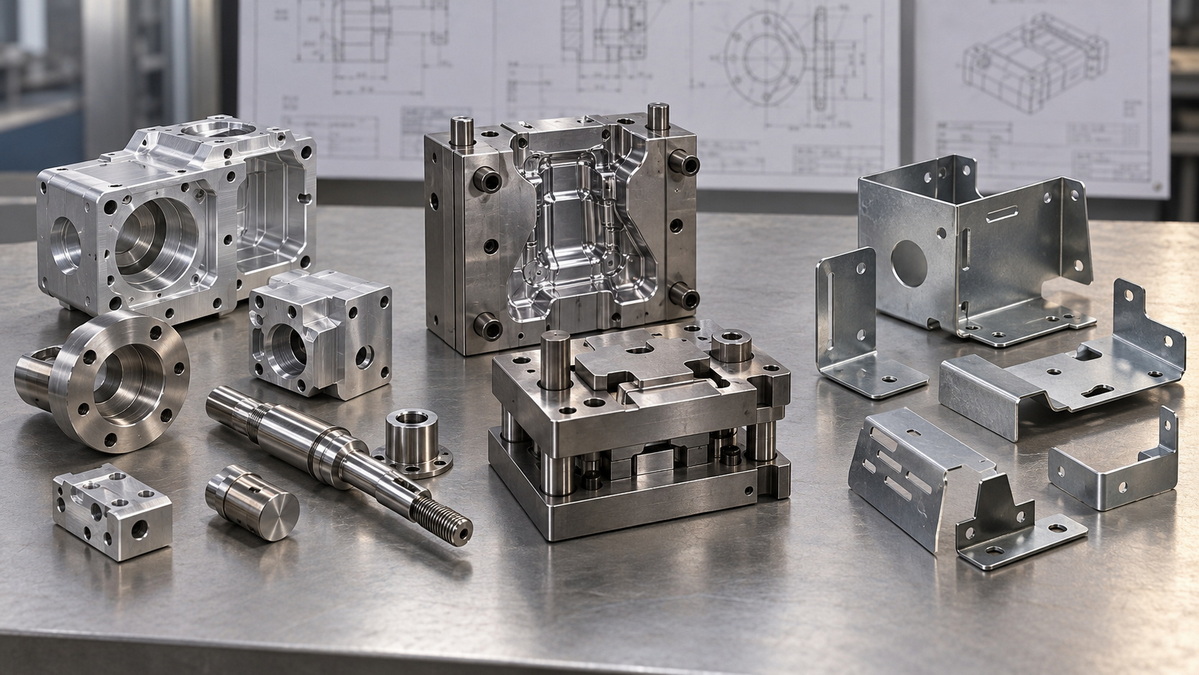
"Aluminum," "stainless steel," and "engineering plastic" are not sufficient purchasing specifications.
A practical material requirement identifies:
- Grade and governing material specification.
- Temper, hardness, or heat-treatment condition.
- Acceptable stock form.
- Required material certificates.
- Lot or heat traceability.
- Restrictions on substitutions.
For example, "6061-T6 aluminum" communicates more than "aluminum," but a demanding program may still require an agreed material specification and traceable documentation.
For regulated substance requirements, include the applicable material and finish declarations. RoHS concerns restricted substances in relevant electrical and electronic equipment; it is not a dimensional-quality certificate. NIST explains the associated technical-documentation and conformity responsibilities.
Do not use ISO 9001, ISO 14001, CE marking, and RoHS as interchangeable purchasing requirements.
- A management-system certificate applies to an organization and its stated scope.
- A dimensional report applies to inspected characteristics.
- A material declaration addresses the supplied material or substance requirements.
- Product conformity obligations depend on the product and applicable legislation.
European Commission guidance describes CE marking as the responsible party's declaration that the product conforms to applicable EU provisions. A generic "CE-certified CNC factory" statement does not establish that a machined component meets your drawing or that a finished assembly satisfies its regulatory obligations.
At tight tolerances, the measurement procedure becomes part of the acceptance requirement.
NIST's work on dimensional measurement documents the contribution of thermal expansion and temperature-related uncertainty. This matters when a supplier and buyer measure the same component under different conditions.
Agree on:
1. Reference temperature and stabilization procedure.
2. Datum alignment and part restraint.
3. Measurement equipment and probe access.
4. CMM program or agreed inspection method where necessary.
5. Treatment of uncertainty near specification limits.
6. Final inspection after specified secondary operations.
A successful sample establishes feasibility under the conditions used to make that sample. It does not establish stable production across time.
Use a staged approval process:
1. Review the drawing and resolve technical questions.
2. Approve the proposed material and process route.
3. Inspect first articles.
4. Run a pilot batch representative of production.
5. Review results across the batch, not only selected parts.
6. Release repeat production with controlled revisions and change notification.
For critical features, require the supplier to explain how the process will be monitored and what happens when measurements approach an agreed intervention limit.
| Pitfall | Why it creates risk | Practical control |
|---|---|---|
| Accepting a headline tolerance | The stated capability may apply only to selected features or conditions | Obtain feature-specific written acceptance |
| Material substitution | Similar-looking stock may not satisfy the specified grade or condition | Require traceability, certificates, and appropriate verification |
| Uncontrolled subcontracting | Finishing or machining may move to an unapproved site | Require disclosure and approval of critical subcontracted processes |
| Inspection before finishing only | Delivered dimensions may differ from the inspected condition | Define final acceptance after all specified operations |
| Approving only presentation samples | Selected parts may not represent production variation | Inspect representative pilot-batch samples |
| Treating machine count as capacity | Machines may be occupied or unsuitable for the part | Review the actual route, schedule, and bottlenecks |
| Ignoring packaging | Functional surfaces may be damaged after acceptance | Specify separation, protection, identification, and preservation |
Material verification, documented inspection stages, and clear process responsibility are recurring themes in the published quality approaches of U-Need, DEK, and 3ERP. Buyers should convert those general statements into project-specific contractual requirements.
One of the most useful questions in a tight tolerance supplier review is:
"How was this part held when it was measured?"
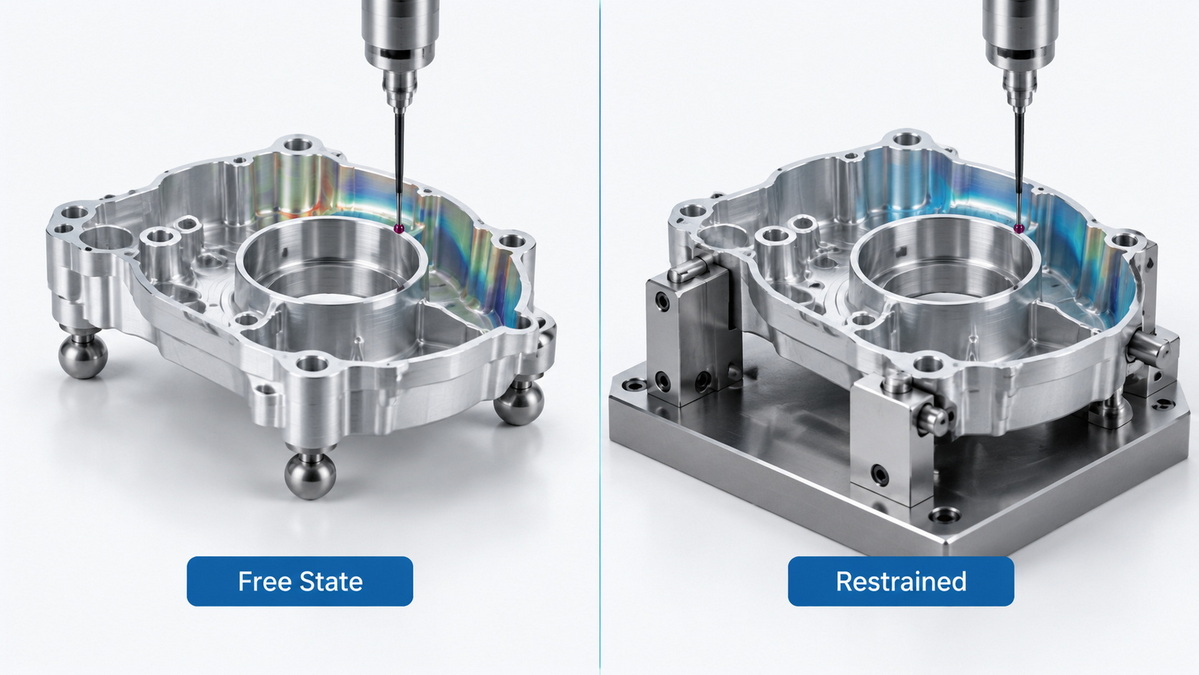
A thin-walled housing or flexible component can behave differently when clamped, supported, assembled, or left free. If the supplier measures under restraint while incoming inspection measures the unrestrained part, both parties may produce internally consistent results that do not agree.
The procurement safeguard is to define the inspection state before samples are made:
- Free-state or restrained condition.
- Support and contact locations.
- Assembly condition, if applicable.
- Datum simulation.
- Measurement sequence.
- Any permitted force or fixture arrangement.
This is a recommended qualification check, not an allegation about any listed supplier. It addresses a broader principle also evident in dimensional metrology: acceptance depends on controlled measurement conditions, not merely instrument resolution.
Packaging and shipment requirements should be part of the RFQ, not an afterthought.
Specify which surfaces must not contact other parts, whether corrosion protection is required, how lots must be identified, and which documents must travel with the shipment.
The purchase order should also establish:
- Delivery terms and the named destination.
- Responsibility for transport, insurance, and import clearance.
- Documentation requirements.
- Treatment of rejected parts and replacement freight.
- Ownership of fixtures and inspection tooling.
- Notification requirements for material, site, process, or subcontractor changes.
For recurring orders, evaluate landed cost rather than unit price alone. Inspection effort, rework, delays, replacement shipments, and excess inventory can materially change the economics of an apparently inexpensive quotation.
The most useful shortlist is not the one with the smallest advertised tolerance. It is the one that matches your component, production stage, documentation requirements, and acceptable commercial risk.
U-Need is relevant for buyers seeking flexible order quantities and coordinated support across precision parts, tooling, and fabrication. Other companies on this list offer different strengths in prototype development, manufacturing networks, precision processes, or repeat production.
For a meaningful U-Need quotation, submit the controlled drawing, 3D model, material specification, annual demand, batch quantities, critical characteristics, finishing requirements, and required inspection documents. Request a manufacturability review, a proposed production route, and a sample-validation plan before authorizing production.
Request the complete certificate, including its number, legal company name, manufacturing address, scope, issuing body, and validity dates.
Use IAF CertSearch where applicable to check status and compare the listed identity and scope with the proposed production site. The service provides information on certification bodies and accreditation as well as certificate status. If the record is missing or inconsistent, seek clarification directly from the issuing body rather than treating a website logo as proof.
Not without drawing-specific confirmation.
An advertised minimum tolerance does not establish capability for every geometry, material, feature, or production quantity. For example, U-Need publishes ±0.001 mm machining accuracy, but the purchasing requirement must still identify which characteristics need that accuracy and how they will be accepted.
Request a signed technical review, agreed inspection method, representative samples, and evidence from the intended production route.
First compare measurement procedures, not just reported values.
Check drawing revision, datum alignment, restraint, measurement temperature, stabilization, equipment, and whether inspection occurred before or after finishing. Temperature-related uncertainty is a documented issue in dimensional metrology.
Then remeasure the same identified parts using an agreed procedure. If disagreement persists, use a mutually accepted independent laboratory and document the acceptance rule for future lots.
Specify the grade, governing specification, condition, and traceability requirement before ordering. Require the certificate to connect to the actual material lot and production batch.
Also ask what verification method the supplier uses and whether it addresses the property at issue. A general statement that material testing is available is not enough; the agreed check must relate to the specified requirement. 3ERP, for example, publicly states that it uses material-testing equipment, but buyers still need project-specific documentation and acceptance criteria.
Ask for a part-specific capacity review showing the process route, suitable machines, expected cycle times, inspection workload, secondary-process lead times, and current loading.
Treat published annual output and broad production ranges as screening information. DEK's annual part count and HLH's advertised production range describe company-level activity, not reserved capacity for your order. Validate the proposed schedule through a representative pilot run and documented delivery commitments.
1.AMT—The Association For Manufacturing Technology: July 2025 China industry update reporting CMTBA machine-tool trade statistics. [amtonline]
2.Silverado Policy Accelerator: China Machine Tool Industry Profile, published in 2026. [silverado]
3.NIST: Research on uncertainty and thermal effects in dimensional measurement. [nvlpubs.nist]
4.NIST: RoHS compliance guidance. [nist]
5.European Commission: RoHS interpretation and conformity guidance. [environment.ec.europa]
6.IAF CertSearch: Certificate validation and certificate-detail checking. [iafcertsearch]
7.U-Need: Company history, manufacturing services, engineering support, and published capability statements. [uneedprecisionmachine]
8.WayKen: Manufacturing capabilities and company profile. [waykenrm]
9.RapidDirect: Manufacturing model, establishment year, and published certifications. [rapiddirect]
10.Star Rapid: Company background, international support, and manufacturing services. [starrapid]
11.HLH Prototypes: Company history and prototype-to-production service scope. [hlhprototypes]
12.DEK: Company history, production claims, and quality-control description. [dekmake]
13.3ERP: Official manufacturing capabilities and facilities; founding year is reported in a separate published supplier profile. [3erp]
14.Runsom Precision: Official machining services and quality-system statements. [runsom]
15.AT-Machining: Official company history and machining capability statements. [at-machining]
16.Gensun Precision Machining: Company milestones and published management-system certifications. [china-machining]


