Views: 254 Author: U-Need Publish Time: 2026-09-09 Origin: Site
Content Menu
>> Why Manufacturers Use Anodized Aluminum
● Main Types of Anodized Aluminum Finishes
● Type II Sulfuric Acid Anodizing
>> When to Choose Type II Anodizing
>> Appearance Options for Type II Anodizing
>> Benefits of Type III Hard Anodizing
>> Limitations of Type III Hard Anodizing
● Clear Anodizing for Natural Aluminum Appearance
>> Common Uses for Clear Anodized Aluminum
>> Surface Texture Still Matters
● Color Anodizing for Product Identity
>> Factors That Affect Anodized Color Consistency
● Bright Anodizing for Reflective Decorative Parts
● Type II vs. Type III Anodizing
● How Anodizing Affects Part Dimensions
>> Example of Dimensional Planning
● Important Design Rules for Anodized Parts
>> Identify Critical Features Before Production
>> Specify the Surface Finish Before Anodizing
>> Plan for Racking and Handling Marks
● Choosing the Right Aluminum Alloy
● Quality Control for Anodized Aluminum Parts
● Summary
>> What is the difference between anodized aluminum and painted aluminum?
>> Is Type II or Type III anodizing better?
>> Does anodizing make aluminum parts larger?
>> Can anodized aluminum be black?
>> Can anodized aluminum scratch?
>> Does anodizing affect electrical conductivity?
>> Which aluminum alloy is best for anodizing?
>> Can sheet metal parts be anodized?
Selecting the right anodized aluminum finish is an engineering and product-design decision—not only a visual one. The finish can influence corrosion resistance, surface hardness, wear performance, dimensional fit, electrical insulation, color consistency, and the perceived quality of the final product.
For precision-machined parts, stamped components, molds, and sheet metal assemblies, anodizing should be considered early in the manufacturing process. A well-planned finish can improve product durability and appearance. A poorly defined finish can create tolerance issues, inconsistent color, visible cosmetic defects, or unexpected production costs.
U-Need provides end-to-end manufacturing support for global brands, distributors, and industrial manufacturers. Our capabilities include custom precision parts machining, injection mold manufacturing, stamping dies, cold-forging dies, laser cutting, bending, stamping, and sheet metal fabrication. By integrating manufacturing requirements with surface-finishing considerations, we help customers produce aluminum parts that perform reliably and present professionally.

Aluminum anodizing is an electrochemical finishing process that transforms the outer surface of aluminum into a controlled aluminum oxide layer. Rather than applying a separate coating on top of the metal, anodizing creates a protective oxide structure that is integrated with the aluminum substrate.
The process usually includes cleaning, pretreatment, anodizing in an electrolyte bath, optional coloring, and sealing. During anodizing, the aluminum component acts as the anode in an electrical circuit. The resulting oxide layer can be thin and decorative, thick and highly wear-resistant, clear, dark, brightly colored, or engineered for specific industrial performance requirements.
Anodizing is commonly used for CNC-machined housings, brackets, electronics enclosures, automotive parts, industrial equipment, medical components, camera accessories, sporting goods, lighting parts, and architectural hardware.
Anodizing offers a combination of functional and visual benefits that makes it one of the most widely used aluminum finishing options.
- Improved corrosion resistance for parts exposed to moisture, handling, and many working environments
- Enhanced surface hardness compared with untreated aluminum
- Better wear resistance, particularly with Type III hard anodizing
- Decorative color options including black, blue, red, gold, gray, green, and custom shades
- A durable metallic appearance that preserves the character of aluminum
- Improved scratch resistance for many consumer and industrial applications
- An insulating oxide layer that can be useful in electrical and electronic assemblies
- A finish that does not peel or flake like conventional paint films
However, anodizing is not automatically the best finish for every aluminum component. It can affect dimensions, thread fit, electrical grounding, visible surface texture, and color uniformity. These factors should be evaluated before production begins.
The phrase "anodized aluminum finish" can refer to a formal coating process, a performance level, a color, or a visible surface style. Understanding the difference helps engineers, purchasing teams, and product designers create clearer specifications.
| Anodized Finish | Main Purpose | Typical Appearance | Wear Resistance | Color Flexibility | Common Applications |
|---|---|---|---|---|---|
| Type II anodizing | Corrosion protection and decorative appearance | Clear, black, colored, satin, matte | Moderate | High | Enclosures, consumer products, brackets |
| Type III hard anodizing | High wear and abrasion resistance | Dark gray, bronze, olive, dark matte | High | Limited | Industrial equipment, automotive parts, tooling |
| Clear anodizing | Natural aluminum appearance with protection | Silver, gray, satin, matte | Varies by coating thickness | None | Instrument housings, hardware, panels |
| Color anodizing | Product differentiation and branding | Dyed colors, matte or satin | Moderate to high | Very high | Electronics, tools, sporting goods |
| Bright anodizing | Decorative reflectivity | Bright, glossy, mirror-like | Moderate | Limited | Trim, reflectors, premium hardware |
Type II anodizing is one of the most common aluminum finishing processes for commercial and industrial parts. It is often chosen because it provides a practical balance between corrosion protection, cost, visual appearance, and color flexibility.
This finish is commonly used for CNC-machined aluminum parts, sheet metal covers, electronics housings, handles, mounting brackets, camera accessories, control panels, consumer products, and decorative metal components.
Type II anodizing can be left clear or dyed in a broad range of colors. Black is one of the most frequently requested options because it provides a professional appearance and works well with many industrial and consumer products.
Type II anodizing is a strong option when a part needs:
- A decorative finish with a clean metallic appearance
- A black, red, blue, gold, green, or custom-colored surface
- Good resistance to corrosion in normal commercial environments
- A relatively thin coating with limited effect on part dimensions
- A cost-efficient finish for medium- or high-volume production
- A finish suitable for visible consumer-facing surfaces
- A protective finish for aluminum enclosures, covers, brackets, and housings
For example, a CNC-machined 6061 aluminum electronics enclosure with visible exterior surfaces may use bead blasting followed by black Type II anodizing. The bead blasting creates a uniform matte texture, while the anodizing provides color and surface protection.
Type II anodizing can be combined with different pre-finishing methods to create a wide range of final appearances.
- CNC-machined anodized finish: Visible tool paths or machined patterns remain visible beneath the anodic coating.
- Bead-blasted anodized finish: Produces a smooth, uniform, matte texture that is popular for electronics and premium consumer products.
- Brushed anodized finish: Creates directional lines and a refined metallic appearance.
- Polished anodized finish: Delivers a brighter decorative surface, although it may reveal scratches or surface imperfections more easily.
- Tumbled anodized finish: Helps soften edges and reduce sharp machining marks on small parts.
The base surface should always be specified before anodizing. Simply writing "black anodized aluminum" on a drawing does not define whether the final part should be glossy, matte, brushed, bead blasted, or visibly machined.
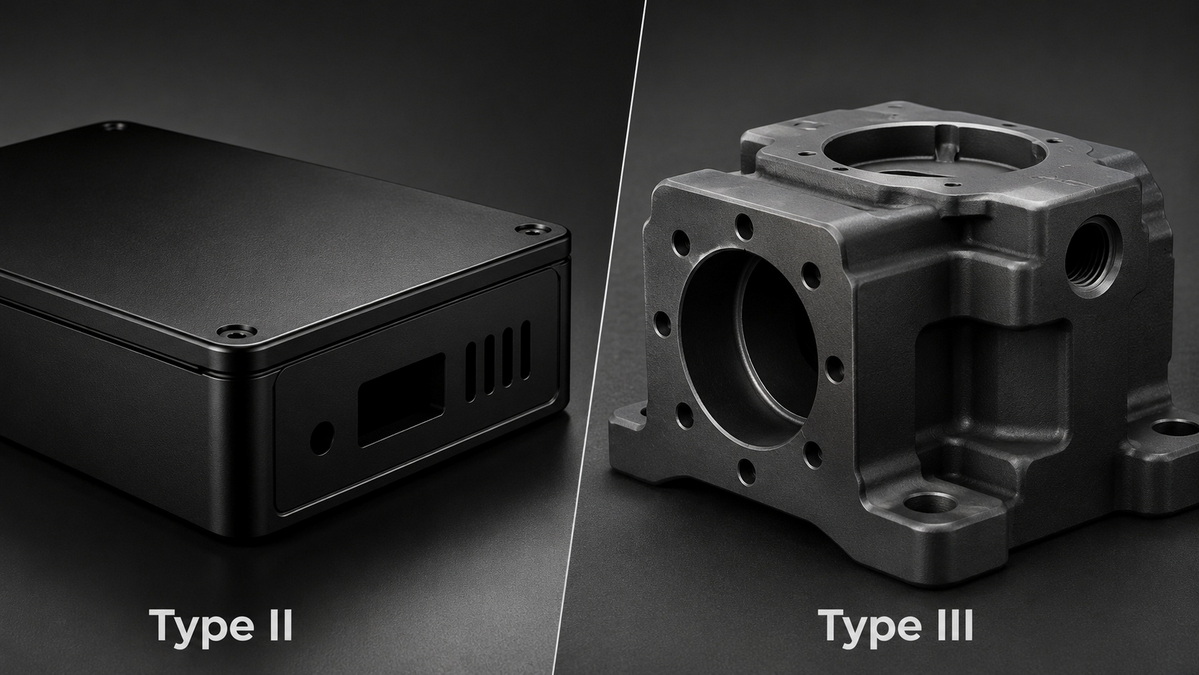
Type III hard anodizing, often called hardcoat anodizing, is designed for aluminum parts that require high wear resistance, improved hardness, and better durability in demanding working environments.
Hard anodizing produces a thicker and denser oxide layer than standard Type II anodizing. It is commonly used for mechanical components subject to friction, sliding contact, abrasion, repeated handling, or industrial exposure.
Typical applications include:
- Industrial machine components
- Automotive hardware
- Valve bodies
- Pneumatic and hydraulic parts
- Wear-resistant brackets
- Tooling components
- Robotics parts
- Actuator housings
- High-contact fixtures
- Aerospace and defense-related components
Hard anodizing is often selected for functional performance rather than decorative color control.
- Higher abrasion resistance for moving or high-contact parts
- Greater surface hardness than standard decorative anodizing
- Improved durability in demanding industrial applications
- Better suitability for friction and wear conditions
- A thicker oxide layer for added surface protection
- Good corrosion resistance when properly specified and sealed
Although Type III hard anodizing provides strong functional performance, it has important design tradeoffs.
- Color can vary from dark gray to bronze, olive, charcoal, or nearly black.
- Color matching is more difficult than with Type II dyed anodizing.
- The finish is generally matte or industrial-looking, rather than bright and decorative.
- Coating thickness has a greater impact on tolerances.
- Sharp edges and corners may show different coating build behavior.
- Some aluminum alloys may produce less uniform cosmetic results.
Hard anodizing is often the right choice for a sliding component, mechanical housing, fixture, machine part, or rugged automotive accessory. It is usually not the first choice for a premium consumer product requiring an exact glossy black or vivid branded color.
Clear anodizing provides a protective oxide layer without adding a colored dye. It is often selected when designers want to retain the natural appearance of aluminum while improving corrosion and wear resistance.
Clear anodized aluminum may appear silver, soft gray, satin, matte, or slightly darker than raw aluminum. The exact result depends on the alloy, surface preparation method, anodizing thickness, and lighting conditions.
A polished aluminum part and a bead-blasted aluminum part can both receive clear anodizing, but they will look very different after finishing.
Clear anodizing is widely used for:
- Instrument housings
- Medical and laboratory equipment
- Industrial control panels
- Precision brackets
- Architectural hardware
- Aluminum covers and frames
- Electronics enclosures
- Machinery guards
- Interior components with a clean metallic look
Clear anodizing is a practical choice when the product needs a clean, understated, professional appearance without the visual intensity of black or colored finishes.
Clear anodizing does not hide dents, deep scratches, machining marks, pits, tool marks, or material inconsistency. In some cases, it can make these features more visible.
For visible surfaces, define the required pretreatment clearly:
- CNC-machined finish
- Fine bead blast
- Coarse bead blast
- Brushed finish
- Polished finish
- Vibratory finish
- Tumbling finish
- Cosmetic surface free from visible tool marks
For a premium aluminum product, the best approach is to approve a physical sample before mass production.
Color anodizing is commonly used when a product requires visual differentiation, branding, functional identification, or a more distinctive appearance.
During the finishing process, the anodic pores can absorb dyes before the surface is sealed. This allows manufacturers to create a variety of colors while preserving the metallic character of aluminum.
Popular color options include:
- Black
- Blue
- Red
- Gold
- Green
- Purple
- Gray
- Champagne
- Bronze
- Custom colors
Black anodized aluminum remains one of the most popular finishes because it is versatile, professional, and suitable for technology, automotive, industrial, optical, audio, and sporting applications.
Anodized color should not be treated as a simple paint code. Several manufacturing variables can influence the final appearance.
- Aluminum alloy composition
- Material batch variation
- Surface preparation method
- Part geometry
- Part orientation during finishing
- Coating thickness
- Dye concentration
- Dyeing time
- Sealing process
- Lighting conditions during inspection
For example, two black anodized parts may appear different if one part has a bead-blasted surface and the other has visible CNC machining marks. Even when the same color requirement is used, aluminum alloys can respond differently during anodizing.
For appearance-critical programs, use a documented color standard, approved reference sample, defined viewing distance, and specified lighting conditions.
Bright anodizing is intended for products that need a more reflective, high-gloss, or premium decorative finish.
Before anodizing, the aluminum surface is typically brightened using specialized pretreatment methods. The anodizing process then adds protection while preserving a reflective appearance.
Bright anodized aluminum may be used for:
- Decorative trim
- Lighting reflectors
- Appliance details
- Premium hardware
- Consumer product accents
- Signage components
- Display fixtures
- High-visibility metal parts
Bright anodizing requires excellent starting surface quality. Surface scratches, pits, tool marks, and material defects may become more noticeable on a highly reflective part. For that reason, bright anodized projects should include sample review and realistic cosmetic acceptance standards.
The most common decision for engineers and buyers is whether to use Type II or Type III anodizing.
| Decision Factor | Type II Anodizing | Type III Hard Anodizing |
|---|---|---|
| Primary purpose | Decorative appearance and corrosion protection | High wear and abrasion resistance |
| Typical color options | Clear, black, red, blue, gold, custom colors | Natural dark gray, bronze, dark tones |
| Appearance | Satin, matte, brushed, machined, colored | Matte, darker, industrial |
| Coating thickness | Generally thinner | Generally thicker |
| Dimensional impact | Lower | Higher |
| Wear resistance | Moderate | High |
| Cost level | Usually lower | Usually higher |
| Best applications | Enclosures, consumer products, brackets | Industrial parts, fixtures, mechanical components |
Choose Type II anodizing when appearance, color, corrosion resistance, and cost efficiency are the main priorities.
Choose Type III hard anodizing when abrasion resistance, surface hardness, friction performance, and mechanical durability are more important than exact color matching.
Choose clear anodizing when you want to preserve a natural aluminum appearance.
Choose color anodizing when the finish supports product identity, color coding, or brand differentiation.
Choose bright anodizing when reflectivity and decorative appearance are central to the product design.
One of the most important manufacturing considerations is the effect of anodizing on part dimensions.
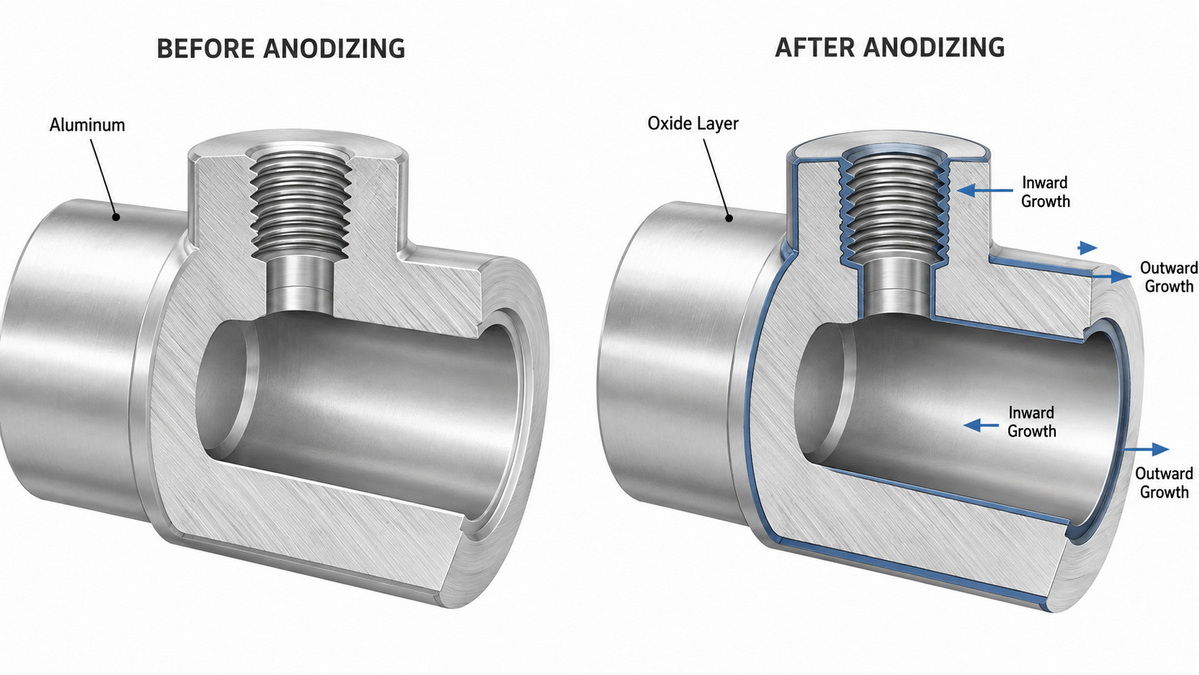
The oxide layer grows both into the aluminum surface and outward from it. As a result:
- Outside diameters can become larger
- Hole diameters can become smaller
- Threads can become tighter
- Press-fit features can change
- Sliding interfaces may require additional clearance
- Bearing seats may need masking or secondary machining
- Critical tolerance features may need pre-finish dimensional compensation
A common planning rule is that approximately half of the coating thickness grows outward from the surface, while the remaining portion penetrates into the aluminum substrate. The actual result can vary depending on alloy, process conditions, geometry, and coating thickness.
Imagine a precision aluminum shaft with an outside diameter that must fit into a close-tolerance mating component.
If the part receives a relatively thick hard anodized layer, the shaft diameter can increase enough to interfere with assembly. The engineering team may compensate by reducing the shaft diameter before anodizing, masking the critical diameter, or machining the feature after anodizing.
This is why anodizing requirements should be reviewed together with the part drawing and tolerance plan—not added after machining is complete.
A successful anodizing program begins with manufacturability planning.
Mark the following areas on the engineering drawing:
- Threads that must remain functional
- Tight bores and precision holes
- Bearing seats
- Press-fit surfaces
- Electrical grounding points
- Conductive contact areas
- O-ring grooves
- Sealing surfaces
- Cosmetic Class A surfaces
- Areas that require masking
If a component requires conductivity in one area and insulation in another, the design should define exactly where anodizing is allowed, masked, removed, or replaced with another surface treatment.
Anodizing follows the existing surface. It does not eliminate scratches, dents, machining marks, welding discoloration, pits, or inconsistent surface texture.
A more complete finish note could look like this:
> Material: 6061-T6 aluminum.
> Surface preparation: Fine bead blast.
> Finish: Black Type II anodizing, sealed.
> Cosmetic requirement: No visible scratches, stains, or tool marks on designated exterior surfaces under standard inspection lighting.
> Critical interfaces: Mask threaded holes and electrical grounding pads.
This type of instruction reduces ambiguity between engineering, procurement, machining, finishing, inspection, and assembly teams.
During anodizing, parts must be held on conductive racks. Contact points may leave small rack marks where the component is clamped or electrically connected.
For non-visible industrial parts, rack marks may be acceptable. For premium consumer products or highly visible exterior components, the location of rack marks should be agreed in advance.
A practical approach is to identify non-cosmetic surfaces, hidden assembly areas, or internal features where racking contact can be placed without affecting the final product appearance.
Not all aluminum alloys respond identically to anodizing. Alloy composition can influence color, brightness, coating uniformity, corrosion behavior, and visual consistency.
For many visible CNC-machined components, 6061 aluminum is widely used because it offers a practical balance of machinability, strength, availability, and anodizing performance.
However, material selection should consider more than appearance. The final alloy choice may depend on:
- Strength requirements
- Weight targets
- Machinability
- Weldability
- Corrosion environment
- Sheet metal formability
- Cost
- Availability
- Required anodized appearance
- Production volume
Some alloys can produce darker, less uniform, or more variable anodized finishes. For color-sensitive products, it is best to use a consistent alloy, material source, surface preparation process, and finishing method across all matching parts.
Anodized part inspection should cover functional quality as well as visible appearance.
A robust quality-control plan may include:
- Coating thickness inspection
- Color comparison against an approved sample
- Visual inspection for scratches, burns, stains, pits, and streaks
- Dimensional inspection after anodizing
- Thread gauge verification
- Inspection of masking areas
- Surface texture confirmation
- Corrosion-resistance testing when required
- Packaging inspection to prevent transport damage
- Batch traceability for production consistency
For cosmetic parts, define inspection conditions in advance. A part inspected under harsh direct lighting may appear different from the same part viewed in a typical office, retail, or end-use environment.
For global supply programs, clear acceptance criteria reduce the risk of disagreement after production.
The best anodized aluminum finish depends on how the part will be used, how it must look, and how tightly it must fit with other components.
Type II anodizing is an excellent all-purpose choice for decorative color, corrosion protection, and cost-efficient production. Type III hard anodizing is designed for higher wear resistance and demanding mechanical applications. Clear anodizing preserves a natural aluminum appearance, while color anodizing supports product differentiation and visual identity. Bright anodizing is suitable for high-reflectivity decorative components.
The most reliable results come from planning the finish before machining or fabrication begins. Define the aluminum alloy, base surface texture, anodizing type, color, thickness, masking requirements, cosmetic expectations, critical tolerances, and inspection standards before releasing the part for production.
U-Need supports customers from prototype development to scalable production, combining precision machining, mold manufacturing, sheet metal fabrication, finishing coordination, inspection, and export packaging. With clear manufacturing requirements and early engineering review, anodized aluminum components can achieve the right balance of performance, appearance, durability, and cost.
Anodized aluminum has an oxide layer that is formed from the aluminum surface itself. Painted aluminum has a separate paint film applied on top of the metal. Anodizing maintains a metallic appearance and is less likely to peel or flake in the way that paint can, while paint offers a wider range of opaque colors.
Neither finish is universally better. Type II anodizing is usually better for decorative parts, colored finishes, and cost-sensitive production. Type III hard anodizing is better for components requiring high wear resistance, abrasion protection, and surface hardness.
Yes. Anodizing creates an oxide layer that grows both outward and inward from the original aluminum surface. Outside dimensions can increase, while hole diameters and threads can become tighter. Critical dimensions should be planned before anodizing.
Yes. Black anodizing is one of the most common finishes for CNC-machined aluminum and sheet metal parts. Black Type II anodizing is commonly selected for electronics enclosures, camera components, industrial panels, automotive accessories, and consumer products.
Anodized aluminum has better surface protection than untreated aluminum, but it can still scratch, especially under severe abrasion, sharp impacts, or contact with harder materials. Type III hard anodizing generally offers greater wear resistance than standard Type II anodizing.
Yes. The anodic oxide layer is electrically insulating. This can be useful for some electronic applications, but it can create problems where direct electrical grounding or conductive contact is required. Conductive areas may need to be masked or treated separately.
6061 aluminum is commonly selected for anodized CNC components because it offers good machinability, strength, and generally reliable visual results. The ideal alloy still depends on the specific structural, manufacturing, environmental, and cosmetic requirements of the part.
Yes. Aluminum sheet metal components can be anodized after laser cutting, bending, punching, stamping, or machining. Designers should consider how bends, sharp edges, welds, handling marks, and surface preparation may affect the final appearance.
1. [MIL-PRF-8625: Anodic Coatings for Aluminum and Aluminum Alloys]
2. [Aluminum Anodizing: All You Need to Know]
4. [MIL-PRF-8625F Anodizing Reference]
5. [How to Design and Manufacture Anodized Aluminum Parts]
6. [A Review on Anodizing of Aerospace Aluminum Alloys for Corrosion Protection]
7. [Influence of and Differences Between Chromic and Sulfuric Acid Anodising on Fatigue Properties]


