Views: 254 Author: U-Need Publish Time: 2026-06-29 Origin: Site
Bending stainless steel tubing is a high-precision process that demands the right tooling, careful setup, and a clear understanding of material behavior. When done correctly, it delivers clean geometry, consistent flow performance, and long-term durability in industries such as automotive, medical, HVAC, food processing, and industrial equipment. [youtube]
In this guide, we rebuild the topic from an engineering and manufacturing perspective. You will learn the main bending methods, design rules, common defects, inspection steps, and practical ways to improve part quality before production begins. [rapiddirect]

Stainless steel is strong, corrosion-resistant, and widely used, but those same properties make it more difficult to form than softer metals. Its higher strength means more force is required during bending, and its elastic recovery makes springback a major concern. [youtube]
If the bend process is not controlled carefully, the tube may ovalize, wrinkle, flatten, or fail to meet the required angle. For precision parts, even a small deviation can affect sealing, assembly, and final performance. [rapiddirect]
Different applications require different tube bending methods. The best choice depends on wall thickness, bend radius, production volume, and cosmetic or functional requirements.
| Method | Best for | Key advantage | Main limitation |
|---|---|---|---|
| Rotary draw bending | Precision parts, tight radii, repeatability | Excellent accuracy and surface control | Requires dedicated tooling |
| Compression bending | Simple bends, lower-cost setups | Fast and economical | Less precise, more deformation risk |
| Roll bending | Large-radius curves | Good for long, smooth bends | Not ideal for tight bends |
| Manual tube bending | Prototyping and small jobs | Flexible for low-volume work | Operator skill affects quality |
Compression bending remains a common option for straightforward jobs, while rotary draw bending is often preferred for precision stainless steel tubing because it offers tighter control over bend geometry. [youtube]
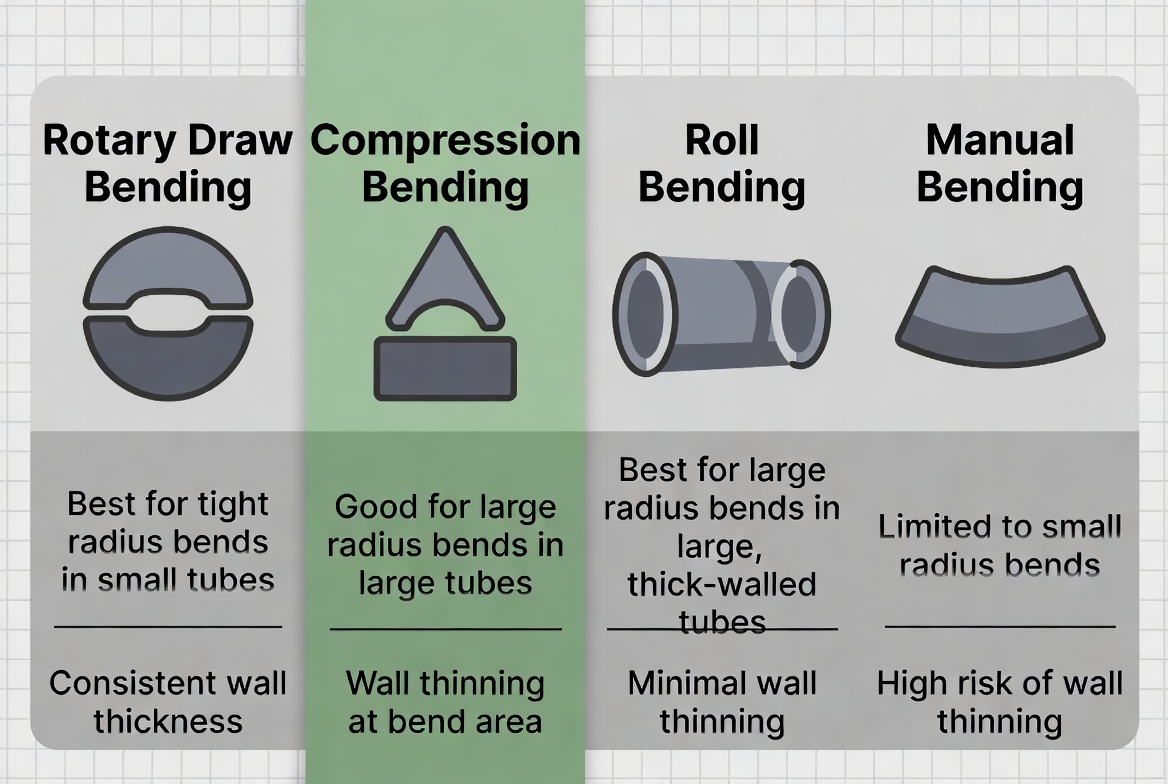
The right method starts with the end-use requirements. A sanitary tube for a food line has different demands from a decorative tube for furniture or a hydraulic line in industrial equipment. In practice, engineers should evaluate bend radius, tolerance, tube diameter, wall thickness, and how much springback the material is likely to show. [rapiddirect]
For high-precision assemblies, rotary draw bending is usually the safest choice. For simpler shapes or lower budgets, compression bending may be acceptable if the design allows slightly more variation.
Good bend quality starts at the drawing stage. The most reliable production outcomes come from designs that respect the material's forming limits and the machine's capabilities. [rapiddirect]
Use these rules early in design:
- Keep bend radius generous whenever possible.
- Avoid placing bends too close to tube ends.
- Specify clear tolerance requirements for angle, ovality, and centerline dimensions.
- Confirm whether the tube will be bent before or after welding, cutting, or surface finishing.
- Plan for springback in the tooling setup.
As a practical rule, tighter bends increase stress and raise the risk of distortion. A more conservative radius usually improves manufacturability and consistency.
Before production begins, the tube must be prepared correctly. A clean cut, correct tube size, and accurate marking are essential for repeatable results. [youtube]
A reliable setup process includes:
1. Cut the tube squarely.
2. Remove burrs from both ends.
3. Confirm the correct bending die for the tube diameter.
4. Mark the bend location clearly.
5. Check the tool's zero position and angle reference.
6. Test for springback using a sample part.
The source material also emphasizes the importance of using the correct tubing cutter and making clean, square cuts, since poor preparation can lead to fitting problems later. [youtube]
Springback is one of the most important challenges in stainless steel tube bending. After the load is removed, the tube tends to recover slightly, which means the final angle may be smaller than the angle set on the machine. [youtube]
This is why operators often bend slightly beyond the target angle. For example, if the required bend is 90 degrees, the tool may need to be set a little past 90 degrees so that the part settles into the correct final angle after release. The exact compensation depends on grade, wall thickness, radius, and machine setup. [youtube]
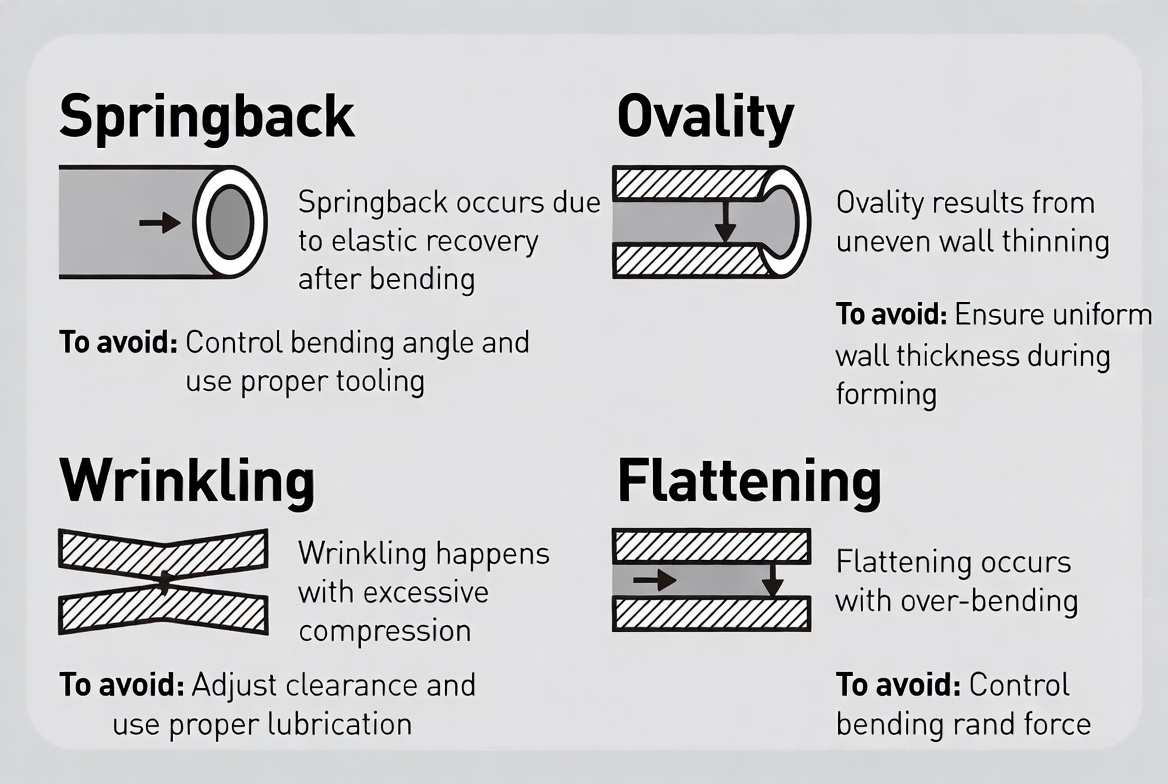
Even experienced teams can run into defects if the process is not well controlled. Understanding the cause of each defect makes troubleshooting much faster. [rapiddirect]
Common defects include:
- Flattening or ovality, usually caused by excessive force or an unsupported bend radius.
- Wrinkling, often linked to compression on the inner bend wall.
- Cracking, which may occur if the material is overworked or the radius is too tight.
- Angle error, usually caused by springback or poor machine calibration.
- Surface marking, often from tooling wear or contamination.
Preventing these issues is usually cheaper than repairing them after the fact.
Quality control should be part of the bending process, not an afterthought. After bending, the part should be checked for angle accuracy, dimensional consistency, and compatibility with the intended fittings. [youtube]
For fitting-based assemblies, the tubing and connection points must be verified carefully. The source content notes the use of a gap inspection gauge for checking whether a compression fitting is adequately tightened. This kind of verification helps prevent leaks and reduces rework. [youtube]
A strong inspection routine should include:
- Bend angle measurement.
- Centerline dimension checks.
- Surface inspection for scratches or dents.
- Ovality measurement for critical applications.
- Fit testing with mating components.
Stainless steel tubing bending is used across a wide range of sectors because the material is durable, hygienic, and corrosion-resistant. Its performance makes it especially valuable in systems where reliability matters. [rapiddirect]
Typical applications include:
- Medical device assemblies.
- Food and beverage processing lines.
- Automotive exhaust and fluid systems.
- HVAC and refrigeration piping.
- Industrial machinery and control systems.
In each of these areas, precision is not just a quality feature; it is a functional requirement.
From a manufacturing standpoint, the best bending results come from combining smart design with disciplined process control. The most common reason for failure is not the machine itself, but the lack of coordination between design intent and shop-floor execution.
Here are three expert-level recommendations:
- Design bends around the machine's real capability, not the theoretical ideal.
- Validate one first article before launching a full run.
- Work with a supplier that understands both forming behavior and downstream assembly needs.
This is also where a precision manufacturing partner like U-Need can add value. When your project involves custom precision parts, tooling, or sheet metal components, integrating tubing requirements with the broader manufacturing plan helps reduce risk and improve delivery consistency.
If your project requires precision tube bending, custom metal parts, or integrated manufacturing support, partner with a supplier that can manage design, tooling, and production under one workflow. U-Need helps global brands and manufacturers turn complex requirements into reliable, production-ready parts.
Rotary draw bending is usually the best choice for precision work because it offers strong control over radius, angle, and repeatability. [rapiddirect]
Stainless steel has elastic recovery, so it partially returns toward its original shape after the load is removed. That is why bends often need slight overbending. [youtube]
Use the correct die, choose an appropriate bend radius, and avoid forcing the tube beyond its forming limits. Good tooling and support are essential. [rapiddirect]
Yes, but it is generally better for simpler applications where very tight tolerances are not critical. Precision jobs usually benefit from rotary draw bending. [rapiddirect]
Inspect the bend angle, surface condition, ovality, and fit with mating components. For compression fittings, verify proper tightening and seal quality. [youtube]
1. RapidDirect. "Bending Stainless Steel Tubing: Effective Processes and Considerations."
[https://www.rapiddirect.com/blog/bending-stainless-steel-tubing/] [rapiddirect]
2. Kevin Jones. "How to Bend Stainless Steel Tubing (101)." YouTube video transcript and instructions.
[https://www.youtube.com/watch?v=HBxoVD57doI] [youtube]
3. RapidDirect. "Sheet Metal Fabrication: Ultimate Guide."
[https://www.rapiddirect.com/blog/sheet-metal-fabrication-ultimate-guide/] [rapiddirect]
4. U-Need. "Our Values | Precision Manufacturing | U-Need."


